

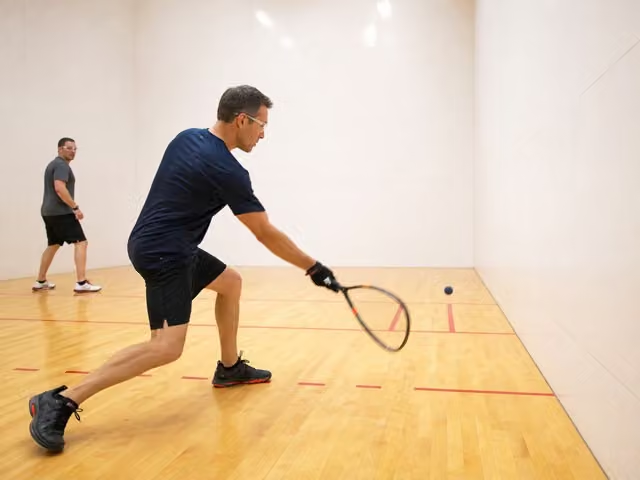
The quick version
Bounce the serve in the service zone, hit the front wall first and send it beyond the short line. Alternate returns before the second floor bounce, reaching the front wall before the floor. A server who wins adds 1 and serves again; a receiver who wins takes serve without a point. Win two games: the first two go to 15, a deciding third to 11, with no two-point margin.
Saved on this device only — clearing your browser's cache or site data removes them (no account backup).
Book the court and prepare to play
Reserve an indoor racquetball court and check entry, rental and footwear requirements with the facility. The standard court is 20 feet wide, 40 feet long and 20 feet high; a squash court is not a substitute. Ask staff to identify any gallery openings or surfaces out of play. Check the floor and ball are dry, the door closes securely and the playing area is clear. Keep bags, bottles and waiting friends outside.
Each player needs a purpose-made racquetball racquet with its wrist cord securely attached, non-marking court shoes and lensed protective eyewear designed for racquetball and warranted by its manufacturer to meet the applicable ASTM F803 standard. Ordinary glasses and lensless guards do not meet the USAR protective standard. Wear the cords and eyeguards during warm-up as well as play. Use a sound racquetball, about 2¼ inches across; a tennis ball or squash ball changes the game. A spare ball and towel are useful. Paper and pencil outside the court are optional for remembering game scores.
Find the solid short line halfway down the court, the service line 5 feet closer to the front wall, and the receiving line 5 feet behind the short line, usually dashed. The strip between service and short lines is the service zone; the strip behind it to the receiving line is the serve's safety zone. The smaller markings beside each side wall are not separate singles serving boxes.
Flip a coin; the winner chooses whether to serve or receive first. Start at 0–0 and agree to the best-of-three finish. This is a recreational match: by explicit house agreement, either player may take a rest between rallies, and you stop if the booking expires rather than imposing tournament delay penalties. If interrupted before a match winner exists, record the scores and next server for a later continuation; do not invent a winner from an unfinished match.
Put the first ball in play
Announce the score and check readiness
Say your score first, then the receiver's, and agree before every serve. Stand in the service zone with both feet inside its boundaries. The receiver starts wholly behind the receiving-line plane, including their racquet. If not ready, raise the racquet head above your head or turn your back before the server checks readiness. Begin with a controlled serve rather than a hard drive.
Bounce, then strike
Drop the ball for one bounce in the service zone and strike it before another bounce. It must hit the front wall first, then be capable of bouncing beyond the back edge of the short line. One side wall is allowed before that bounce. Stay inside the service zone until racquet contact for a simple legal stance; the server can then leave it, while keeping the receiver's swing and shot paths clear.
Distinguish a fault from losing serve
A bounce on or before the short line is short; reaching the back wall before the first bounce is long. Touching both side walls or the ceiling before the first bounce is also a fault. Other faults include a foot fault, bouncing outside the service zone, serving without a bounce, or a screened serve that impairs the properly positioned receiver's view. Call a fault immediately. One fault gives a second serve; any second fault loses serve. A complete miss, a second bounce before striking, body contact on the serve, a double hit, a ball that fails to hit the front wall first, or striking a front-wall junction so that front-wall-first cannot be established loses serve immediately. A serve leaving the court before its first floor bounce also loses serve.
Receive within the line rule
Wait until the serve either bounces in the safety zone or crosses the receiving line before your body or racquet crosses that line's plane. Stepping on the receiving line early is a violation: the server gets 1 point. You may volley a legal serve or hit after one floor bounce. Do not cross the short-line plane with body or racquet during the return unless the ball is coming back off the back wall. Once the serve has been legally returned, these serve-only restrictions end.
Keep a drive serve legal
For a hard, low drive sent between you and the nearer side wall, keep your body, racquet and ball outside that wall's 3-foot drive-service zone until contact. The 3-foot line itself is part of the restricted zone. Cross-court drives, Z serves and lobs are exempt from this specific drive-zone restriction, but must still meet the other serve rules. Do not stand in the receiver's return lane after serving.
In this self-officiated game, the receiver calls screen serve immediately, before attempting a return. A close pass alone is insufficient: it must impair the view from a proper receiving position. Count it as a fault, not an automatic replay that erases an earlier fault.
Alternate returns, score and finish
Return the ball to the front wall
After a legal serve, the players alternate hits. Make contact before the ball's second floor bounce. Your return must reach the front wall before touching the floor; it may use the side walls, back wall or ceiling on the way. The receiving player may volley or wait for one floor bounce. Wall contacts do not count as floor bounces. A ceiling shot is therefore legal in a rally, even though a ceiling serve is a fault.
Know when the rally ends
Two floor bounces before a return, or a return that hits the floor before reaching the front wall, loses the rally. Use the racquet head or throat, with one contact only; a double hit, intentional carry or body touch loses the rally. A swing that misses the ball does not end play if you can still make one legal contact before its second bounce. A shot hitting its own hitter loses the rally. A ball coming back from the front wall that touches a player loses the rally for that player. A shot reaching an out-of-play surface or leaving the court before a floor bounce loses the rally; leaving after legally reaching the front wall and bouncing on the floor is a replay hinder. Losing eyeguards or undoing the wrist cord loses the rally: stop and correct the equipment before resuming. If a shot hits the opponent before reaching the front wall, stop and resolve the hinder rules below rather than treating every body hit as a point.
Give the hitter room
After hitting, clear your opponent's view, route to the ball and full swing. Allow both a straight shot to the front wall and a cross-court shot toward the far rear corner. Moving to the middle is not permission to block those paths. If you are about to hit and might strike your opponent with ball or racquet, hold up and call hinder immediately. Do not hit someone to prove you were blocked.
Award a point or change serve
If the server wins, add 1 to that player's score; they serve again with two opportunities. If the receiver wins, scores stay the same and the receiver becomes server with two opportunities. For example, at 6–4 with you serving, your win makes it 7–4; your opponent's win changes serve, and their next announcement is 4–6. A replay changes neither score nor server.
Win the match
First to 15 wins game one; reset both scores to zero for game two, opened by the player who did not serve first in game one. If one player wins both, the match ends. If games are split, play a third to 11. Whoever scored more total points across games one and two chooses whether to serve or receive first in game three; equal totals require another coin flip. Stop as soon as a player reaches the target. At 14–14, the next server to score wins a 15-point game; there is no win-by-two extension. After a deciding third game, its winner wins the match.
Resolve close calls and keep the match playable
Before scoring, demonstrate one legal serve, one short serve and a return that skips off the floor before the front wall. Then try a few gentle unscored returns. Point out that service-zone and receiving-line restrictions belong to the serve; they do not confine ordinary rallies. Ask an experienced player or facility instructor to demonstrate clearing a swing if either player is unsure.
Replay hinder: an unavoidable obstruction, impaired view or safety hold-up can stop play without a point. The player attempting the shot calls a hinder immediately, rather than taking a full shot and asking for a redo after seeing it miss. An ordinary rally replay restarts at first serve. A dead-ball serve, including a safety hold-up on the serve return, preserves any first fault: a second-serve hold-up is replayed as second serve under the September 2026 rule. A broken ball or irregular court bounce on the serve likewise preserves an existing fault.
Penalty hinder: preventable blocking, swing interference or failing to clear the required shot paths can lose the rally, even if unintentional. If you caused it, concede the rally. In self-officiating, an agreed penalty makes the offender lose the rally: a server's offense changes serve without a point; a receiver's offense gives the server 1. If the players cannot agree on the penalty, replay under USAR's self-officiating guidance. Repeated disputes call for an agreed referee, not harder shots.
Ball hits a person: before the front wall, a shot that could reasonably reach that wall normally produces a replay hinder, or a penalty hinder if someone failed to clear. A shot that could not reach the wall loses the rally for its hitter. After the front wall, touching a player loses the rally for the touched player. Stop immediately for contact and resolve the call before another serve.
Skip, second bounce or score dispute: make calls against yourself honestly. Agree the last rally and both scores before restarting; if the outcome cannot be agreed, replay it. A ball merely contacting a vent or irregular surface is not automatically a court hinder: the September 2026 rules require an irregular bounce affecting play. Repair wet areas before resuming. If a ball is confirmed broken during a completed rally, replace it and replay that rally at first serve; do not test it by smashing it with the racquet.
For extra friends, finish or pause the two-player game before rotating another person in; this guide does not add a third player mid-rally. Keep spectators outside the court. On a break, remember the score, server and any remaining first fault. Replace dislodged protective equipment before putting the ball back in play.
Already know the game?
Ideas & Twists
Choose a variation together before you start.
Racquetball · See main rules
Suggested house variationOne game to 11
Replace the best-of-three match with one side-out game to 11. Start 0–0, flip for the choice of first serve and keep all serve, return and hinder rules. First to 11 wins with no two-point margin. This changes the finish, not the scoring method, and does not guarantee a particular number of minutes.
Racquetball · See main rules
Suggested house variationLob-serve game
Keep the normal match and scoring, but agree that every serve must be a gentle high lob rather than a hard drive. A legal lob still hits the front wall first and bounces beyond the short line without touching the ceiling or back wall first. Use ordinary faults for illegal serves; for a disputed drive-versus-lob call, replay that serve without erasing an existing fault. Only the serve is restricted; rally shots remain unrestricted.
Racquetball · See main rules
Suggested unscored practiceCooperative return practice
Replace competition with shared rally practice for the same two players. Start each rally with a gentle legal serve, alternate returns and aim to make the next ball playable. Count consecutive legal returns together, resetting the count when a return fails or play stops for a hinder. Alternate who starts each new rally. Compare your longest rallies if useful, but declare no winner; finish when either player wants to stop or the booked court period ends. This is preparation for a match, not a scored match or an accessibility guarantee.
About this guide
Rules were checked against the official September 1, 2026 PDF, including Sections 1–3 and self-officiating Appendix D. Older online section text can differ. This is indoor singles using side-out scoring, not IRF rally scoring or professional-tour rules. Flexible rests and booking-expiry continuation are explicit recreational house procedures; full tournament administration and technical penalties are outside this guide. All three variations are suggestions.
Ready for something different?
Find another game →