

The quick version
Give each player a clean board and marker; use only the four white route dice. Roll once, then everyone draws each rolled route once in an empty square, connecting it legally to an exit or existing route. Rotate or mirror routes as needed. Each player may add one unused special route per round, with a maximum of three for the game. Number the new squares and wait until everyone finishes before rerolling. After round seven, add exit-network points, the longest road, longest railway and occupied center squares, then subtract unfinished ends. Highest total wins; fewer errors breaks a tie, otherwise share the win.
Saved on this device only — clearing your browser's cache or site data removes them (no account backup).
Give everyone a map
This guide uses the physical Railroad Ink: Deep Blue Edition base game and the English rulebook linked by Horrible Guild. One box supplies six fold-out boards, six markers, four white route dice, two river dice and two lake dice. Keep all four blue expansion dice in the box. Railroad Ink Challenge, app goals, river/lake scoring and larger special boards are separate formats.
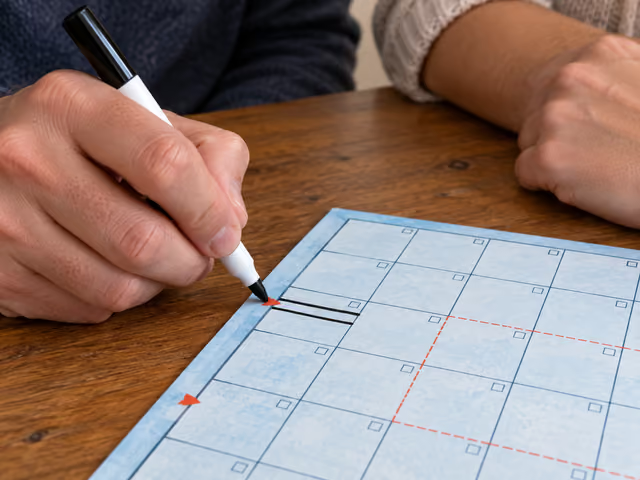
For one to six people, give each person one clean standard seven-by-seven board and a working dry-erase marker. Each board has twelve edge exits, nine central squares, special-route icons and scoring reminders. Seat everyone with a clear view of the same four dice and room to draw on their own board. Check the marker ink before starting. A soft cloth for cleaning boards between games is useful; no paper score sheet, phone or timer is needed.
Three route dice show road or railway straights, bends and T-junctions. The fourth shows stations and an overpass. Roads join roads; railways join railways. A station joins a road to a railway. An overpass lets them cross without joining: you cannot transfer from one to the other there. Show these two symbols before rolling.
Roll together, draw your own routes
Make the first roll
Roll all four white route dice once and leave them visible. Every player uses that identical set of four results; nobody takes a die away. On a blank board, choose a route and draw it in an empty edge square with an end matching an exit's road or railway. Other routes can start at other matching exits or connect to a route already drawn this round.
Place every route you can
Draw one complete die pattern per empty square. You choose the order and may rotate or mirror a pattern, but cannot change its branches. Each new square must make at least one genuine connection to a printed exit or an existing route; merely touching a filled square is insufficient. No floating routes, diagonal joins, second routes over an occupied square, or direct road-to-rail joins are allowed. Other ends may remain open for later rounds; an end facing the board's outer edge is allowed.
Use the four results once each
Every die result must be drawn if possible, even when you dislike the available placement. Two dice showing the same pattern mean two separate copies to place. A result may be left undrawn only when no legal placement is available, not to avoid a likely error. You never copy one die several times in place of another, choose new dice results or reroll an awkward roll. Drawing one route can create a connection for the next, so check your remaining choices before declaring a result unusable.
Add an optional special route
Each player has six special patterns printed on their own board. You may draw one of them as an extra route during a round, following the same empty-square and connection rules. Cross out its reference icon after use. Use at most one special per round and at most three different specials in the entire seven-round game. Specials do not replace the four dice results. You may use one before placing a die route if it makes that placement possible.
Close and number the round
Write the round number in the little box of every square filled this round, including a special route. Wait until all players have finished their available placements before rolling the next round. Previous-round routes stay fixed and cannot be erased. Continue through round seven even if one player's board cannot use every result. There is no speed bonus and no need to finish before another player.
If a roll contains two railway straights, you must account for both dice. You might extend one railway by two squares; someone else might start at two separate railway exits. Both choices can be legal. A road and rail crossing at an overpass still belong to separate networks unless a station joins them elsewhere.
Score the map after round seven
Exit networks: Trace each connected network, switching between road and railway only at stations. Count its distinct printed edge exits once each. Zero or one exit scores 0; two scores 4, three 8, four 12, five 16, six 20, seven 24, eight 28, nine 32, ten 36, eleven 40, and all twelve 45. Add the scores of your separate networks. Two exits in one network and three in another give 4 + 8 = 12 points. Do not count an overpass crossing as a connection or an unmarked edge end as an exit.
Longest road and railway: Find one continuous road path and count one point per square it visits. Choose a path through junctions rather than counting every branch; you cannot revisit a square. A station does not break the road, but changing there to railway does not continue your road score. Repeat separately for your longest railway. Only one path of each type scores, even if several share the maximum length. A square containing both modes can count once in each separate calculation.
Center: Score 1 point for each of the nine center squares with any route, regardless of how many lines that square contains. The maximum is 9.
Errors: Mark every open route end pointing into the board that connects to neither another matching route nor the outer edge. Subtract 1 per end, not per square: a single unfinished junction may have several errors. Ends reaching the outer boundary are not errors, even away from a printed exit; they simply add no exit to the network. Leave the expansion score unused.
Add networks + longest road + longest railway + center, then subtract errors. For example, 12 + 7 + 5 + 6 - 3 = 27. Highest total wins. If totals tie, the tied player with fewer error marks wins; if those counts also tie, share victory. Solo play uses the same seven rounds and scoring, with no opponent or official target score in this guide. Keep your result if you want to compare later attempts; different rolls can produce very different opportunities.
Check connections before they become permanent
Teach the exit-network score and the single-path bonuses separately. Before the first competitive game, point to an imaginary three-way junction: a longest path can enter and leave through two arms, but cannot collect the third arm by retracing its steps. At the finish, invite each player to trace their networks and best paths while a neighbor checks the count. This is host advice, not a new scoring rule.
During the round, leave the dice alone and check whether all four results have been used. If someone says a result cannot fit, inspect empty squares, possible rotations and connections together. A future dead end is not the same as an illegal placement. At every road/rail contact, check for a station; where routes cross, check whether it is an overpass. A route drawn earlier in the same round is available for connections.
For a friendly first game, agree before play on this house correction policy: marks from the current unfinished round may be erased and redrawn to repair a mistake, but once everyone closes that round, its squares are locked. If a locked illegal drawing is discovered later, jointly restart an unscored teaching game rather than silently inventing a penalty. The printed rules forbid erasing earlier rounds and provide no general late-error penalty; this restart policy is a suggestion.
Check a disputed total by tracing the physical routes rather than judging their appearance. Keep branch counts out of longest-path scoring, count separate errors individually, and resolve total ties with the printed error tiebreak. Plan from several exits so awkward rolls have more possible homes; that is practical community advice, not a guarantee of a higher score. This seated game needs drawing, small-symbol recognition and shared-dice visibility, so discuss assistance needs before choosing it.
Already know the game?
Ideas & Twists
Choose a variation together before you start.
Railroad Ink · See main rules
House suggestion · four or six peoplePaired mapmaking
Form two or three pairs and give each pair one board and marker. The partners discuss every placement, then one draws; switch who holds the marker after every round. All pairs use the same four-dice roll. Score and win by board, with the normal seven-round finish and error tiebreak. The three-special limit belongs to the pair's board, not separately to each partner. Neither partner has a second private map. All placement and scoring rules stay unchanged.
Railroad Ink · See main rules
House suggestion · add paper and a penSame-roll rematch
Before the first game, choose a recorder to write or sketch all four die faces for each of its seven rounds on paper. Record repeated faces separately, including exact road/rail station connections and overpasses. After scoring that game, keep its totals on the same sheet, clean all boards and play a second seven-round game from the recorded sequence instead of fresh rolls. Reset special-route availability. Each player still chooses placements independently and uses every result if possible. Score each game normally; for a two-game contest, add the two totals, break a tie with fewer combined errors, then share victory. Solo players can compare their two maps without an invented score target.
About this guide
Rules follow the publisher-linked Deep Blue English v02 PDF, printed pages 2–9, retrieved October 2, 2026. This is the original physical base route-drawing game for one to six people; river/lake dice, Challenge goals, app rules and large boards are excluded. Paired mapmaking, the recorded-roll rematch and mistake-repair/restart policy are house suggestions. Practical planning and shared score checking are host advice, not official new rules.
Ready for something different?
Find another game →