

The quick version
Begin each round by resolving Collect abilities and optionally taking essences from your components. If taking from a particular component, take all its essences; leaving them can preserve scoring or growth effects. Follow printed costs and restrictions.
Saved on this device only — clearing your browser's cache or site data removes them (no account backup).
Prepare the table
Set out the eight magic items, essence supply and five Places of Power. Use the first-game sides pictured in the rulebook, or randomly choose one side of each for experienced play. Shuffle monuments, reveal two and leave the rest as a deck. Everyone receives one of each of the five essences, including gold. Choose a first player.
For a first game, use the rulebook's matching marked mage and three-card starting hand for each player, then deal five unseen artifacts as their deck. Otherwise deal each player two mages and eight artifacts: inspect all, shuffle the eight artifacts, draw three, then choose and reveal one mage. Remove unused cards. In reverse player order, choose one magic item each.
Play a turn
Begin each round by resolving Collect abilities and optionally taking essences from your components. If taking from a particular component, take all its essences; leaving them can preserve scoring or growth effects. Follow printed costs and restrictions. Everyone can collect together, or request player order.
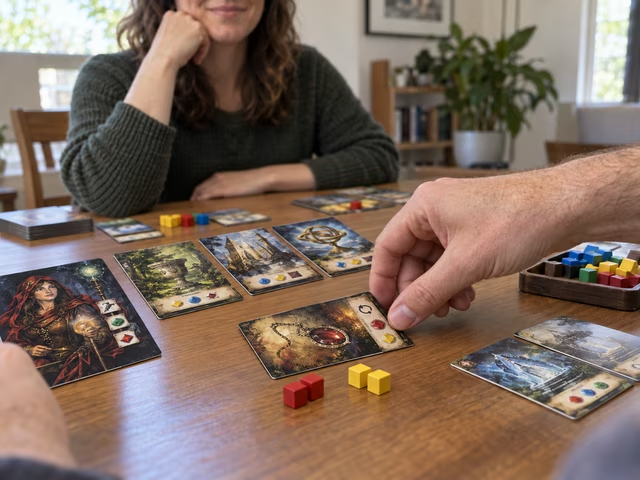
Then take clockwise turns, one action each: pay to place an artifact from hand; pay to claim a visible monument or Place of Power; discard a hand card for one gold or any two non-gold essences; use one component power; or pass. Refill a claimed face-up monument. You may instead buy the top unseen monument at its standard cost. Placed components start upright.
A power requires every cost before its effect. Turning sideways is often a cost; a turned component cannot use ordinary powers until straightened. Powers without a turn cost may be used on later actions again. Printed abilities still apply while turned. React powers respond to their trigger outside your turn, but cannot pay a turn cost with an already turned component. Destroy means discard from play; discard means from hand.
For Life loss, pay the required Life from your pool, then two other essences for each missing Life if possible, unless you pay an offered prevention cost. Players who have passed ignore Life loss. When passing, the first passer takes the first-player marker; every passer exchanges their magic item for a different available one, flips it to Passed, and draws one artifact. Reshuffle your own discard when your deck runs out. Passing ends your actions for this round, although you still receive benefits granted by rivals.
Finish and score
After everyone passes, count points on all your components plus one for the first-player marker. If anyone has at least ten, highest score wins. Ties favor the largest essence pool, counting gold twice; an exact tie is shared. Some printed powers trigger an earlier victory check and the Golden Statue can react to a check. If nobody reaches ten, straighten all components, turn passed items upright, and begin another round.
Host the first game
The Reddit comparison with Race for the Galaxy includes players who find Res Arcana easier to introduce, but both use a substantial icon vocabulary. Demonstrate paying a complete power cost, turning a component and discarding a card for resources before starting. Your eight artifacts are a toolbox; you do not need to build all eight.
Already know the game?
Ideas & Twists
Choose a variation together before you start.
Res Arcana · See main rules
Published base-rulebook variantDraft the artifacts
After receiving two mages, deal four artifacts each. Keep one and pass the rest left until all are kept. Repeat with four new cards, passing right. Shuffle your eight, draw three, then choose mage and magic item normally.
Res Arcana · See main rules
Original STUDplay house twistOpen monuments
Reveal four monuments instead of two, refilling to four after purchases while the deck lasts. Buying the top unseen monument remains available.
Res Arcana · See main rules
Original STUDplay house twistChoose the landscape
Before dealing player cards, players take turns choosing the displayed side of one unchosen Place of Power until all five are set. Start with the randomly chosen first player; no location is claimed.
Res Arcana · See main rules
Original STUDplay house twistOne opening redraw
After choosing your mage but before choosing magic items, you may once shuffle your entire three-card hand back into your deck and draw three new cards. Everyone decides independently; the new hand must be kept.
Res Arcana · See main rules
Original STUDplay house twistEarly item commitment
Choose starting magic items in the usual reverse order before drawing your opening artifact hand. You may inspect your eight-card deck and select your mage first; shuffle and draw three only after taking your item.
About this guide
Requires the named physical game and its supplied components. Rules are paraphrased teaching guidance; keep the box's cards and reference diagrams beside the table. Original STUDplay house twists are optional, untested suggestions rather than publisher rules. Agree one before setup; unchanged rules still apply.
Ready for something different?
Find another game →