

The quick version
Black starts. Place one disc on an empty square to trap at least one opposing disc between it and an existing disc of your color. Flip every trapped line. Pass only when you have no legal move. When neither player can move, the larger disc count wins; equal counts draw.
Saved on this device only — clearing your browser's cache or site data removes them (no account backup).
Prepare the board and its four-disc opening
The reference edition is Mattel Othello T8130, English instruction sheet T8130-0920, copyright 2010. Its component list is 64 reversible discs, one playing board with removable storage lids, and four board feet. Fit the feet underneath and open the storage lids before play. Other 8×8 Reversi sets can use this rule format; assemble their hardware according to their own instructions.
Sit opposite each other at a stable table. Choose who plays Black and who plays White, then divide the discs into 32 each. Each player puts two in the center, leaving 30 in their supply. Keep your assigned color throughout.
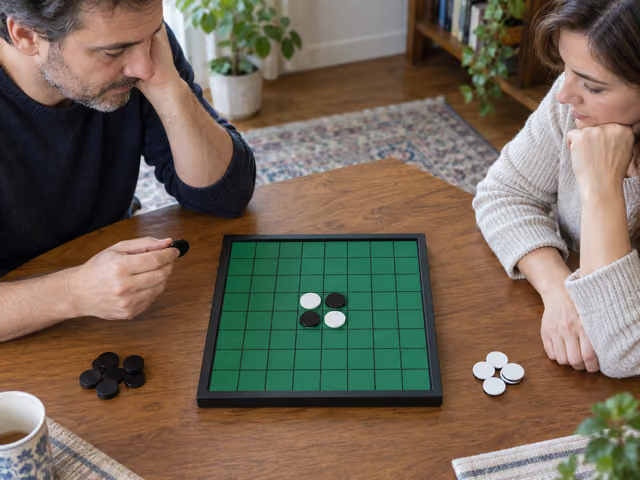
Use one fixed viewing side for coordinates: columns A–H run left to right and rows 1–8 run top to bottom. Put White on D4 and E5, and Black on E4 and D5. On an unlettered board, the middle four squares form a 2×2 block: White occupies its upper-left and lower-right squares; Black the other diagonal. All other squares start empty. Agree to use the friendly correction policy below.
Place, flip, pass and count
Try the opening move
Black can start at C4, D3, E6 or F5. For a demonstration, put a black disc on C4: the white disc on D4 lies between C4 and the existing black disc on E4, so flip D4 to black. White now plays; C3 is one legal reply. Reset the four-disc opening after an unscored demonstration.
Find a legal square
On your turn, place one disc with your color up on an empty square. In at least one horizontal, vertical or diagonal direction, it must bracket an unbroken line of one or more opposing discs ending at an existing disc of your color. An empty square or your own disc breaks the opposing line; you cannot jump either. Merely touching an opponent is insufficient.
Complete every captured line
Check all eight directions from the newly placed disc and flip every line it brackets. You cannot choose to leave a captured line unchanged. Flipped discs do not trigger further captures around themselves: all capture lines must run directly from your new disc. Discs stay in their squares; turn them over rather than removing or sliding them. Then the opponent takes a turn.
Pass only when forced
If you have a legal move, you must play. If none exists, say pass and let your opponent move again; check for a legal move when your next turn comes. One pass does not finish the game. If your supply runs out while you still have a legal move, take a spare disc from your opponent's supply.
Finish and agree the result
Stop when neither color has a legal move, even if squares remain empty. Count the occupied squares showing each color. The higher count wins; equal counts are a draw. Empty squares score nothing in this retail format, including when one color disappears entirely. Confirm both counts before clearing the board.
An early majority earns no points. Before a move, consider which replies it gives your opponent. A corner disc cannot be bracketed, but gaining a corner does not itself win the game.
Resolve close calls while the layout is visible
Trace disputed lines outward from the newly placed disc. A line cannot bend, cross a gap or use a newly flipped disc as a fresh starting point. Before accepting a pass, both players scan the empty squares for a legal bracket. Keep spare discs within reach and wait until all flips are complete before taking the next turn.
Friendly correction policy — suggested house rule: pause on an illegal placement, missed flip or extra flip. If both players can reconstruct the layout immediately before the faulty turn, restore it and resume from that turn with a legal move and all required flips. If they cannot agree, restart that game unscored. This replaces T8130's printed cutoff for correcting wrongly flipped discs after the opponent has moved. Use this policy consistently, rather than adding a penalty midway through play.
Let spectators watch without calling out moves unless both players chose the teaching variation. More friends can play the next game; the main game has exactly two players. Put all 64 discs back in storage afterward.
Already know the game?
Ideas & Twists
Choose a variation together before you start.
Reversi · See main rules
Suggested house variation · 2 playersExchange-colors match
Play exactly two complete games, rebuilding the four-disc opening and exchanging colors for game two. Each win earns 1 match point and each draw earns each player ½. The higher total wins the match; equal totals mean a drawn match. Keep each game's normal final-count rules. This lets both opponents try the first move.
Reversi · See main rules
Suggested teaching variation · 2 playersTalk through the choices
Before placing a disc, name the line you intend to flip and one reply you think your opponent might have. Either player may ask the other to identify legal squares. The player whose turn it is still chooses the move. Keep normal turns and final scoring, use the agreed correction policy, and treat advice as shared practice rather than a competitive result.
Reversi · See main rules
Suggested house variation · 4 playersConsulting pairs
Make two teams of two, each controlling one color. Teammates may discuss each move, then alternate who places the disc on their team's actual moves. A forced pass does not advance that team's placer rotation. Black still starts, every capture is mandatory, and the team's final disc count decides the game with a draw for equal counts. This changes the main game's headcount; it is not four separate colors.
About this guide
Standard Othello mechanics are checked against WOF and the T8130 booklet. USOA corroborates equipment, legal moves and equal-count draws; its clocks, penalties and 64–0 tournament wipeout score are not part of this retail format. Friendly error restoration and the three variations are suggested house formats. The dated reference booklet identifies a specific set, not current retail availability.
Ready for something different?
Find another game →