

The quick version
Place the five-peg target on level grass and mark a line 2 metres from its nearest peg. Take five underarm throws each, keeping both feet behind the line until release. Leave rings in place until the turn ends; each ring still around one peg scores 1. Record the score, collect all five rings and pass them to the next person. Play five complete rounds. Tied leaders get one extra five-ring turn each; if still tied, share the win.
Saved on this device only — clearing your browser's cache or site data removes them (no account backup).
Set the target and throwing line
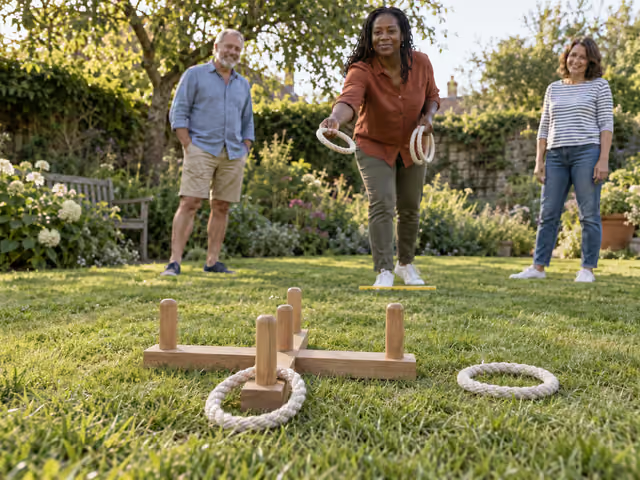
This guide uses a garden quoit set with five short upright wooden pegs on a low cross-shaped base and five loose rope rings. Assemble and check the target using its own instructions. Alga's five-ring garden set is one example of this equipment. A wall board with hooks, a ring hanging from a string, carnival bottles and heavy metal quoits use different setups.
Choose level outdoor grass with clear space around the target and beyond it for missed throws. Place the base flat, with all five pegs secure. Measure 2 metres from the nearest peg to a flat throwing-line marker. Keep spectators behind the thrower and to the side, and keep the lane clear while anyone is throwing.
Use the same line and the same five rings for everyone. Give each person one unscored five-ring practice turn. If the distance is too difficult, move the line closer before the match and let everyone practice there. Once scoring begins, keep the line fixed.
Write each player's name with five round columns and a total. Agree the turn order by choosing a volunteer to start, then moving down the list. One round means every person has taken one five-ring turn. The 2-metre distance, one-point scoring, five-round match and tie procedure are house choices for this guide, rather than universal quoit rules. Ignore printed peg values in the main game; the printed-score variation uses them.
Throw five, then pass the rings
Start behind the line
The first player takes all five rings and stands with both feet behind the marker. Hold one ring comfortably and toss it underarm toward any peg. Keep both feet behind the line until the ring leaves your hand; reaching forward with your arm is allowed.
Finish the turn
Throw the other four rings one at a time. Leave every thrown ring where it lands until all five have been thrown, including misses. A later throw may knock an earlier ring off a peg; its final position decides whether it scores. A throw released with either foot on or beyond the marker uses up that ring and scores zero, even if it lands on a peg.
Count and collect
After the fifth ring settles, count 1 point for each legal ring whose opening surrounds exactly one upright peg. Several rings can score on the same peg. A ring merely touching a peg, leaning against it without encircling it, lying nearby, or surrounding more than one peg scores zero. There are no closest-ring points, bonuses or cancellation. Record a score from 0 to 5, then collect all five rings while nobody throws.
Give everyone equal turns
The next person uses the cleared target and the same five rings. After everyone has played, round one is complete. Follow the same turn order for four more rounds. Each player therefore gets 25 scored throws in the main match.
Finish and settle a tie
Add each person's five round scores. The highest total wins. If two or more people share the lead, only those people take one extra five-ring turn each from the same line on a cleared target. Compare only those extra-turn scores. The highest playoff score wins; if that score is still shared, those players share the win. Everyone in the playoff finishes their turn before deciding the result.
If three rings remain around pegs and two miss, the turn scores 3, even if all three successful rings surround the same peg. If a later ring knocks one of those three off, the final score becomes 2.
Make the next turn easy
Show one slow underarm toss during practice, then let people find a comfortable grip and release. An easy first line is more useful than a distance nobody can reach. With a larger group, keep the score sheet beside the waiting players so the next person knows whose turn comes next. Soft conversation is fine; nobody needs to shout or hurry.
Confirm the score together before lifting any ring. Look down at its opening: the peg must be inside it. Rings stay where they finish, even when a bounce carries one onto a peg. A dropped ring before an attempted toss can be picked up; a released attempt is a throw. Do not give a replay simply because a ring bounced out.
If the target tips or shifts, or a person or animal enters the lane, stop. Clear the rings, restore the target and replay that player's whole five-ring turn without counting the interrupted turn. If someone collects rings before the score can be agreed, use the same whole-turn replay. These are house remedies. Wait until the lane is clear before resuming, and stop using a damaged or unstable set.
The target and rings do the scoring work; there is no need for a phone or timer. At the end, collect the five rings, pack the target and remove the line marker so the lawn is clear again.
Already know the game?
Ideas & Twists
Choose a variation together before you start.
Ring toss · See main rules
Manufacturer-style scoringPlay the printed scores
Use a five-peg set with clearly printed point values. Replace the main game's 1 point per successful ring with the value printed beside the peg it surrounds. Read all five values aloud before practice; do not assume the center is highest or that another set uses the same numbers. Add every successful ring, including several on one peg. Keep the same line, five-ring turns, cleared target and five complete rounds. Highest total wins; tied leaders take one extra five-ring turn using the printed values, and share the win if that playoff is still tied. Alga's garden instructions use peg values and an agreed number of rounds; this tie rule remains a house choice.
Ring toss · See main rules
House distance challengeStep back together
Before practice, add flat markers 3 and 4 metres from the nearest peg, with room beyond the target for misses. Everyone throws from 2 metres in rounds 1 and 2, from 3 metres in rounds 3 and 4, and from 4 metres in round 5. Give everyone one unscored five-ring practice turn at each distance before starting. Keep one-point scoring and five throws per turn; add all five round scores to decide the winner. Tied leaders each get one extra five-ring turn from 4 metres; highest playoff score wins, with a shared win if still tied. Move the whole group together rather than making successful players change line mid-round.
Ring toss · See main rules
House team format for 4, 6 or 8Pairs on one score sheet
Make equal teams of two. In each round, both teammates take a separate five-ring turn, clearing the target between players, and add their scores to the team's round total. Both teammates throw in every round; partners can offer aiming advice from behind the line. After five rounds, each team has had 50 throws and the highest combined total wins. If teams tie for the lead, both members of each tied team take one extra five-ring turn and combine those two scores. Highest combined playoff score wins; teams still tied share the win. Keep the same distance and one-point ring scoring.
About this guide
Alga's garden instructions establish a five-ring, five-peg target, successive five-throw turns, a group-agreed distance and a highest-score finish after agreed rounds. This guide's main game is an explicit house simplification: every ring scores 1, the starting line is 2 metres away, and everyone plays five rounds. Turn order, final-position rulings, fouls, interruption replays, tie procedure, team format and distance challenge are house suggestions. The printed-score variation retains Alga's peg-value approach. The supported 2–8 hosting range is this guide's choice, not a manufacturer's maximum. Traditional two-hob, metal-quoit, hook-board and suspended-ring rules are not imported.
Ready for something different?
Find another game →