

The quick version
Choose army colors and claim all 42 territories in turn. Place your remaining starting troops on your territories. On each turn, receive and place reinforcements, trade eligible card sets, then attack neighboring enemies if you wish. Compare the highest dice in pairs; ties favor the defender. Capture a territory by removing its last defending troop. After attacking, draw one card if you conquered anything, then optionally move troops once through your own connected territories. The last player standing wins.
Saved on this device only — clearing your browser's cache or site data removes them (no account backup).
Choose the edition and claim the map
This guide uses Hasbro B7404 Classic RISK, Game 2, for 3–5 players, from the English booklet marked 0323B7404IN13. Its two-player game is a separate variation below. Older six-army boxes, Secret Mission, Legacy, themed games and the digital app can differ; use the booklet matching your physical set.
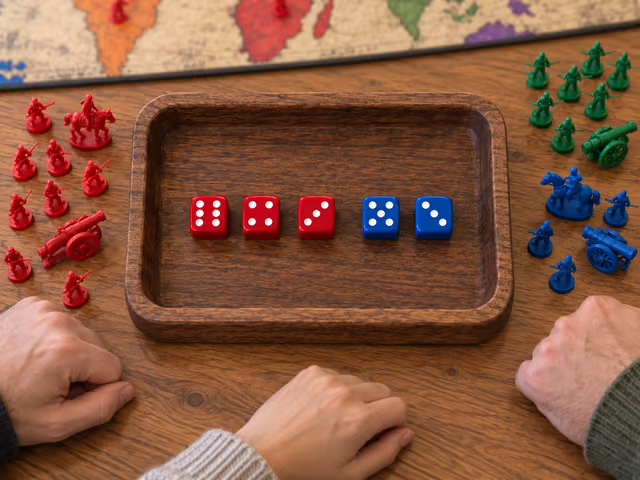
The complete B7404 set has one 42-territory world board; five army colors, each with 40 infantry, 12 cavalry and 8 artillery figures; 56 cards comprising 42 territory cards, two wild cards and 12 mission cards; three red attack dice and two blue defense dice; a card box and five storage crates. For Classic, put the 12 mission cards away. Use the 44 territory/wild cards, the army colors chosen by your players, and the five dice. Storage crates do not affect play. Provide a stable table with room for the full board, each player's reserve and card hand, and a clear dice-rolling area. No phone, timer or score sheet is required.
One infantry represents one troop, cavalry five, and artillery ten. They are different counting denominations, with no different combat powers. Start with infantry: 35 troops each for three players, 30 each for four, or 25 each for five. Keep the other figures in reserve. Exchange equal troop values for larger figures when space is tight; always count troop values, not the number of plastic figures.
Everyone rolls one die. The highest roller starts; as a host tie rule, tied highest rollers reroll until there is one starter. That person places one starting infantry on any unoccupied territory. Proceed to the left, placing one infantry on an unoccupied territory each time, until all 42 are claimed. In the same order, place one remaining starting infantry at a time on any territory you control until everyone has used their starting allocation. Nobody may claim a territory twice or leave one empty. The first person to claim a territory takes the first turn. Shuffle the 42 territory cards together with the two wild cards and place them facedown; nobody starts with a card hand.
Before claiming territories, agree whether you can leave the board set up for a later session and what happens if someone needs to leave. Classic has no fixed round count or guaranteed short finish. Players lose their seat in the game when eliminated. If that does not suit tonight, choose the fixed-round house variation or another game before starting.
Reinforce, attack, then maneuver
Receive troops, including on the first turn
Count your territories, divide by three and round down; receive at least three troops. Add continent bonuses for every entire continent you control at the start of your turn: North America 5, South America 2, Europe 5, Africa 3, Asia 7, Australia 2. Then handle any card trades described below. Place your reinforcement troops on any territories you already control before attacking. A continent captured mid-turn gives its bonus on your next turn only if you still hold all of it.
Choose an attack or pass
You may attack an enemy territory sharing a printed border or connected by a printed sea-line to one of your territories. Alaska and Kamchatka connect. Mere visual closeness across water is insufficient. Attack from one territory into one territory at a time, and keep at least one troop in the origin. You therefore need at least two troops in the origin to attack. Announce the origin, target and committed attacking troops, then resolve a battle as below. You can repeat attacks, switch targets or origins, attack from a newly conquered territory, or stop whenever you wish. Attacking is optional.
Draw at most one earned card
When you finish attacking, take the top card from the territory deck if you captured at least one territory this turn, whether you still hold every earlier capture or not. Several captures still earn only one card. No capture means no draw. Keep your cards private; elimination can separately give you an opponent's whole hand. Drawing a card does not let you trade it immediately.
Make one optional maneuver
After attacking and any earned draw, you may move any number of troops from one territory you own to one other territory you own, provided a continuous chain of your territories connects them by printed borders or sea-lines. You may travel through several friendly territories, but never an enemy one. Leave at least one troop in the origin, take none from intermediate territories, and put all moved troops in the single destination. This is one move, not several redistributions. Once you maneuver or decline to, your turn ends; pass the dice to the next surviving player on your left. You cannot resume attacking afterward.
Trade sets and track the shared increase
At the start of your turn, before attacking, you may exchange a three-card set for troops. In this booklet a set is three identical troop symbols; one infantry, one cavalry and one artillery; or two identical troop symbols plus one wild. Its printed wild-card combination is narrower than some other editions. Do not import an app's card values or wild-card permissions.
The value depends on how many sets anyone has traded in this game: first 4 troops, second 6, third 8, fourth 10, fifth 12, sixth 15, then 20, 25, 30 and five more for each later set. It is one shared sequence, not a separate track per player or a value tied to the set's symbols. Keep each traded set faceup under the board edge so everybody can count the sequence. Put these troops on your existing territories before continuing.
If you begin your turn with five or six cards, you must trade at least one set; with six you may also trade a second valid set. With three or four cards, a valid trade is optional. Each trade consumes exactly three cards. If a traded card names a territory you control, the trade also grants two troops that must go on that territory, in addition to the set's value. Count this as one two-troop bonus per set. The booklet does not spell out choosing among several matching owned territories; this guide uses a declared host ruling: choose one matching owned territory and place both bonus troops there.
When you conquer an opponent's last territory, take their entire card hand. If that raises your hand to six or more, immediately trade enough sets to get down to four or fewer cards, then stop trading. Place the resulting troops on your territories and continue attacking if you wish. If the inherited hand leaves you with five or fewer cards, wait until the beginning of your next turn to trade. Merely reaching five cards during an elimination does not trigger this exception. If a draw pile runs out, this guide's house refill rule is to keep the number of sets already traded recorded, shuffle the used territory/wild cards into a new draw pile, and continue the same troop-value sequence; never reset it to four.
Resolve one roll without adding the dice
Choose one, two or three attacking troops, never more than the origin's troop count minus one. The booklet moves those committed troops across the border for the battle. The defender chooses one or two defending troops, never more than the target contains. Each side rolls that many dice: red for attack, blue for defense. Declare both counts before rolling, then roll simultaneously.
Sort each side's dice from high to low. Compare the highest attacker die with the highest defender die. If both sides rolled at least two dice, also compare their second-highest dice. Ignore any unmatched dice. In each pair, a higher attacker die removes one defender troop; otherwise remove one attacker troop, because a tied pair favors the defender. Remove losses to their owner's reserve. Resolve both pairs from the roll; do not add the dice totals or reroll ties. At most two troops total are lost in one roll.
For example, attack dice 6, 3, 1 against defense dice 5, 3 remove one defender for 6 versus 5 and one attacker for the tied 3 versus 3; the 1 is unused. If only one side has a second die, there is only one comparison. A territory containing two troop-units can attack with at most one die. A lone cavalry figure represents five troop-units, so it can supply up to three attackers; exchange it for infantry as needed to show the split and losses clearly.
If defenders remain, surviving committed attackers return to their origin; you can choose another legal battle or stop. If the last defender is removed, the territory is yours: leave all surviving committed attackers in the conquered territory, and you may move additional troops there from the same origin immediately. Keep at least one troop in the origin. Do not move troops from elsewhere on the map for this capture. In this B7404 procedure, the minimum occupation is the surviving committed attackers.
Say the 6,3,1 versus 5,3 example aloud, then point out one troop that must stay in an attacking origin. This is an unscored explanation; do not remove or award real troops during the demonstration.
Elimination and the actual finish
A player is eliminated when their last territory loses its last defending troop and is captured. The conqueror takes their cards, applying the immediate-trade threshold above. The eliminated player receives no further turns and does not reenter. Having no reserve figures left is not elimination: exchange denominations or use clearly marked paper counters if the physical supply runs short.
Classic ends immediately when one player has captured all 42 territories and eliminated every opponent. There is no point score, equal-turn finish or official tie in a completed Classic game. If everyone agrees to stop an unfinished game, call it unfinished; the biggest army or most territories does not retroactively become the official winner.
For a house pause between turns, leave the board in place and keep hands private. Record the next player, troop values on each territory, shared trade-in count, and card/deck state so the game resumes unchanged. A private photo can help if everyone agrees, but is optional and does not replace keeping card hands hidden. If you cannot preserve the state or resume together, stop without claiming a Classic winner. Do not automatically donate a departing player's troops or cards to a friend.
Make a long competitive game fair to host
Read the borders together before the first attack, especially sea-lines. Announce the reinforcement calculation, next trade value and attack dice counts so errors can be caught before a roll. Count actual troop values when swapping infantry for cavalry or artillery. For unclear or off-table dice, agree before play to reroll only the affected die; that is a host rule.
Risk rewards attacking, but a good plan can still lose to dice. Keep enough troops on exposed borders and consider whether one useful capture is worth more than a long attack that leaves you weak. Explain the increasing card sequence early: leaving it out changes how the game develops. Give people room to make their own choices rather than having one experienced player direct every army.
Table talk and temporary agreements can be part of the experience, but they do not authorize sharing territories, troops, cards or turns. This guide's host agreement treats promises as nonbinding and prohibits physical transfers except those specified by the rules. State that before anyone makes a deal. Keep disagreements about a move separate from personal loyalties. An eliminated friend may watch or choose another activity; they are not obliged to sit waiting or to advise a remaining player.
Set breaks between turns, and agree a latest stopping point before you start if people have transport or other commitments. Neither extra troops nor faster rolling guarantees a short game. If a missing rule changes a completed battle, consult the matched booklet before the next roll and agree on a remedy; do not invent a favorable result for one player. A seated table and quiet conversation can suit this format, but the dense map, small figures, color distinctions and dice still need to work for your group.
Already know the game?
Ideas & Twists
Choose a variation together before you start.
Risk · See main rules
Official B7404 format with a host starter ruleTwo-player neutral army
Use two players plus a third, neutral army color. Set aside 40 starting infantry for each of the three colors. Remove missions and both wild cards, shuffle the 42 territory cards and deal three facedown piles of 14: one per player and one neutral. Put one matching infantry in every assigned territory. Players alternate placing two of their remaining starting troops on one or two of their own territories until each player's 40 are placed. Then alternate placing one remaining neutral troop on any neutral territory until all 40 neutral troops are placed. Collect all territory cards, restore both wild cards and shuffle the draw pile. The booklet does not name a starter here; this guide's house choice is high die, rerolling ties. Play the main turn, card, combat and maneuver rules. The neutral army never has turns, attacks or receives reinforcements; your opponent rolls defense when you attack neutrals. Capture of neutral territory can earn your one conquest card, but neutrals have no card hand to inherit. Win immediately by capturing your opponent's last territory; you need not conquer the neutral army. This changes the supported group to exactly two and the finish from all 42 territories to eliminating the other human player.
Risk · See main rules
House setup suggestionRandom starting territories
Keep 3–5 players, the normal 35/30/25 starting troops, and the full Classic finish. Replace only the initial territory-claiming choices: choose the starter by highest die with tied high rollers rerolling; remove missions and wild cards, shuffle all 42 territory cards, and deal them one at a time starting with the starter and then to the left until all are dealt. At four or five players, two players receive one extra territory. Each player puts one starting infantry on every territory shown in their dealt cards. Then, in turn order, place one remaining starting infantry at a time on your own territories until all allocations are used. Collect the territory cards, restore the two wild cards and shuffle the draw pile; dealt setup cards are not kept in hand. The starter takes the first turn. Reinforcement, escalating trades, attacks, one earned card, maneuvering and elimination remain unchanged. This trades deliberate initial claiming for a scattered random map; it does not promise a faster whole game.
Risk · See main rules
House finish suggestionSix-round campaign
Before setup, agree to replace world conquest with a maximum of six complete rounds. Keep 3–5 players, normal setup and all troop, card, combat and elimination rules. Add paper and a pen to record rounds; one round means every surviving player in the original turn order has had one turn, starting with the original starter or, if eliminated, the first surviving player after them. Players eliminated before their turn are skipped. If one player eliminates every opponent, that player wins immediately. Otherwise finish the sixth full round, then count territories; the survivor controlling the most territories wins, and equal highest counts share the win with no sudden-death roll or troop-count tiebreaker. Do not award points for eliminated players, cards or continents. This caps rounds rather than minutes and still permits early elimination. Choosing the limit in advance gives every survivor equal turns and avoids changing the win condition to favor the current leader.
About this guide
Main rules follow Classic RISK in the currently downloadable B7404 English booklet marked 0323B7404IN13, printed pages 6–13; this establishes the selected booklet, not the newest edition sold in every region. Its two-player neutral format is separately explained. Tie rerolls for choosing a starter, the two-player starter, choosing one owned territory for a card bonus, deck refill, pause arrangements, dice remedies, deal etiquette and the two house variations are explicit host suggestions. No digital-app, six-player 00044, Secret Mission or Legacy rules are blended into the main format.
Ready for something different?
Find another game →