

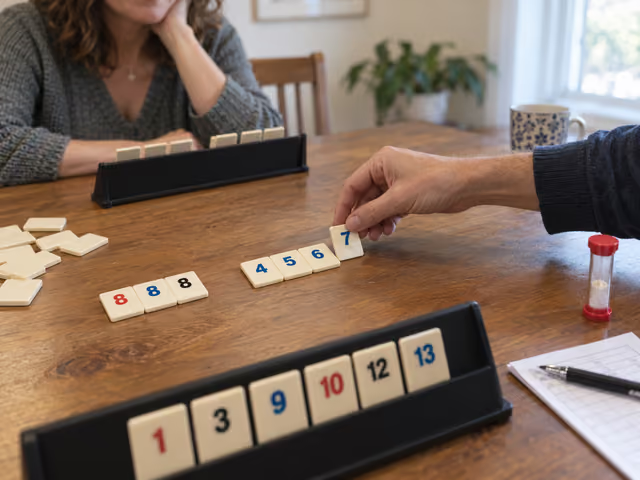
The quick version
Take 14 tiles each. Your first play must use only your own tiles in valid groups or runs totaling at least 30. On later turns, add and rearrange, leaving every table tile in a valid set. Play at least one rack tile or draw one and end your turn. An empty rack wins the game; the most game wins takes the round, with total points breaking a tie.
Saved on this device only — clearing your browser's cache or site data removes them (no account backup).
Check the set and deal the racks
Use 106 tiles: two copies of numbers 1 through 13 in each of four colors, plus two jokers. Classic includes four racks with their holders; assemble the racks as your set requires. The current Classic product box also lists instructions and a storage tray. Add a one-minute sand timer or other timer, paper and a pen; the timer is not listed as a Classic box component. Seat two, three or four people at a table with room for several separate tile rows, the face-down pool and everyone's private rack.
Agree to play one round: two games for two players, three for three, or four for four. Track both game wins and points. This guide's house tie procedure shares a result if both measures remain equal. For a blocked game with tied lowest racks, each tied player gets one game win and nobody scores points.
Mix all tiles face down. Each person draws one; highest number starts. House setup clarification: redraw a joker, and redraw between people tied for highest. Return all opening-draw tiles and mix again. Everyone takes 14 tiles and keeps their faces hidden on a rack. The rest stay face down as the pool, separate from the playing area. Choose the opener this way again for each new game.
Show a practice group and run before dealing, then return those tiles. A group has three or four equal numbers in different colors: red 8, blue 8, black 8. A run has at least three consecutive numbers in one color: orange 4, 5, 6. Two equal blue 8s cannot share a group. Runs stop at 13; 12, 13, 1 is illegal. Leave gaps between sets so their boundaries are obvious.
Open with 30, then work the table
Make your first play
Start the one-minute timer when your turn begins. Lay one or more valid sets from your own rack totaling at least 30 by face value. For example, blue 4-5-6 and three differently colored 5s total 15 + 15 = 30. A joker contributes the number it represents. During this opening turn, do not add to, borrow from or rearrange table sets, even after laying your 30. Those moves start on your next turn.
Draw once if you do not play
If you cannot make your opening or choose not to play, draw one tile from the pool and end your turn. You cannot play the tile you just drew. Pass clockwise. The same draw-and-stop choice applies on later turns; there is no draw-until-you-can-play rule.
Add or rearrange on later turns
After opening, play fresh sets, extend existing sets or rearrange any player's table tiles. Play at least one tile from your rack during the turn. All table tiles must end in valid groups or runs, with no loose pieces. Played tiles belong to the shared layout: you cannot take them into your rack.
Try a small split
Suppose red 3-4-5-6-7 is on the table and you hold another red 5. Insert your 5 to form red 3-4-5 and red 5-6-7. Both new runs have three tiles, and you used a rack tile. Merely separating the original run into 3-4 and 5-6-7 would leave an illegal pair.
Finish within the minute
If time expires with a legal table but you have not ended your turn, draw one tile and stop. If your rearrangement remains incomplete, restore the previous table, take back your attempted rack tiles and draw three penalty tiles instead. That ends the turn. This is the selected rule sheet's incomplete-move penalty, not an extra host-invented penalty. House shortage procedure: draw only the penalty tiles still available if the pool has fewer than required.
Check the last tile
When you legally play your final rack tile, say Rummikub and stop the game immediately. First verify every table set. No one gets an equalizing turn, and a legal final joker is allowed. Score before mixing tiles for the next game.
Free a joker and use it again now
A joker stands for a needed number and color. In blue 6-joker-8 it is blue 7; in red 9, black 9, joker it can fill either missing color. After your opening turn, you may free a table joker by replacing or rearranging tiles so every remaining set is valid. Replacement tiles may come from your rack or the table. A three-tile group does not require both missing colors to release its joker.
Use the recovered joker in a new valid set during that same turn, and play at least one tile from your rack somewhere in the turn. Never save the recovered joker on your rack. For example, replace the joker in blue 6-joker-8 with your blue 7, then use the joker beside red 10 and red 11 from your rack as red 12. The table now contains blue 6-7-8 and red 10-11-joker. The new set need not contain two rack tiles under this selected sheet; older editions may say otherwise.
Keep the selected rules available for disputes. Do not import a remembered restriction such as freezing all joker sets or demanding the exact replacement from your rack; those are different edition rules or agreed house changes.
Score each game and finish the round
When someone empties their rack, every other player adds their remaining numbers and records that total as negative points. Each retained joker counts 30. The winner scores the sum of those losses as positive points and receives one game win. If the other racks total 12, 17 and 25, record -12, -17, -25 and +54. Points should sum to zero.
An empty pool does not end the game. Keep taking turns and playing legal moves; a person unable to play passes. When everyone confirms that no legal move remains, end the blocked game and count rack values, including 30 per joker. A uniquely lowest rack wins the game. Each opponent loses the difference between their own rack total and the winner's; the winner gains the sum of those differences. For totals 4, 9 and 15, record +16, -5 and -11. Do not use ordinary empty-rack scoring for this finish.
The rule sheet does not specify tied lowest blocked racks. Use the house procedure agreed at setup: all tied-low players receive one game win, with zero points for everyone in that game. A player choosing not to play is not evidence that no legal move exists; check that everyone is actually blocked before counting racks.
After scoring, return all 106 tiles, mix, select the opener and deal new racks. Continue until the agreed two, three or four games are complete. Most game wins wins the round. Among tied leaders, higher accumulated points wins; if still equal, share the match as this guide's house final-tie rule. Do not quietly switch to highest points alone.
Keep trial moves understandable
Read the opening, drawing and joker rules aloud before the first timer starts. Ask someone to check the 30-point example and the two runs in the split example. A person repeatedly drawing may have no legal opening; do not assume they misunderstood or pressure them to show their rack during a competitive game.
Plan a rearrangement before touching tiles. Move one section at a time and remember its starting layout, so a failed move can be restored. Everyone checks the finished sets before the next turn. Pause to resolve a rules question using the selected sheet; house hosting convention: resume the remaining turn time after the ruling rather than spending it on the discussion.
If the previous table cannot be reconstructed after an incomplete move, this guide uses a house recovery: abandon that game without wins or points, mix all tiles and replay the same game slot. Do not guess a layout that advantages one rack. A paper sketch before a complex move can help without requiring a phone.
This is a seated table format, but reading four colors, handling small tiles and reaching the shared layout still matter. Check your group's needs and the actual room; no universal accessibility or whole-game time guarantee is implied.
Already know the game?
Ideas & Twists
Choose a variation together before you start.
Rummikub · See main rules
Suggested house variationOne-game finish
Play one game instead of a full two-, three- or four-game round. The legal empty rack wins; if the pool empties and everyone is blocked, lowest rack value wins, with tied lows sharing the result. You can omit the score sheet because there is no match total. Keep the 30-point opening, joker rules and one-minute turn procedure.
Rummikub · See main rules
Suggested house variationTwenty-point opening
Lower only the opening threshold from 30 to 20. Opening sets still need three or more tiles, all opening tiles come from your rack, and table manipulation still starts on your next turn. Keep all other rules and scoring. This may reduce waiting for an opening, but drawing can still be necessary; it does not guarantee a shorter game.
Rummikub · See main rules
Suggested house variationOpen-rack teaching game
Play a separate practice game with racks visible and discuss possible moves together. Remove the turn clock and its timeout draw. The active player chooses the move; an abandoned incomplete rearrangement must still be restored, attempted rack tiles returned and three tiles drawn, limited to what remains in the pool. Keep the opening threshold and legal sets. Use the blocked-game finish if needed, but record no competitive wins or points; return all tiles and redeal privately before a scored game.
About this guide
Main mechanics follow Lemada's standard 106-tile Classic format, specifically English sheet D-4600-0236-0014/EN 270525 hosted on the manufacturer's MSC Travel rules page. Its filename carries 0013 although the printed footer carries 0014. The general Classic product/How to Play links still lead to the older English sheet. Neither source's XP/Mini XP paragraph expands this guide beyond four people. Opening-draw ties/jokers, tied blocked games, exhausted-pool penalties, unrecoverable table restoration, paused rules discussion and a final double tie have explicit house procedures here. The three variations are house suggestions, not official Classic editions.
Ready for something different?
Find another game →