

The quick version
Deal secret roles and leave one role unused. Set the ladder opposite three hidden goals, with seven card-width spaces between ladder and middle goal. On your turn, play one connected tunnel card, play one action, or discard one card to pass; then draw one. Reaching the gold ends the round for the miners. If everyone runs out of cards first, the saboteurs win. Reveal roles, award gold, and redeal for three rounds.
Saved on this device only — clearing your browser's cache or site data removes them (no account backup).
Hide the roles and lay out the mine
This guide uses the original 110-card Saboteur base game with AMIGO's English version 4.0 rules (2025). Bring 44 path cards, including one ladder start and three goals; 27 action cards; 28 gold cards; and 11 dwarf role cards, seven miners and four saboteurs. Saboteur 2, The Duel, The Dark Cave, Lost Mines and anniversary extras are separate formats. An ordinary playing-card deck cannot replace this set.
Use an indoor table with enough clear space for everyone to see and reach the growing mine, their private hand and role card, and the draw, discard and gold piles. Sit around it without crowding the layout. Set the ladder face up. Shuffle the three goals, one gold and two rocks, and place them face down in a vertical column to the right. Align the middle goal with the ladder. Leave seven card-width spaces between the ladder's right edge and the middle goal's left edge, and one card-length space between neighboring goals. Keep every card's long axis in the same direction. The mine can grow beyond this starting rectangle.
Build the role pool for the exact group: three players use one saboteur and three miners; four use one and four; five use two and four; six use two and five; seven use three and five; eight use three and six; nine use three and seven; ten use all four saboteurs and seven miners. Put other roles away. Shuffle this pool, deal one role to each player, and leave the extra role face down and unexamined. Look at your own role secretly and keep it face down. At three or four, the unused role might be the only saboteur; do not assume there must be a traitor.
Shuffle the remaining 40 path cards with all 27 action cards. Deal six cards each for three to five players, five each for six or seven, or four each for eight to ten. The rest form the face-down draw pile. Leave a discard area beside it. Shuffle the gold cards separately and keep that deck face down for scoring. No timer, phone, board, dice or score sheet is needed. The youngest player starts the first round; turns go clockwise.
Choose one card, then draw
Extend a connected tunnel
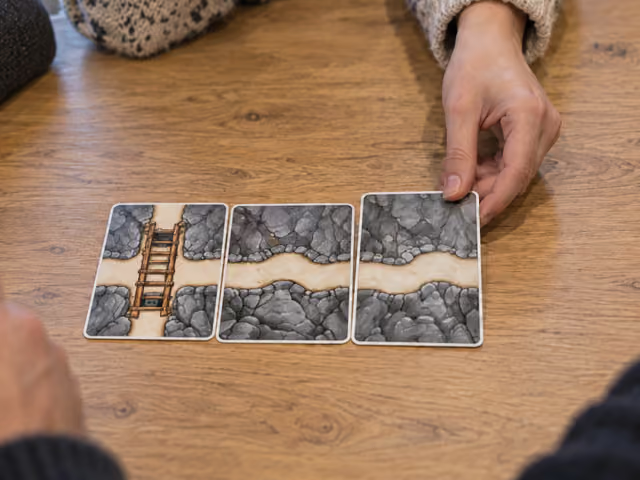
If you have no broken tool in front of you, you may play one path card. Place it edge-adjacent to the mine, with all neighboring tunnel openings and walls matching. Keep its long axis parallel to the other cards; do not turn it sideways. The new card must have an uninterrupted tunnel connection to the ladder. Touching a disconnected island is insufficient. A dead-end card can still be legal when its entrance connects correctly; a saboteur must follow the same placement rules as a miner.
Use an action instead
A red broken-tool card goes face up in front of another player. Any broken tool prevents that player from laying paths, but they can still play actions or discard. A player may have broken pickaxe, lantern and cart cards together, but never two of the same kind. A green repair removes one matching broken tool from yourself or someone else; discard both. A repair showing two tools fixes only one of them. Repairs cannot protect a tool in advance.
Change the mine or inspect a goal
A rockfall removes any one laid path card and is discarded with it. It cannot remove the ladder or a goal. Remaining cards stay in place, and a later legal path can fill the gap; new placements still need a connection to the ladder. A map lets you privately inspect one face-down goal, then return it to the exact same place face down and discard the map. You may discuss what you saw, including bluffing, but do not expose the card to prove a claim.
Pass by discarding
If you cannot or do not want to play a path or action, put one card from your hand face down on the discard pile. Passing spends a card. After any of these choices, draw one card if the draw pile still has cards. When it empties, keep playing from your shrinking hand; do not reshuffle discards. A player with no cards skips their turns while others continue. Repairing your tool uses this turn, so you cannot also lay a path immediately.
Reveal a reached goal
When a newly laid path creates a continuous tunnel from the ladder into a goal, turn that goal face up. Gold ends the round immediately. A rock stays face up and play continues. Orient the revealed goal to connect with the tunnel that reached it; the rules allow a rare mismatch on a revealed goal, which is not permission to mismatch ordinary path cards. The other way to end a round is for every player's hand to become empty, after the draw pile has run out.
Use the ladder and a straight tunnel card to demonstrate a matching connection, then show why a wall facing a tunnel opening does not match. Put the demonstration card back before shuffling the full deck. This is an explanation, not an extra turn or an altered starting layout.
Award gold, then change roles
Reveal the roles when the round ends. If the gold was reached, all miners win that round, including miners with broken tools. For this 2025 rules version, draw one gold card per miner, not one per player. The miner who completed the tunnel looks at these cards and chooses one, then passes the remainder counterclockwise to the next miner, skipping saboteurs. Continue until every miner has one card. If a saboteur completed the tunnel, miners still win; the first miner to that saboteur's right chooses first. Saboteurs receive nothing.
If the gold was not reached, count the saboteurs actually dealt, not those in the original pool. A lone saboteur receives gold cards totaling four nuggets; with two or three saboteurs, each receives three nuggets; with four, each receives two nuggets. Use cards from the remaining gold deck that total each award. Miners get nothing. If the round had no saboteur and no one found the gold, no one receives gold.
Keep earned gold face down, separate from the remaining gold deck. For the next round, reshuffle the roles in the same player-count pool and leave one unused again. Reshuffle and replace the three goals, reset the ladder, and shuffle all path and action cards for a fresh deal. Broken tools do not carry over. Keep earned gold. The player to the left of the person who played the previous round's last card starts.
Finish after the third round. Reveal earned gold and count nuggets printed on the cards, not the number of cards. Highest total wins; tied highest totals share the win. A miner win in one round is not the whole-game result.
Keep suspicion useful and disputes simple
Explain both incentives before the first turn: miners need the tunnel completed, but the finisher gets first choice of gold. A poor-looking move is not proof of a role; someone may have awkward cards or be protecting their own chance to finish. Accuse the move, not the person, and keep discussion at a comfortable conversational volume. Being blocked does not remove a player from the game: actions, maps, rockfalls and discards remain available.
Check a disputed placement before drawing the replacement card. Trace the connection back to the ladder, then compare every shared edge and card orientation. For an illegal placement caught immediately, this guide suggests returning the card to its owner's hand and letting them make a legal choice; that is a house correction, not a printed penalty. An accidental peek by the whole table at a hidden role or goal is best handled by restarting that round with a fresh shuffle and no gold awarded for the abandoned round; this is also a house remedy.
Use the chosen edition's payout consistently. This guide uses AMIGO's 2025 one-card-per-miner rule. Do not combine these systems, add expansion roles, or exclude broken-tool miners from scoring unless everyone deliberately chooses a separate house version before play.
Some community groups dislike the base game's low-count balance or how easily a saboteur can be identified; others enjoy the accusations and changing alliances. Try the official deal first rather than promising equal chances in every round. For a group that wants a known number of saboteurs, the variation below changes that deal explicitly. Everyone needs to distinguish the card symbols and track a shared tunnel; seated play alone does not establish suitability for every access need.
Already know the game?
Ideas & Twists
Choose a variation together before you start.
Saboteur · See main rules
House deal inspired by community playGuaranteed saboteurs
Before shuffling the normal player-count role pool, remove one miner. Deal every remaining role, leaving none unused. This guarantees the normal pool's maximum saboteur count: one at three or four players, two at five or six, three at seven through nine, and four at ten. At six, for example, deal two saboteurs and four miners. Identities stay secret, but the number of saboteurs is now known. Use the usual hand sizes, actions, one-gold-card-per-miner awards, saboteur nugget awards and three-round finish. This changes uncertainty and balance; it is not the official base deal.
Saboteur · See main rules
House information ruleKeep map discoveries private
Map users still peek at one face-down goal and return it to its place, but may not say, signal, show or bluff about which goal they inspected or whether it contained gold or rock for the rest of that round. Discuss tunnel moves and suspicions normally; do not demand a player's private goal information. Everyone uses the same restriction. If a goal becomes publicly reached, discuss its revealed face freely. Card counts, path rules, scoring and the three-round finish stay unchanged. This limits shared certainty without adding cards or changing roles.
Saboteur · See main rules
House scoring-order experimentClockwise gold choices
When miners find gold, draw one gold card per miner as in the main guide. The finishing miner picks first, but now pass the remainder clockwise, skipping saboteurs, until each miner has one. If a saboteur finished, the first miner to their left starts this clockwise selection. Turn order remains clockwise as usual; only reward-choice order changes. All other payouts, hidden roles and the three-round total stay unchanged. This changes which neighboring player benefits from setting up a finish, so agree before the first round and use it for the whole game.
About this guide
Main rules follow AMIGO's English base-game version 4.0, dated 2025, for 3–10 players. Gigamic's presently linked older French sheet has a different gold-card distribution, described above for hosts checking their purchased copy. All three twists, the demonstration, immediate illegal-card correction and exposed-secret restart are explicit host or house suggestions. No expansion, tournament scoring, broken-tool scoring exclusion, two-player or digital rules are imported.
Ready for something different?
Find another game →