

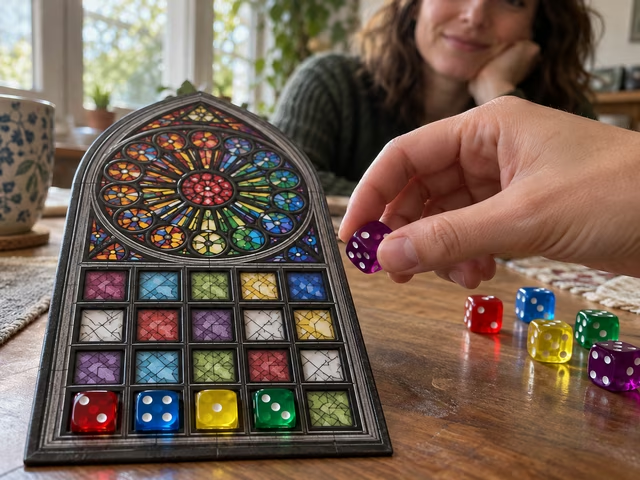
The quick version
Choose a window and private color objective. In each of ten rounds roll two dice per player plus one. Draft clockwise, then in reverse, placing up to one die and using up to one tool on each turn. Score public objectives, private-color dice and unused favors, minus empty spaces.
Saved on this device only — clearing your browser's cache or site data removes them (no account backup).
Choose a window and reveal the shared goals
This guide uses the original 1–4-player base box's multiplayer rules for two to four people, not the remastered edition or Sagrada Artisans. Give each player one private objective and two double-sided pattern cards. Choose one of their four patterns, slide it into a window board, and take favors equal to its difficulty number. Keep the private objective secret.
Reveal three random tools and three public objectives; set all other cards aside. Put all 90 dice in the bag and the round track where everyone can reach it. Choose a starting player. Read the three tools and objectives together before drafting; their printed effects supply game-specific exceptions.
Take two turns in a snake draft
The starting player draws and rolls five dice for two players, seven for three, or nine for four. These form the shared pool. Starting there, take one turn each clockwise. The last player takes a second turn immediately; then return counterclockwise, ending with the starting player's second turn.
On each turn you may draft one die and place it, use one tool, do both in either order when the tool permits, or pass. Pay one favor for the first use of a tool in the game, putting it on that card; later uses cost two favors. Follow its complete text and timing. A tool only overrides the restriction it explicitly names.
Your first die must touch the window's outer edge. Later dice must touch an existing die by an edge or corner. Match any printed color or number in the chosen space. Orthogonally adjacent dice can share neither color nor value; diagonal neighbors may. White spaces remove only the printed-space restriction. A red three beside a blue three is illegal; diagonally beside it is legal.
After both turns per person, put all remaining dice on this round's space, without changing their values. Pass the bag clockwise and begin the next round. After round ten, stop.
Score the completed window
Apply each public objective independently, including repeated qualifying sets. Row and column objectives require a completely filled row or column. Add the face values of all dice matching your private color. Add one per unused favor and subtract one per empty window space.
Highest total wins. Ties go to greater private-objective points, then more remaining favors, then the player later in reverse order in the final round. If an illegal window is noticed during play, its owner removes dice until it is legal; removed dice leave play and the empty spaces still count.
Keep the puzzle visible
Before the first draft, show one legal edge placement, one illegal matching neighbor and a legal diagonal. Leave future printed numbers and colors room to breathe. The group's chosen windows need not have equal difficulty: their different favor allowances are part of the base setup. Check that everyone can distinguish the five colors in the available lighting.
Players comparing it with Azul enjoy the spatial puzzle but find the placement restrictions easy to miss. Walk through one legal die and one illegal die before drafting.
Already know the game?
Ideas & Twists
Choose a variation together before you start.
Sagrada · See main rules
Original STUDplay house twistOpen color goals
Reveal everyone's private objective during setup instead of hiding it. Each still scores only their own objective. This lets the table plan around visible competition for high-value dice.
Sagrada · See main rules
Original STUDplay house twistWindow draft
Reveal one random double-sided pattern card per player plus one extra. Starting with the last player in the first round and going counterclockwise, choose a card and either side. Take its normal favor allowance. This replaces the private choice from two cards.
Sagrada · See main rules
Original STUDplay house twistOne-tool round
Each person may use a tool on only one of their two turns per round. Place a spare coin beside your board after using it and clear that reminder at round end. Normal favor costs still apply. Tools that change turn structure retain their printed instructions.
Sagrada · See main rules
Original STUDplay house twistFavor reserve
At setup place one of your favors beside your private objective. It cannot be spent during rounds one through five. Return it to your available supply at the start of round six. It still counts as unused if kept at the end; every player makes the same commitment.
Sagrada · See main rules
Original STUDplay house twistLate-window repair
Give each player a paper repair token. Once during the game, at the beginning of their own turn, discard it to move one previously placed die to a currently empty space. The final window must obey every ordinary restriction and the moved die must touch another die. This is separate from the optional tool action; no points are awarded for an unused token.
About this guide
Use the named physical base game and its supplied cards, boards and rules. Rules below are paraphrased teaching guidance. Original STUDplay house twists are optional suggestions, not publisher rules or balance-tested claims; agree one before setup.
Ready for something different?
Find another game →