

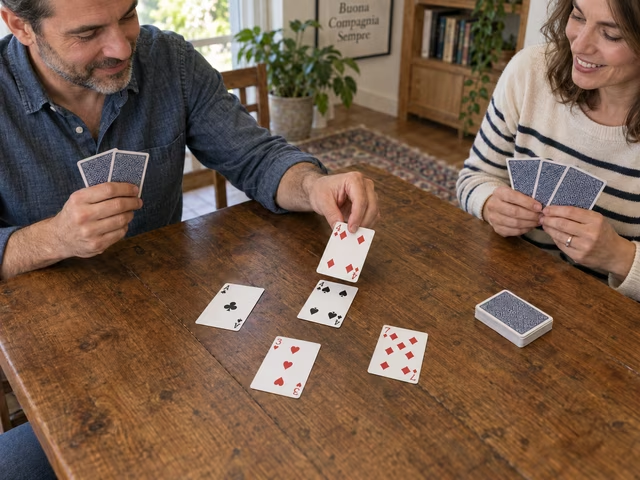
The quick version
Deal three cards each and four face up to the table from a forty-card deck. Take turns playing one card. It must capture one equal-value table card if present; otherwise capture one group whose sum matches, or leave it on the table if no capture exists. Clearing the table scores a sweep, except on the final card of the whole deal. Deal three more each whenever both hands empty. After the stock and hands run out, the last capturer takes leftovers. Score sweeps, most cards, most diamonds, the seven of diamonds and the best four-suit prime. First to at least eleven after a complete deal wins, with a further deal if tied.
Saved on this device only — clearing your browser's cache or site data removes them (no account backup).
Use forty cards and keep values visible
Remove eights, nines, tens and jokers. For captures, ace is 1; two through seven have their number; jack is 8, queen 9 and king 10. Suits do not limit captures. Diamonds replace the coins suit used in many Italian packs. Choose a dealer; deal three cards each and four separate cards face up to the center. If those four include three or four kings, reshuffle and redeal. Leave the rest as the stock.
The nondealer starts. Make a separate capture pile for each player and leave the table layout easy to see. Write the prime values from the scoring section on your score sheet before starting. The three cards in your hand are your choices; do not draw after each play.
Choose a capture or leave a new possibility
Play exactly one card
If a table card has the same capture value, take one such card plus your played card. A single match takes priority over any sum. If there are two matching cards, choose one, not both.
Use a sum only without a single match
With no single match, you may capture a group adding to your card's value. A six can take ace plus five, for example. If several groups work, choose one group. A legal capture is compulsory for the card you chose, but you may choose another hand card that makes no capture.
Leave a card when nothing matches
If your chosen card matches neither a single card nor a sum, leave it face up in the layout. It can be captured later. You cannot build or stack a promised future total as in Cassino.
Mark a sweep
When your capture removes every table card, turn one card sideways face up in your capture pile to mark one sweep. The next player must begin a fresh layout. The very last play of the entire deal can never score a sweep, even if it captures everything.
Refill both hands together
After both people have played all three cards, the dealer gives three more to each from the stock. Do not add fresh table cards. The nondealer starts each new packet. After the last packet, the last person who made a capture takes any table leftovers, without earning a sweep for that pickup.
Score five things after the whole deck
Give one point per sweep. Give one point for most captured cards and one for most diamonds; ties earn neither side that point. The captured seven of diamonds is worth one point by itself.
The final point is the prime, or primiera. Each player selects their best prime card from each suit. Values are: seven 21, six 18, ace 16, five 15, four 14, three 13, two 12, and every face card 10. Add your four selected values. You need at least one card from every suit to qualify. Highest total earns one point; a tied prime earns no point. These values apply only to the prime, not to capturing.
Record the whole deal before checking the match result. At eleven or more, the higher total wins. If both reach the target tied, deal again. Alternate dealers between deals. This guide does not allow claiming victory halfway through a deal.
Explain the single-card priority first
Try this unscored example: the table has ace, three and four. Playing a four must take the four, leaving ace and three. It cannot take ace plus three instead, and it cannot take all three. Playing another card may create a new opportunity for the opponent.
Keep a visible sweep marker separate from the prime calculation. Count all forty captured cards before scoring. Give the prime its own four-card row so a newcomer can check it. The variations change decisions within Scopa; agree on one before the first deal rather than changing a disputed capture.
Already know the game?
Ideas & Twists
Skim the ideas, then open a twist for its full rules. Agree on the variation before you start.
Ace sweeps, without a sweep point
An ace takes the entire table when no ace is already there, but earns no sweep point for doing so.
How to play this twist
An ace takes the entire table when no ace is already there, but earns no sweep point for doing so. If an ace is present, it captures just one ace under normal single-match priority; even a sole-ace capture earns no sweep point in this selected version. An ace played to an empty table stays there. Keep the main scoring and eleven-point finish. This selected house boundary avoids the different regional rule where an ace captures itself.
Scopa · See main rules
Capture fifteen
Replace equal-value captures with this rule: your played card plus the captured table card or group must sum to fifteen.
How to play this twist
Replace equal-value captures with this rule: your played card plus the captured table card or group must sum to fifteen. Keep ace 1, jack 8, queen 9 and king 10. A six may take a nine, or a five plus four. If more than one group works, choose one; there is no single-match priority. A possible capture is compulsory. Otherwise leave the card. Keep sweeps, final leftovers and ordinary scoring, including no sweep on the final play. Play to eleven.
Scopa · See main rules
King of diamonds bonus
Add one point for capturing the king of diamonds, alongside the normal seven-of-diamonds point.
How to play this twist
Add one point for capturing the king of diamonds, alongside the normal seven-of-diamonds point. All captures and other scores stay unchanged. Use the same eleven-point target, checking only after a whole deal. The extra valuable card makes sacrificing a king to prevent a sweep a more consequential choice.
Scopa · See main rules
Build the diamond sequence
Add a bonus for holding ace, two and three of diamonds together in your captured pile: three points.
How to play this twist
Add a bonus for holding ace, two and three of diamonds together in your captured pile: three points. Extend that run upward for one additional point per consecutive diamond, stopping at the first missing rank; jack, queen and king follow seven as 8, 9 and 10. Without ace-two-three, score no sequence bonus. Keep normal scoring too. Use a house target of 21, checked after each deal; break equal leaders with another deal.
Scopa · See main rules
Six-card decisions
Keep two players and all main Scopa capture and scoring rules, but deal six cards each per packet instead of three.
How to play this twist
Keep two players and all main Scopa capture and scoring rules, but deal six cards each per packet instead of three. Put four cards on the table only at the opening. Three packets use the full deck. Keep diamonds as the bonus suit, the normal prime values, no final-play sweep, and the eleven-point finish. This borrows the larger hand, not Hurrikan's changed bonus suit, scoring or match format.
Scopa · See main rules
About this guide
Traditional Scopa documented by Pagat, using a reduced French-suited deck. Scopa d'Assi has conflicting local rules; the selected boundary is explicit. Capture Fifteen and Six-card decisions are labeled adaptations, not claims that all regional games share these rules. The archived Nardò invitation names organizer Gianni Guagnano and local collaborators; it supports one gathering, not attendance or popularity.
Ready for something different?
Find another game →