

The quick version
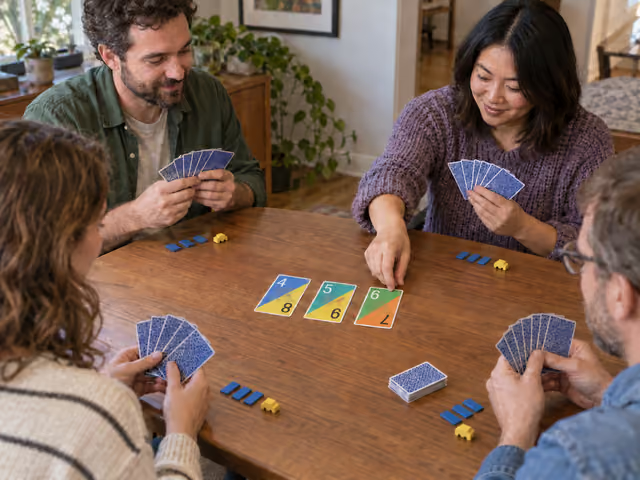
Deal the correct deck without sorting. Each player may rotate their entire hand once before play. Going clockwise, Show a stronger neighboring set, Scout one table-edge card into your hand, or spend your once-per-round Scout & Show chip to do both in that order. Score when someone empties their hand after a Show or every opponent only Scouts after a Show. Play as many rounds as there are players; highest total wins.
Saved on this device only — clearing your browser's cache or site data removes them (no account backup).
Deal without sorting
Use the Oink Games circus-themed physical SCOUT edition and its English instruction sheet, version 1.1, ©2021. This is not the earlier One More Game! SCOUT! edition, a standard playing-card game or the app. Oink also supports two players with different rules; that format is outside this guide.
Sit 3–5 players around a table where everyone can see the central cards. Choose a starting player and give them the marker. For three players, remove all nine cards containing a 10, leaving 36 cards. For four players, remove only the card with 9 and 10, leaving 44. For five, use all 45. Keep removed cards in the box for the whole game.
Put Scout chips and score chips within reach. Give each player one Scout & Show chip, available side up. Shuffle the deck, changing both the order and the top/bottom orientation of cards. Deal every card face down, one at a time: 12 each for three players, 11 each for four, or nine each for five. Wait until dealing is complete before lifting your pile.
Pick up your cards in their dealt order. Each card has two possible values, one at each end. Your active values are the large numbers at the upper left. Before anyone takes a turn, you may rotate your entire collected hand 180 degrees and fan it again to use all the opposite values. You cannot choose a different orientation for each card or sort the numbers. Once play starts, neither rotation nor rearrangement is allowed. Keep your hand private. There is no draw deck left on the table.
Know what beats the table
A Show is one card, or a block of neighboring cards from your hand. A block must be all the same number, such as 6–6–6, or consecutive numbers in order, such as 3–4–5 or 5–4–3. You cannot skip a card in your hand, rearrange a block to make it legal, or wrap a run from 10 to 1. A single card may come from anywhere in your hand.
Compare a proposed Show with the active set, the cards currently face up on the table. First compare length: more cards always beat fewer, regardless of value or type. If lengths match, matching numbers beat a run. If length and type both match, compare the lowest number: the higher lowest number wins. Equal strength does not beat anything. A single card beats another single only with a higher number.
For example, 2–3–4 beats 9–9 because three cards beat two. A pair of 2s beats the two-card run 8–9 because matching numbers beat a run of the same length. The run 5–6–7 beats 4–5–6 because its lowest number is higher. A pair of 5s cannot beat a pair of 5s. When the table is empty, any legal Show may lead.
Show, Scout, or do both
Lead the first Show
The starting player lays down any legal single or neighboring set, preserving its sequence. Put it face up in the center and identify its owner. The next player clockwise acts. On every turn, choose an action; passing is not allowed.
Show a stronger set
Take a legal neighboring block or single from your hand that beats the current active set. Turn the beaten table cards face down and keep them as your captured-score pile. Lay your cards face up as the new active set; you now own it. Close the gap in your hand without changing the remaining cards' relative order. Removing an awkward card can bring useful neighbors together. If there was no active set, you capture nothing.
Scout one end card
Instead of Showing, take exactly one card from either end of the active set. With a one-card set, take that card. You may rotate this newly recruited card before inserting it anywhere in your hand; keep every old card in its previous relative order. The active set's owner takes one Scout chip from the supply, worth one point. The Scout card stays in your hand, not your captured pile. You may choose Scout even when you could Show.
Continue with the smaller set
Any table cards left after Scout remain the active set, with the same owner. Compare later Shows against what remains, not against the original size. If Scout removed the last card, the table is empty and the next player may lead any legal Show. Taking the last card does not by itself end the round.
Spend Scout & Show when useful
Once per round, place your available Scout & Show chip in the center. First complete a normal Scout, including the owner's one-point chip and inserting the recruited card. Then immediately make a legal Show against the remaining table cards; if none remain, lead any legal set. The Show does not have to include the card you recruited. Spend the chip only when you can complete both actions. This is one turn; otherwise a normal Scout passes play clockwise.
Check the finish after each action
End immediately when a player has no cards left after their Show. Also end when, after a Show, every other player takes only Scout on their next turn and nobody replaces that Show. In a four-player game that means all three opponents only Scout. Scout & Show includes a Show, so it breaks that sequence and creates a new owner to watch. If the table empties before all opponents have Scouted, the next free Show starts the sequence afresh. Do not give the active owner another turn once every opponent has only Scouted.
The table has 6–6 and your hand has a single 6. Scout one table 6 and insert it beside yours; give the table owner a Scout chip. Your new pair beats the one remaining table 6. Capture only that remaining card, then Show the pair. Your hand is empty, so the round ends. The pair you just Showed stays active and earns no captured-card points.
Count points, then rotate the start
At the end of a round, earn one point per captured face-down card and one per Scout chip you received. Subtract one point per card left in your hand. The player whose Show ended the round because every opponent only Scouted does not subtract their remaining hand. Someone who went out already has no hand penalty. The active table cards earn nobody points, and an unused Scout & Show chip is worth nothing.
For example, four captured cards plus two Scout chips minus three hand cards scores three. If those same cards belonged to the owner whose Show survived every opponent's Scout, that player scores six instead. Negative round scores are possible. Exchange the result for score chips, using their negative sides when needed; retain each player's accumulated total.
Return all Scout chips to the supply and reset everyone's Scout & Show chip. Gather the in-play cards, shuffle their order and orientations, and deal again using the same headcount deck. Pass the starting-player marker one seat clockwise. Play three rounds with three players, four with four, or five with five, so everyone starts once. Highest total points wins. Equal highest totals share the win; there is no official tie-break round.
Make the hand-order rule visible
Before shuffling, show a small unscored example with the actual deck. Put 3–8–4–5 in a sample hand and explain why 3–4–5 cannot be played yet: the 8 is between them. Removing the single 8 would bring 3–4–5 together. Demonstrate a Scout at an end of a table set, rotating only the recruited card and inserting it without sorting. Then return every demo card and shuffle for the real deal.
Ask everyone to keep their new hand in order from the moment it is lifted. Players who habitually sort card games may need a reminder before looking. Count each other's remaining hand sizes openly if asked, without showing values. For each new Show, say the owner's name and keep their Scout-chip pile separate from the shared supply. This makes the all-opponents-Scout finish and the hand-penalty exception easier to track.
Settle strength disputes in this order: card count, matching set versus run, then lowest number. Recheck adjacency in the showing player's hand before they remove a disputed block. An end-card Scout may rotate the new card; old hand cards may never flip individually. The rulebook treats Scout chips as unlimited; if the supply runs out, use spare markers as one-point substitutes and announce their meaning. That contingency needs additional markers only if it arises.
The booklet does not prescribe a repair for an accidentally sorted hand or an illegal move discovered much later. Suggested house remedy: if caught before another player acts, restore the exact previous state when everyone agrees it is known. If order or hidden information cannot be restored, void that round, return its Scout chips, and redeal with the same starting player; do not count the void round. Agree to that remedy before play. Use the twists for a fully open rehearsal or a deliberate rules change, not an unannounced correction.
This is seated hand-management play with small printed numbers. Check that people can hold their ordered hand and see the table values. Keep cards on a stable, well-lit surface. No timer or phone is required.
Already know the game?
Ideas & Twists
Choose a variation together before you start.
SCOUT · See main rules
House teaching formatOpen-hand rehearsal
Before the scored game, play one complete unscored round with every hand face up in an ordered row in front of its owner. Use the normal headcount deck, starting player, actions, round finish and Scout & Show allowance. A player may ask the table for advice, but only that player chooses their move; advice cannot authorize sorting. At the finish, count example scores aloud without keeping them. Return all Scout chips, reset all action chips, reshuffle and redeal private hands for the normal three-, four- or five-round game. This changes information and coaching for the rehearsal only and does not require extra cards.
SCOUT · See main rules
House shorter formatOne-round challenge
Agree before dealing to play exactly one scored round with the normal rules and headcount deck. Choose the starting player by agreement or randomly, end by the usual empty-hand or all-opponents-Scout condition, and use ordinary round scoring. Highest round score wins; tied leaders share the win. There is no equal-start rotation within this short format. If you play another standalone challenge, move the starting marker clockwise; each challenge has a fresh score rather than a carried total.
SCOUT · See main rules
House tactical restrictionScout or Show only
Set every Scout & Show chip aside before the first deal. Each turn must be exactly one normal Show or one normal Scout; you can no longer recruit and immediately Show in the same turn. All hand-order restrictions, deck sizes, Scout points, comparison rules, round-ending checks and scoring remain unchanged. Play one round per player, rotating the start, and use highest total with shared ties. This removes the rescue action and makes each recruitment commit you to waiting until your next turn. Apply the restriction to everyone for the entire game.
About this guide
Rules use Oink Games' physical SCOUT English v1.1 instruction sheet, ©2021, reviewed October 2, 2026, and the publisher's edition/errata page. The main guide supports 3–5; Oink's separate two-player rules are not included in matching facts. Community threads identify teaching and interpretation problems, not rule authority or evidence of popularity. The three twists, demonstration, tracking advice and error-repair agreement are original house suggestions.
Ready for something different?
Find another game →