

The quick version
Draw two and keep one, or take a top discard. Play any useful duo pairs. At seven card points, you may stop immediately or call Last Chance. Score the round, reshuffle and continue to the player-count target, unless four mermaids win immediately.
Saved on this device only — clearing your browser's cache or site data removes them (no account backup).
Make two separate discard piles
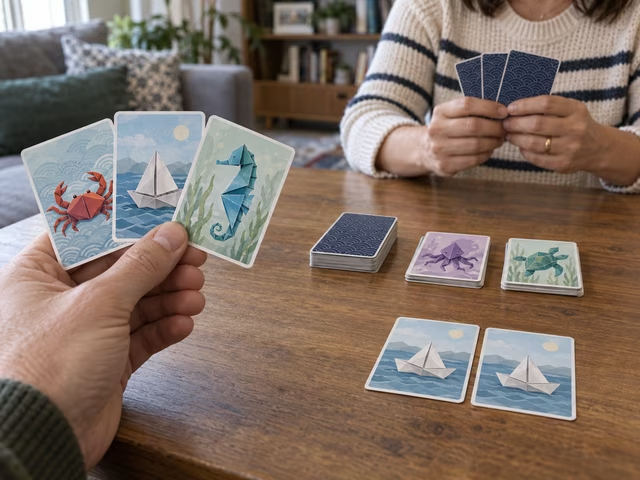
Use the 58-card base deck without expansions. Shuffle, reveal two cards into separate discard piles, and leave the rest face down. Nobody starts with a hand. Choose a first player; play clockwise. Put the scoring aids where everyone can read them and record a running score for each person.
Take a card, then optionally play duos
Either draw the top two deck cards, keep one and discard the other onto either pile, or take the top card of one discard pile. If a discard pile is empty, a card you discard must fill it. You cannot normally inspect buried discard cards.
You may then expose any number of complete duos from your hand and use each effect once when exposed. Two crabs let you inspect one discard pile and take any card from it without showing the selection. Two boats give an immediate extra turn. Two fish draw the deck's top card. One shark with one swimmer steals one random card from another player's hand. Exposed duos stay in front of you and cannot be reused for another effect.
A duo scores one point whether exposed or still in your hand. Unpaired duo cards score no pair point. Exposing gives the effect and removes those cards from the hand that opponents can steal from.
Count the hand and exposed cards together
Shell sets score 0, 2, 4, 6, 8 or 10 for one through six shells. Octopuses score 0, 3, 6, 9 or 12 for one through five. Penguins score 1, 3 or 5 for one, two or three. Sailors score 0 for one or 5 for two.
Each mermaid scores the count of one color in your entire collection. Choose your most numerous color for the first mermaid, the next most numerous for the second, and so on; never reuse a color. Mermaids themselves are white. Four mermaids revealed together win the whole game immediately.
Multiplier cards add one per boat, one per fish, two per penguin or three per sailor, as shown on their card. The multiplier is not itself a member of that animal/card type. These bonuses add to ordinary pair or collection points.
Choose Stop or Last Chance
After taking cards and playing any duos, if your card score is at least seven, you may end the round. Reveal your hand and say Stop or Last Chance. Stop makes everyone reveal and score their card points immediately.
Last Chance gives every OTHER player one final ordinary turn in order. At the end of that turn they reveal their hand; revealed hands cannot be stolen from. Compare card points after these turns. If you have at least as many as every opponent, you score card points PLUS your color bonus and all others score only their color bonus. If anyone beats your card score, you score only your color bonus and all opponents score card points. A color bonus is one point per card in your single most common color.
If the deck is empty at the end of a turn, the round instead ends with no points. Otherwise add round results to totals. Reshuffle every card and start left of whoever ended the round. With two players the target is 40, with three 35, with four 30. Once any total reaches the target, highest total wins; ties go to more points in that final round. Share a remaining tie as a house resolution.
Explain the two ways to close before playing
Compare a Stop with a Last Chance using the same example hand. Make clear that a color bonus differs from card points and is not automatically added every round. Keep printed reference cards beside the score sheet. Do not apply optional expansions unless the whole table deliberately changes editions.
Players in the linked discussion especially enjoy the two-player game and origami artwork. Keep the card reference handy so recognizing a picture does not substitute for checking its effect.
Already know the game?
Ideas & Twists
Choose a variation together before you start.
Sea Salt & Paper · See main rules
Original STUDplay house twistEight-point horizon
Raise the card-point requirement to end a round from seven to eight. Stop and Last Chance otherwise work normally. Four mermaids still win immediately and deck exhaustion still cancels the round. This gives developing collections a little more room.
Sea Salt & Paper · See main rules
Original STUDplay house twistPublic opening card
On each player's first turn of a round, keep the card they acquire face up in a separate personal row. It remains part of their hand for pairs, scoring and random theft until played. For random theft, mix it with the hidden hand before the opponent selects, then restore face-up status if it was not taken. Subsequent cards stay hidden.
Sea Salt & Paper · See main rules
Original STUDplay house twistOne protected card
Once per round, at the end of your own turn, you may place one hand card face down sideways as protected. It scores as part of your hand but cannot be stolen. You may return it to your hand at the start of a later turn, ending its protection permanently for that round. You cannot replace it with another protected card.
Sea Salt & Paper · See main rules
Original STUDplay house twistLast Chance only
A player with at least seven card points may close a round only with Last Chance; remove the immediate Stop option. The final-turn protection and both scoring outcomes stay unchanged. This makes the closing decision more confrontational without adding card powers.
Sea Salt & Paper · See main rules
Original STUDplay house twistTidal discard
At the end of every completed round, turn the first two cards of the next shuffled deck face up as usual, then let the new first player swap which discard pile is on the left. Throughout that round, a card discarded after drawing two must go onto the pile with FEWER cards; choose either when tied. Empty-pile priority still applies. Other discard effects and taking top cards are unchanged.
About this guide
Use the named physical base game and its supplied cards, boards and rules. Rules below are paraphrased teaching guidance. Original STUDplay house twists are optional suggestions, not publisher rules or balance-tested claims; agree one before setup.
Ready for something different?
Find another game →