

The quick version
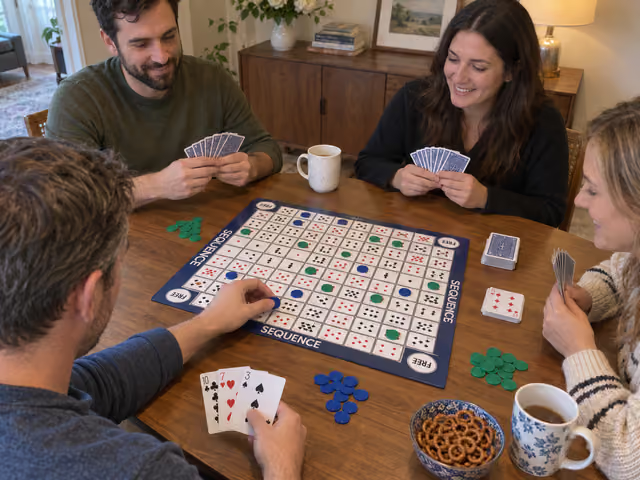
Play one card and place a chip on an open matching space, or use a Jack. Draw one replacement card and continue clockwise. Five spaces in a straight line make a sequence. Two players or two teams need two sequences; three players or three teams need one. Finished sequences are protected.
Saved on this device only — clearing your browser's cache or site data removes them (no account backup).
Choose sides, deal and show a first turn
Use the standard board, its 104 SEQUENCE cards and all three chip colors. Remove any extra Joker cards; keep all eight Jacks. Put the board on a flat table where everyone can see it and reach the playing area. Leave room for the face-down draw deck, chip supplies and a separate face-up discard pile in front of each player. Shuffle both decks together.
Count people exactly: 2 or 3 play individually. With more people, use equal teams: 4, 8 or 10 form two teams; 9 forms three teams; 6 or 12 can choose two or three teams. Five, seven and eleven do not fit this format. For two sides, use blue and green and alternate seats A-B-A-B. For three sides, add red and repeat A-B-C around the table. Each team shares a color, but every player has a private hand and takes their own turn.
- 2 players: deal 7 cards each.
- 3 or 4 players: deal 6 each.
- 6 players: deal 5 each.
- 8 or 9 players: deal 4 each.
- 10 or 12 players: deal 3 each.
Have everyone cut a card; the lowest rank deals, with Aces high. House procedure for a tied low cut: only the tied players cut again. Return those cards, shuffle and deal. Put the remainder face down. The player immediately left of the dealer starts, then turns move clockwise.
Before starting, state the target: two sides need two sequences; three sides need one. Point out the four printed corner spaces: each already counts as everyone's color. A line using a corner needs four actual chips plus that corner; do not put a chip on it. Demonstrate an ordinary card, a two-eyed Jack and a one-eyed Jack with spare cards, then remove the demonstration chips and return the cards before dealing the real game.
Play one card, draw and check the line
Exchange one dead card if you want
At the start of your turn, a non-Jack card is dead when both matching board spaces are occupied, by any colors. Announce it, discard it and draw a replacement. You may exchange only one dead card on that turn, then still take your normal turn. Having a one-eyed Jack in your hand does not reopen a space until you actually play it. You may keep a dead card instead of exchanging it.
Play an ordinary card
Choose a card from your hand and place it face up on your own discard pile. Put one chip of your side's color on either open space showing that exact rank and suit. Each non-Jack card appears twice on the board. An occupied space is unavailable, even if its chip is yours; do not stack, move or replace it.
Or play one of the Jacks
Jacks have no matching board spaces. Discard a two-eyed Jack (clubs or diamonds) to put one of your chips on any open card space. Discard a one-eyed Jack (hearts or spades) to remove one opponent chip that is not in a completed sequence. Return the removed chip to that side's supply. Removal is your board action for the turn: you do not put your chip in the newly opened space. You cannot remove your own side's chip or break a completed sequence.
Draw one card and pass the turn
After your ordinary placement or Jack action, draw one replacement card. A dead-card exchange is separate, so a turn with an exchange and a play draws two cards in total. If the draw deck runs out, shuffle all players' discard piles into a new face-down deck. The official missed-draw rule is strict: if the next player has both made their move and drawn before you take your replacement, you lose that draw and continue with a smaller hand.
Count completed sequences and finish
A sequence is five connected spaces of your color in one straight horizontal, vertical or diagonal line, with no gaps. A printed corner can supply one of the five. Point out the five spaces when you complete a line so everyone knows it is protected. In a two-sequence game, the second line can reuse at most one space from the first; four other spaces must be new to that second line. Nine chips in a straight line therefore can make two sequences, using positions 1-5 and 5-9. First to the required number wins immediately; do not finish the circuit or give other sides an answering turn. Count sequences, not individual chip points.
Removing an opponent chip with a one-eyed Jack opens the square for a later turn. It does not also place your chip. The picture's eyes determine the Jack's power, not whether the suit is red or black.
Keep hands private and settle close calls
The selected U.S. rules prohibit coaching between teammates. Do not reveal your hand, suggest a square or warn a partner away from a move. The published penalty for a teammate's warning is that every member of that team discards one card of their choice; those forfeited cards are not replaced. Explain this before the deal. For a teaching game with strategic discussion, select the open-team variation below instead of quietly changing the rule midway.
Give a new host a simple rhythm to announce before play: optional dead-card swap, discard one card, make one board action, draw. Allow rules questions to be settled openly with the instructions. Check the exact rank and suit before a chip is placed, and show the two matching spaces during the demonstration. Keep completed lines visible; a sixth adjoining chip is not automatically another sequence. Trace the five spaces in each claimed line and count their shared spaces.
House procedure for a stuck turn or draw: if you cannot make a legal placement or removal after your optional one-card dead-card exchange, pass without an additional draw. If every player passes in one complete clockwise circuit, call the game a draw. The selected instruction sheet does not define this case; this is a hosting agreement, not an official tie rule. Ordinary deck exhaustion is not a draw: reshuffle the discards and continue. Normal play has one immediate winner, so there is no score-based tie or extra turn to equalize turns.
For another game, clear all chips, gather hands and discards, shuffle the full deck and choose the dealer again. Do not carry a protected line or reduced hand into the next game. At larger counts, check that everyone can actually see and reach this board; its twelve-player rules do not guarantee that twelve people fit around your table.
Already know the game?
Ideas & Twists
Choose a variation together before you start.
Sequence · See main rules
Suggested house variation · two sides onlyOne-sequence sprint
With two players or two equal teams, change the target from two sequences to one. Keep the same deal, seating, Jacks and turn rules. Stop at the first completed five-space line. This changes the finish condition, not the card count, and makes no promise about elapsed minutes. Three-side games already use a one-sequence target.
Sequence · See main rules
Suggested house variation · team playOpen-team teaching game
Allow teammates to discuss their hands and possible moves openly during their side's turns, and remove the official coaching-card forfeiture for this game. Keep individual hands, alternating seats, one board action per turn and the normal sequence target. The player whose turn it is still chooses the move. Agree to this before dealing; other sides hear the same discussion.
Sequence · See main rules
Suggested house match formatFirst to two game wins
Keep each game's normal sequence target and all main rules. Award one match win for a won game; a drawn game awards none. Clear the board and deal a fresh game after each result. Move the dealer one seat clockwise each game. The first side to win two games wins the match, including in a three-side match. Keep the same sides throughout and mark wins with paper or spare chips away from the board.
About this guide
Main mechanics follow the U.S. JAX SEQUENCE Original Game Instructions, retrieved October 2, 2026. The standard 135-chip set is confirmed by Goliath's U.S. product listing. The multilingual Goliath Classic V08-2204 booklet has a different opening procedure and less detailed coaching/dead-card wording; those editions are not blended here. Tied dealer cuts, the stuck-turn/draw procedure and all three variations are explicit house agreements. Pointing out completed lines is hosting advice. Community links and source comparisons are retained in the research packet.
Ready for something different?
Find another game →