

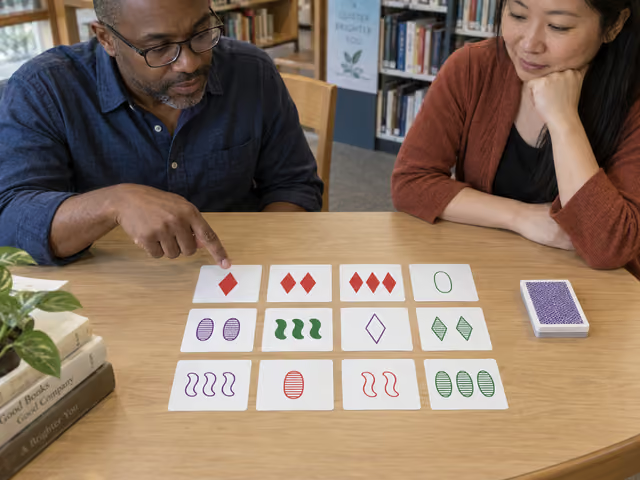
The quick version
Shuffle the 81 cards and deal 12 face-up. Check color, shape, symbol count and shading separately: each feature must be identical across all three cards or different on all three. Everyone searches at once. Say “SET” before taking your three cards; others check them. A correct claim earns 1 point, an incorrect claim costs 1. Replace collected cards while keeping a normal layout of 12. When nobody can find a SET, agree before adding 3 cards. Finish after the draw pile is empty and the remaining layout has no SET.
Saved on this device only — clearing your browser's cache or site data removes them (no account backup).
Deal a shared layout
Use classic physical SET: the 81-card edition sold by PlayMonster as item 1000, following its English instructions. This is the four-feature card game, rather than SET Junior or SET Dice. This guide hosts 2–6 individual players; everyone, including the dealer, may search and score.
Choose a dealer to shuffle, replenish cards and keep the layout orderly. Put 12 cards face-up in three rows of four, with all symbols visible to everyone. Place the rest face-down as a draw pile. Leave room for extra cards alongside the rectangle and for each person's collected trios.
Write everyone's name and a starting score of 0 on paper. Add 1 for each accepted SET and subtract 1 for each failed claim; scores can go below zero. Keeping a written total avoids forgetting penalties. Deal and rearrange only while play is paused so the dealer gets the same chance to search.
Test all four features
Every card has a color (red, green or purple), a shape (oval, diamond or squiggle), a count (one, two or three symbols) and a shading (solid, striped or outlined). On one card, all its symbols share that card's color, shape and shading.
A SET is exactly three cards. Examine each feature on its own. Color must be all one color or one of each color; shape must be all one shape or one of each shape; count must be all the same count or one, two and three; shading must be all one shading or one of each shading. All four checks must pass. A feature with two matching cards and one different card invalidates the trio. Different features may pass in different ways; there is no requirement to have exactly one matching feature.
For a practice example, take the cards showing one, two and three solid red diamonds. They form a SET: the counts differ completely, while color, shape and shading each match completely. One red, one green and one purple card could pass the color test, but still fail another feature. Two red cards and one purple card always fail the color test, however promising the other features look.
Ask a learner to describe the third card needed to complete any chosen pair: where the pair matches, keep that feature; where it differs, use the missing third value. For one solid red diamond and two solid red diamonds, look for three solid red diamonds. This is a teaching exercise, not a scored claim. Return any demonstration cards and reshuffle before the real deal.
Search, claim, check and replenish
Begin together
Once all 12 cards are visible, the dealer says to begin. Everyone searches simultaneously; there is no clockwise turn and no private hand. Any three cards in the layout can form a SET, regardless of their positions. Keep your hands clear until you have identified your trio.
Claim a trio
Say “SET” before picking up cards. The first caller has control of the layout; everyone else waits until that claim is resolved. Pick out the three cards within a few seconds. Calling first is not permission to reserve the table while you keep searching.
Verify before collecting
Show the trio and state whether color, shape, count and shading are all the same or all different. The other players check every feature. If valid, keep the three cards together in your collected pile and add 1 to your score. If invalid, or if you cannot produce the trio promptly, subtract 1 and return any selected cards to their original positions. Resume searching after resolving the claim; do not deal replacement cards for a failed claim.
Replace only what is needed
After a valid claim from a 12-card layout, the dealer fills its three gaps from the draw pile. If the layout had 15 cards, remove the claimed trio and bring the remaining cards together as 12, without drawing replacements. More generally, while more than 12 cards remain, remove accepted trios without replacing them; replenish only to 12 when the pile has cards. If fewer than three cards remain in the pile, deal all that remain. Pause claims during dealing and rearranging, then restart together.
Expand a stalled layout
If everyone agrees there is no SET among the face-up cards, the dealer adds three from the draw pile, keeping all previous cards face-up. Search the entire expanded layout. If the group still cannot find one, this guide's house extension is to agree again and add another three, if available. Never discard a stuck layout or reshuffle the draw pile mid-game. Adding cards in group play does not itself cost anyone a point.
Finish the deck
An empty draw pile does not stop a SET already available on the table. Continue claiming valid trios without replacements. Finish when the pile is empty and everyone agrees the remaining cards contain no SET. Those leftover cards earn no points. Compare written totals: collected SETs minus failed claims. Highest total wins. This guide treats equal highest totals as a shared win; there is no extra sudden-death claim.
When no SET is found in 12 cards, add three after group agreement. A correct claim from those 15 cards leaves 12; do not refill its gaps with another three.
Make the search fair and clear
Start with the practice trio before competitive play. Give a learner time to explain all four features, rather than merely confirming that three cards look related. If a claim is challenged, identify the feature that has two alike and one different. Use the actual cards to settle it, not a majority vote about a remembered rule.
Use even light and keep drinks, glare and hands away from the cards. Check that everyone can distinguish the three colors and see striped versus solid fills before starting. Move seats or the layout when useful; a seated game is still a visual search task. Say “SET” clearly at conversational volume; shouting is unnecessary.
The publisher gives the caller a few seconds, rather than a fixed countdown. Ask them to select the trio promptly and apply the same standard to everyone. For calls too close to distinguish, this guide suggests a house procedure: pause and let the tied callers indicate their proposed trios without moving cards. Give the first claim to the tied caller reached first when counting clockwise from the seat to the dealer's left, with the dealer's own seat counted last. Resolve that claim before the next tied caller's claim. A later claim is valid only if its three cards remain. Rotate the dealer for the next game. Do not award two people the same cards.
If the group is stuck, check pairs methodically: decide what third card would complete a pair, then look for that card. A dealt layout can have no SET; use the agreed extra-card procedure. Experienced players may find trios before a learner can finish checking them. Use the shared-search variation when learning together matters more than racing.
Already know the game?
Ideas & Twists
Choose a variation together before you start.
SET · See main rules
Publisher easy-start optionThree-feature introduction
Before shuffling, separate the 27 cards with solid symbols and put the other 54 aside. Play with this smaller deck, dealing 12 cards and replenishing or expanding exactly as in the main guide. Check color, shape and count; shading already matches on every card. Keep the same +1 correct-claim and −1 failed-claim scoring, and finish when the 27-card pile is empty and the remaining layout has no SET. Equal highest scores share the win. For a later full game, reunite all 81 cards and shuffle afresh. This follows the English easy-start idea; other language editions may specify a different initial layout.
SET · See main rules
Official longer-match option with this guide's tie conventionEveryone deals a game
Before the first deal, agree to play one full-deck game for each participant. After each game ends, record each person's game score, combine all 81 cards and reshuffle. Pass the dealer role one seat left for the next game. Keep the main simultaneous play, replenishment and penalties unchanged. When everyone has dealt once, add each person's game scores; highest total wins the match. Equal highest match totals share the win. This is a longer commitment, not a new timed round.
About this guide
Classic 81-card SET uses the publisher's English rules for four-feature trios, simultaneous claims, verification, +1/−1 scoring, 12-card replenishment, 15-to-12 reduction and the longer rotating-dealer match. The English easy-start option supplies the solid-only deck; this guide retains the main 12-card layout. The 2–6 social hosting range is this guide's choice, not the publisher's maximum. Written scoring, shared ties, simultaneous-call priority, further expansion beyond 15 cards and cooperative shared search are explicit host or house choices. Official solitaire has separate penalty instructions and is outside this guide's main game. Community discussions inform the teaching and lighting advice; they do not set the official rules.
Ready for something different?
Find another game →