

The quick version
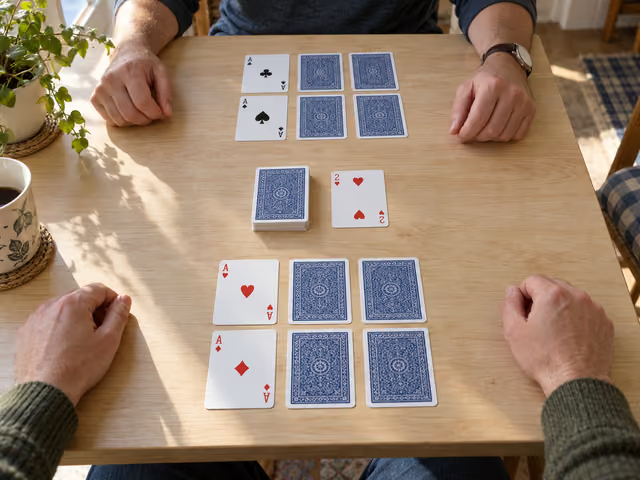
Deal six cards to each player in two rows of three and turn any two face up. Put the remaining deck face down beside a face-up discard. Starting left of the dealer, draw one card and either replace a layout card or discard a stock draw. New layout cards stay face up. Stop immediately when one player has all six exposed, reveal every layout and score it. A vertical pair of the same rank is zero; otherwise aces are 1, twos −2, kings 0, jacks and queens 10, and other numbers their value. Add nine deal scores; lowest wins.
Saved on this device only — clearing your browser's cache or site data removes them (no account backup).
Deal six cards and reveal two
Seat two, three or four players around an indoor table. Bring one complete ordinary 52-card deck, remove all jokers, and keep paper and a pen for nine deal scores and running totals. Everyone needs room for a six-card rectangle and a clear view and reach to two central piles. This guide uses Bicycle's published Six Card Golf format; it is a traditional card game, not a purchased Play Nine, Skyjo or Cabo edition.
Choose a first dealer. Shuffle and deal one card at a time clockwise until everyone has six, face down. Arrange your own cards in two rows of three: the card directly above another belongs to the same column. Put the undealt cards face down in the middle as the stock; turn its top card face up beside it to start the discard pile.
Everyone turns any two cards in their layout face up. They may be in the same column or different columns. Leave the other four face down; do not peek at them. Keep all six positions fixed during the deal. Say before starting: 'Only matching ranks in a vertical column cancel; twos can make a negative total; the deal stops immediately when someone exposes their sixth card.'
Draw, choose a position and discard
Draw one card
The player left of the dealer starts; turns continue clockwise. Take either the top face-down stock card, looking at it, or the visible top discard. Take only the top card, never search through either pile.
Replace one of your six cards
Use the drawn card to replace any one card in your own layout, face up or face down. Decide which hidden position to replace before looking at its old card. Put the new card face up in that same position and put the old card face up on top of the discard pile. Once you see the old card, you cannot undo the choice. You still have exactly six layout cards.
Or reject a stock draw
If you drew from the stock and do not want the card, put it on top of the discard pile and end your turn. Do not reveal another layout card as a bonus action. If you took the visible discard, use it in your layout; do not take it simply to return it unchanged. This compulsory-use clarification follows Pagat's six-card rules.
Watch the last hidden card
A replacement always stays face up. Matching columns remain on the table and can still be changed on later turns. The deal ends immediately when one player's layout becomes entirely face up. Everyone else gets no further turn in the main game. Turn all their remaining hidden cards face up for scoring; the ending player is not automatically the winner.
For an unscored demonstration before the first deal, lay down a visible 8 above a face-down card. Show that taking another 8 can replace the hidden card to make a zero-point column. Reveal and discard the old card even if it was a useful king. Gather the demo cards back into the full deck before shuffling and dealing.
Score columns, then add the nine deals
Score each of your three columns separately. If its two cards have the same rank, that entire column is 0, including a pair of twos. Suits do not matter. A jack with a queen does not cancel: they share a point value but have different ranks. Matching cards across a row or diagonal do not cancel.
- Ace: 1 point.
- Two: −2 points.
- Three through ten: the number on the card.
- Jack or queen: 10 points.
- King: 0 points.
If a column is not a matching pair, add both individual card values. For example, columns 8 over 8, king over queen, and 2 over 3 score 0, 10 and 1: the deal total is 11. A column of two twos scores 0, not −4. Three unmatched twos, each paired with a king, give a legal deal score of −6. Negative scores and negative running totals stay negative.
Record everyone's deal score, including tied scores, and add it to their running total. Collect every card, pass the dealer role left as a host convention, shuffle and deal the next layout. After nine deals the lowest running total wins. This guide's tie agreement is to share the win if the lowest totals are equal; no sudden extra deal is required. A tied individual deal needs no tiebreak because every score contributes to the total.
Keep the hidden cards and house rules clear
Offer the demonstration first and ask someone to explain which pairs cancel. A high card can become useful if it matches its vertical partner; replacing a known low card is not always the best choice. Watch how many hidden cards your opponents have left so the immediate finish is not a surprise. Remember useful discards, but do not make peeking part of the game. Ordinary quiet conversation is enough; avoid coaching another player's private decision unless everyone agreed to a teaching deal.
Leave matching columns in place. Do not slide cards to create new pairs, remove a completed column, use a jack as a power card, or exchange cards with another player. If someone remembers a different finish, joker value or square bonus, choose a variation before the first deal instead of adding it midgame.
Bicycle does not specify stock exhaustion. This guide supplies a house procedure: if the stock runs out before the deal ends, leave the current top discard face up, shuffle all cards underneath it and make them the new face-down stock. Layout cards stay put. If there are no cards underneath to recycle, reveal and score the current layouts. Announce this procedure during setup.
For an accidental peek or an unresolvable mistake, this guide suggests abandoning that deal with no scores and redealing with the same dealer. Agree to it before play; it is a house remedy, not a published penalty. Settle a score dispute by comparing ranks column by column before gathering cards. Players must distinguish ranks and remember the changing discard situation; seated play alone does not establish suitability for every access need.
Already know the game?
Ideas & Twists
Choose a variation together before you start.
Six-card golf · See main rules
Traditional variation recorded by PagatOne last turn
When a player exposes their sixth card, freeze that player's layout. Each other player takes exactly one final turn in clockwise order, then reveal all remaining hidden cards and score. A second player exposing their sixth card during this final circuit does not restart it. Stock draws may still be rejected and top discards must be used. All card values, vertical-pair cancellation and the nine-deal result stay the same. Agree to this finish before dealing; it replaces the main game's immediate stop.
Six-card golf · See main rules
Traditional variation recorded by PagatReveal instead of drawing
Add a third turn choice: reveal exactly one of your own hidden layout cards and end your turn, taking no card from either pile. Leave the revealed card in its position; it may be replaced on a later turn. Revealing your sixth card ends the deal immediately, as in the main game. Drawing, replacement, scoring and nine-deal totals are unchanged. This gives a player a direct way to trade uncertainty for information without replacing that card.
Six-card golf · See main rules
Traditional variation recorded by PagatJokers take the negative score
Before shuffling, add two jokers to make a 54-card deck. Change every two from −2 to +2 points and give each joker −2 points; all other card values stay unchanged. Treat the two jokers as the same rank, so two in the same vertical column cancel to 0, just as paired twos still do. Jokers are ordinary replacement cards, not wild cards or power cards. Setup, turn choices, immediate deal finish and the nine-deal total otherwise follow the main game.
About this guide
Bicycle's undated online rules supply the 2–4-player, one-deck, nine-deal main format and immediate deal finish. Pagat's six-card account clarifies face-up replacement and compulsory use of a taken discard, and records the three optional variations. This guide makes fixed card positions explicit and supplies house procedures for exhausted stock, mistaken exposure, dealer rotation and tied final totals. No universal governing rulebook or commercial edition is claimed. Four-, eight- and nine-card formats and power-card games are separate; their rules are not imported.
Ready for something different?
Find another game →