

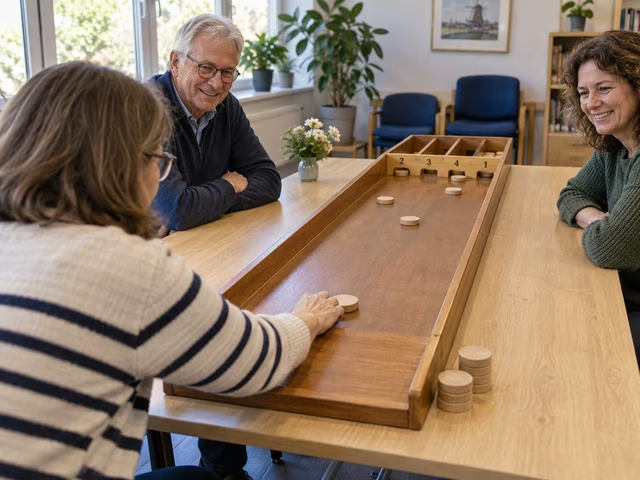
The quick version
Take turns using thirty discs. Slide all thirty, one at a time, toward the gates. Leave them untouched during the pass. Keep fully pocketed discs in their compartments; gather only misses for a second pass, then a third. Each set of one disc in every compartment scores 20; leftover pocketed discs score their gate value. Reset the board for the next player. Everyone takes two full turns; add those scores and share any tie for highest total.
Saved on this device only — clearing your browser's cache or site data removes them (no account backup).
Level the board and agree on two turns each
Use a real sjoelbak and its matching thirty wooden discs. Set the board securely on a level table, with clear space at the playing end and no people reaching across the lane. The four gate values, from the player's left, are 2, 3, 4 and 1. A roughly two-metre board needs more space than a small coffee table.
Choose a first player and a fixed order. One person slides while another counts; spectators can watch from the sides. Standing or sitting is fine when the table permits a comfortable reach. Give each player two full turns, each consisting of up to three passes. This is a social match format, not a tournament bracket.
Slide, leave the layout, then replay the misses
Make the first pass
Start each disc from the playing area at the near end and slide it forward with one hand. Release one disc at a time. Do not throw discs or push a hand down the lane. You may aim directly or bank off a side rail, and a new disc may push an earlier one through a gate.
Leave played discs alone
Do not touch a disc once released during that pass. A disc counts only if it lies completely beyond the gate's front edge. A disc protruding into the lane is still a miss, even if almost through. A disc that leaves the board or returns to the playing area is held for the next pass, not immediately replayed.
Prepare the second pass
Once every available disc has been slid, confirm which are completely through. Stack those neatly inside their existing compartments to clear the entrances, without moving a disc to a different scoring compartment. Return only unscored discs to the player.
Complete at most three passes
Slide the returned discs for pass two, then gather misses once more for pass three. Keep pocketed discs in place throughout. Stop early if all thirty are pocketed. This guide awards no extra bonus discs, even for an early perfect score; that is an explicit simplification.
Score and reset
After the final pass, record the compartment counts and calculate the score below. Count all thirty discs before clearing the board. The next player starts with an empty board and the full supply.
A balanced set scores twenty
Find the smallest of the four compartment counts. That is the number of complete sets. Score 20 for each set, then subtract those sets from the compartment counts and score each remaining disc at its own gate value. Discs outside the compartments score zero.
For example, counts of 3, 3, 4 and 2 in the 2–3–4–1 compartments give two sets for 40. The leftovers are one in 2, one in 3 and two in 4: another 13, for 53 total. The maximum without bonus discs is 148: seven complete sets plus two extra discs in 4.
After two turns apiece, add each person's two scores. Highest total wins; tied leaders share the win. Do not use only the better turn unless you agreed to that different scoring method before play.
Keep the counting visible
Let another player check the four counts before removing anything. Keep a tally sheet with columns for each compartment, complete sets and total. Use an unscored few-disc demonstration to show that a nearly pocketed disc does not yet count. Clear loose discs from the floor between turns.
The game can be played seated at a suitable table, but the specific board, reach and venue determine access. Arrange a helper for retrieving discs if needed; this is not a promise that every venue is accessible. Choose one variation at a time so everyone receives the same opportunities.
Already know the game?
Ideas & Twists
Choose a variation together before you start.
Sjoelen · See main rules
Published format with the guide's match finishOne pass only
Use thirty discs but allow only the first pass. Misses never return during that turn; score the final compartments normally, with no bonus discs. Keep two turns per person and compare summed scores. Blocked lanes now remain a problem for the whole turn, making your early distribution matter more.
Sjoelen · See main rules
Published 20-2 format with the guide's match finishTwenty discs, two passes
Set ten discs aside. Each turn uses twenty discs and at most two passes. Keep the normal balanced-set scoring and no bonus discs. The maximum is 100, achieved with five in every compartment. Everyone still receives two complete turns; highest summed score wins.
Sjoelen · See main rules
Published pairs structure; simplified bonus rulePartners finish the same board
Use four or six people in pairs. One partner plays pass one with thirty discs; the other plays the misses for pass two. Stop there and score the shared board normally. Clear it before the next pair. Each pair takes two turns and swaps who opens on the second. Add its two scores; tied pairs share the win. Keep this guide's no-bonus rule. Partners decide whether the opener should chase balance or clear space for the finisher.
Sjoelen · See main rules
House version of Single CountCount every checkpoint
Use thirty discs and three passes. Score the whole pocketed layout after each pass without removing scored discs from their compartments; add all three checkpoint scores. If everything is pocketed early, the unchanged layout supplies the remaining checkpoint scores. No bonus discs. Keep two turns each and compare their totals. Early pocketed discs now contribute at more than one checkpoint.
Sjoelen · See main rules
House version of Triple CountWeight the early passes
Use thirty discs and three passes. After each pass, score the whole pocketed layout without removing scored discs from their compartments. Multiply the first checkpoint score by three, the second by two, and the third by one, then add those amounts for the turn. If all discs are pocketed early, use the unchanged layout for the remaining checkpoints. No bonus discs. Everyone takes two turns; highest combined total wins. This increases the reward for securing balanced sets before the return passes.
Sjoelen · See main rules
Published Zaandams structure with the guide's match finishClear twenty for a bonus
Use twenty discs and up to three passes. Score the final layout normally, then add 50 if all twenty were pocketed in pass one or 20 if all were pocketed by pass two. Pocketing the last disc in pass three earns no bonus. The discs need not be evenly distributed to earn the clearance bonus. Each person takes two turns; compare their summed scores. This makes clearing a blocked lane valuable even when the easiest gate does not complete a set.
About this guide
The Dutch federation's format document supplies the named scoring systems; Sjoelen Open supplies practical board procedure. Two turns each, shared ties and omission of early-perfect-score bonus discs are this guide's hosting choices. Single Count and Triple Count are adapted explicitly to that no-bonus format. De Neng's listing is one adult community invitation, with no publication date shown; it does not establish popularity or promise current venue access.
Ready for something different?
Find another game →