

The quick version
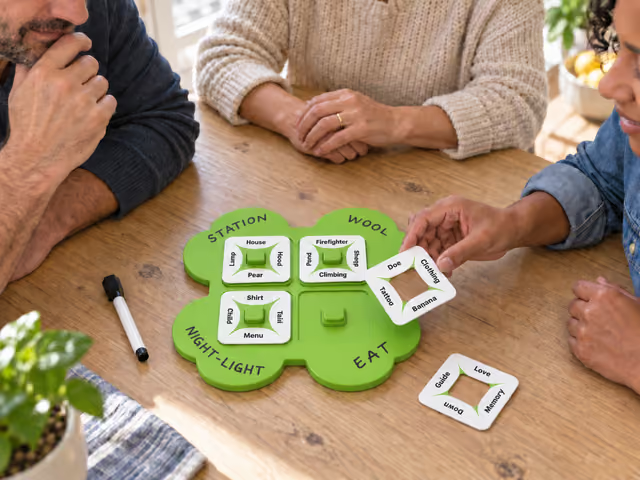
Each person randomly fits four cards on a clover and secretly writes one clue for each outer pair of words. Remove the cards, add one unseen card and shuffle the five. Choose a first puzzle; everyone except its maker discusses and rebuilds it. A perfect first attempt earns six points. Otherwise, the maker removes wrong cards and the team tries once more, earning one point per correct card. Move left to the next maker. Finish after everyone’s puzzle, then total the group score.
Saved on this device only — clearing your browser's cache or site data removes them (no account backup).
Give everyone a clover
Use Repos Production’s English physical base game and its SC_EN01 rulebook: 220 square keyword cards, six clover boards, six erasable markers and a Record of Legends. This main game is for 3–6 people. Give each person one board and a working marker. Check that everyone can read the printed words and see a board placed in the middle of the table.
Shuffle the deck face down. Each person draws four cards and fits them randomly over the four posts on their own board. Keep your layout private and keep its random positions and orientations; do not rearrange the cards to make easier pairs. Each card has four edge words, but only the eight words along the outside of the assembled square matter. Two neighboring words sit below each of the four outer clue areas.
Choose someone to present the first puzzle. Everyone will present once, moving to the person on the left each time. Clear space for one shared clover and its five loose cards. Use the boards and Record of Legends to record points; no timer or device is needed.
Write four connections in secret
Everyone writes at the same time. For each outer pair, write one clue in its matching area on the clover. Try to connect both words. For example, if the pair were BREAD and MORNING, breakfast could link them. This is a spoken teaching example; use the actual pairs on your board for play.
A clue is one word; compound words are allowed. Nouns, proper names, acronyms, numbers and written sound words are permitted. Clues cannot be the keywords themselves, their translations or words from the same word family. Made-up words are also invalid. For instance, baking would be invalid for a pair containing bake because it is a related form.
Keep all four clues legible. Remember your exact layout, then remove the four cards. Draw one extra card without looking at it, shuffle it into your four, and leave the five face down on your clover. Wait until everyone has finished before solving any puzzle. The extra card is a decoy; it does not belong on your original board.
Rebuild one puzzle together
Reveal the first clover
Its maker becomes the spectator and places their board and all five cards face up in the middle. Everyone else solves together. The spectator gives no hints, words, nods or other reactions while the team is solving.
Try positions and rotations
Discuss the four written clues. Move and rotate cards to test which two outer words each clue could link. Fit four of the five cards onto the board and leave one out. Each correct card must be in its original position and orientation. A card affects two neighboring outer pairs, so check both before committing.
Submit one complete arrangement
Say clearly when the team is ready for the spectator to check. Trying arrangements while discussing does not use an attempt. If solvers cannot agree, the person immediately left of the spectator makes the final decision.
Check and score
If all four cards are correct on the first submitted attempt, score four card points plus a two-point bonus: six total. If anything is wrong, the spectator silently removes every incorrectly placed or rotated card and sets it beside the board. Leave correct cards in place. The team has one final attempt, using the available loose cards. After that submission, remove any remaining wrong cards and score one point for each correctly placed card, from zero to four; there is no bonus.
Move left and finish
The spectator writes the puzzle’s points on the back of their board and discards its five cards. The player on their left presents next. After everyone has presented once, add the scores and record the group total. The maximum is six times your player count: 18, 24, 30 or 36. There is one shared score, no individual winner or tiebreak. An equal previous high score remains tied; exceeding it sets a new record.
Three correct cards after the second attempt earn three points, even if some words on a wrong card happen to fit a clue. Four correct cards on the second attempt earn four, not six.
Give each solver room to think
Before dealing, explain one imaginary pair and let the group suggest a clue. During real clue writing, keep your cards private and give people thinking time. A simple shared association is often more useful than a reference only you know. If a pair is awkward, choose your best legal connection rather than waiting for a perfect answer.
During solving, invite each person to offer an idea before someone submits the arrangement. Start with a promising clue, then check how those card positions affect the neighboring clues. Put the board where every solver can read it; offer to move cards for someone who prefers to describe a placement. The spectator must stay neutral even when a guess is funny or nearly right. Save explanations of the intended connections until the puzzle is finished.
The rules give the left-hand solver final say on an arrangement but specify no separate penalty for an invalid clue, a forgotten layout or an accidental hint. Agree on this house remedy before play: if the puzzle cannot be fairly checked, discard its five cards and remake that person’s puzzle with four new random cards, four fresh clues and a new unseen decoy. Score only the replacement, and still let everyone present once. Do not improvise point deductions or award points for an uncheckable layout.
For another game, record the total before erasing the boards, deal fresh cards and choose the first spectator again. Compare records made with the same number of people and the same decoy rule. Quiet conversation works well; reading, writing and a shared view of the cards still matter.
Already know the game?
Ideas & Twists
Choose a variation together before you start.
So Clover! · See main rules
Official harder optionTwo decoys
Before dealing, agree that everyone will add two unseen cards instead of one after writing clues. Each puzzle now has six candidate cards, four spaces and two cards to leave out. Use the same four random starting cards, legal clues, silent spectator, two attempts and 6-or-0–4 scoring. Finish after everyone presents once. Keep this record separate from the one-decoy game. The rulebook permits an agreed larger decoy count; two is the concrete setting here.
So Clover! · See main rules
House suggestionPuzzle night, no totals
Use the usual four cards plus one decoy, but skip point recording and the high-score comparison. Still submit one complete arrangement, let the spectator remove wrong cards, and allow just one retry. After the second check, reveal the intended layout and talk through the connections. Finish after everyone has presented once, whether the puzzles were solved or not. There is no winner, score or tiebreak.
So Clover! · See main rules
House suggestion · two playersA clover for two
Give each of two people a board and marker. Both secretly prepare four random cards, four legal clues and one unseen decoy exactly as usual. Choose whose puzzle goes first. Its maker stays silent while the other person alone places four of the five cards and submits an arrangement; that sole solver makes every placement decision. Use the usual first-attempt six points or second-attempt zero-to-four points. Swap roles for the other board, then finish and add the two scores, up to 12. This is a cooperative house adaptation, not the publisher’s 3–6 player main format; keep its records separate.
About this guide
Main rules follow the English SC_EN01 physical base game: random private layouts, four legal clues, one unseen decoy, silent spectator, left-hand solver’s final say, two checks and shared end scoring. The extra-decoy option is official; two extra cards is this guide’s chosen setting. The demonstration, discussion advice, equal-record convention, replacement-puzzle remedy, score-free night and two-player version are host suggestions. Community reports inform those suggestions and do not change the main 3–6 player count.
Ready for something different?
Find another game →