

The quick version
Reveal four cards from each of three levels and one more noble than players. Start with no cards or tokens. Clockwise, take three different gems, take two of one color from a pile holding at least four, reserve a card and take gold, or buy one card. Bought cards stay as discounts. Check nobles and keep at most ten tokens at turn end. At 15 points, finish the round; highest score wins, with fewer bought cards breaking a tie.
Saved on this device only — clearing your browser's cache or site data removes them (no account backup).
Set the market for your player count
This guide uses the original Space Cowboys Splendor base game with Pascal Quidault artwork and its 2014 English rules, plus the publisher's later clarifications for depleted gem piles and a remaining tie. Splendor Duel, Marvel and expansions have separate rules.
Check the box: 40 level-one, 30 level-two and 20 level-three development cards; ten nobles; seven each of white diamond, blue sapphire, green emerald, red ruby and black onyx tokens; five yellow gold tokens. You need space for the shared market and each person's bought cards and visible tokens. No board, phone, timer or score sheet is required.
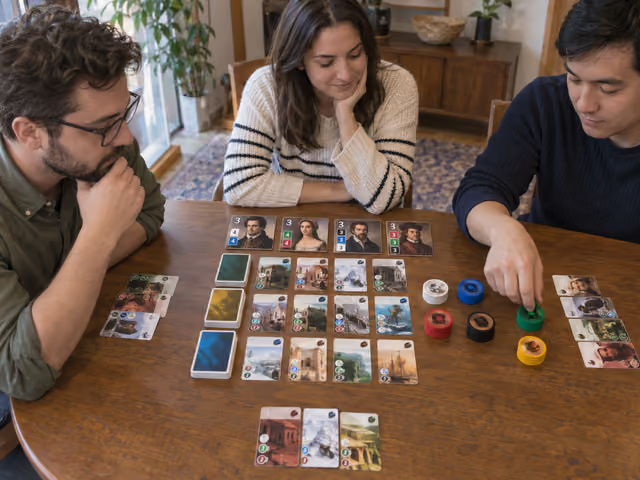
Shuffle the three card levels separately. Put the decks in a column, level one nearest the bottom, and reveal four cards beside each deck: twelve face-up cards in three rows. Shuffle nobles and reveal three for two players, four for three, or five for four. Set the other nobles aside.
For two players, leave four tokens of each gem color in the supply; for three, leave five; for four, use all seven. Always keep all five gold. Sort into six piles. Everyone starts empty. The youngest player starts under the printed rules; remember that seat and play clockwise.
Separate tokens, discounts and points
A development card's colored costs at the lower left are what you must pay. Its gem at the upper right gives one permanent discount of that color after purchase. A prestige number at the upper left gives points; a card with no prestige number gives zero points. Reserved cards give neither discounts nor points until bought.
Discounts reduce the matching costs every time you buy; you never spend or discard the cards. For example, a cost of two blue and one green becomes just one green if you already own two blue bonuses. Excess discounts give no tokens or change. Tokens in your hand are spent; bonuses on your cards remain.
Choose exactly one action on your turn
Take different gems
Take one token from each of three different non-gold colors. If fewer than three colors remain available, take one from each available color instead. You cannot voluntarily take fewer when three colors are available. Gold is excluded.
Or take a pair
Take two tokens of one non-gold color only if that pile contains at least four before you take them. A pile of three does not allow a pair. This is your whole action; do not also take another color.
Or reserve a card and take gold
With fewer than three reserved cards, take one face-up market card or the top card of any nonempty level deck into your private hand. Take one gold if available, even if you already have ten tokens; adjust at turn end. Refill a market gap immediately from the same level. No gold remaining does not prevent reservation. You cannot discard a reserved card or reserve a fourth. Reserving does not buy the card.
Or buy one card
Buy a face-up market card or one of your previously reserved cards. Subtract your matching permanent bonuses from each printed cost, then return the required tokens to the supply. Each gold covers one missing token of any color and can also replace a color you hold. Gold from a reservation can buy any card later, not just the reserved card. Put the bought card face up in your area. A fully discounted card is free, but still costs your one action. Refill a market gap from its own deck; if empty, leave the gap.
End the turn
Keep bought cards grouped by bonus color with bonuses and points visible; keep all held tokens visible too. Check noble eligibility, return tokens of your choice if you hold more than ten including gold, and check your total points. Cards and nobles do not count against ten. Continue clockwise if the game has not finished.
Point to one inexpensive level-one card and show which gem colors would pay for it. The starting player may take those colors now, but buying is a separate future turn. This is a teaching example, not a required opening strategy.
Take a noble when your cards qualify
At the end of every turn, compare your bought-card bonuses with the remaining noble tiles. You need at least every printed color requirement. Held gem and gold tokens cannot help. If a noble requires three blue, three green and three white bonuses, you need that many bought cards of those colors.
A qualifying noble must visit: take its tile for three prestige points without spending cards, tokens or another action. If several qualify, choose exactly one. You may collect another on a later turn if it remains available. Each claimed noble stays with you and is not replaced.
Finish the round and compare scores
Your score is the prestige printed on bought cards plus three per claimed noble. Tokens, unbought reservations and the number of bonuses add no points. When someone ends a turn with 15 or more, announce the final round. Continue clockwise only until the player immediately before the starting player has taken their turn. Everyone then has the same number of turns; players who already acted this round do not get another.
Example: with A, B, C and D in order, if B reaches 15, C and D each take one final turn, then stop. A and B do not act again. Highest final prestige wins, even if someone overtakes the person who triggered the finish. Among tied scores, fewer bought development cards wins. If both score and bought-card count remain tied, share the victory, as clarified in the later publisher rulebook. Unbought reserved cards are not a further tiebreak and incur no penalty.
Help new players plan and settle mistakes
Explain all four actions before starting, especially that reserving gets gold now but requires a later purchase. Ask players to plan during other turns and check an alternative if their target disappears. Community players disagree about pursuing nobles versus expensive point cards. Show both routes; a noble is useful when its colors support purchases you already want, not a requirement for winning.
Before handing over tokens for a purchase, say the printed cost, discounts and payment aloud so others can check. Use the printed card and visible bonuses to settle affordability. Check the pile before a same-color pair; check noble requirements against bought cards rather than held tokens. There is no trading or gifting cards or tokens between players.
Suggested house remedy: correct an illegal take or payment immediately, before anyone else acts, using the remembered prior position. If a mistake is found later and cannot be reconstructed, pause and agree a fair repair; do not invent an official penalty or silently change the result. Keep the rulebook nearby. Good lighting and a readable, reachable market matter; seated play does not guarantee every person's access needs are met.
Already know the game?
Ideas & Twists
Choose a variation together before you start.
Splendor · See main rules
House information variantOpen reservations
Keep every reserved card face up in its owner's separate reserve area, including cards drawn from a deck. Everyone can see future targets; only the owner may buy those cards. All reservation limits, gold, costs, noble rules and the 15-point final round stay the same. Bought cards must remain clearly separate. Use this when the group wants visible planning and fewer memory demands.
Splendor · See main rules
House setup variantNoble veto
Deal the normal twelve-card market, then reveal five nobles for two players, seven for three, or nine for four. Beginning with the starting player and going clockwise, each person removes exactly one noble to the box. This leaves the normal player-count-plus-one nobles. Play the full base game with those survivors; never replace claimed nobles. Costs, tokens, 15-point finish and ties are unchanged. Each person gets one chance to shape which color collections are rewarded.
Splendor · See main rules
House session formatRotating-start series
Agree before play to run one full game per player: two, three or four games. Keep seats and clockwise order fixed, but move the starting seat one person clockwise each game instead of always using the youngest player. Completely reset tokens, reshuffle all three decks and nobles, and use normal player-count setup each time. Record each final prestige score on paper after the equal-turn finish. Highest summed prestige across the series wins; tied totals share the series. Each individual game still uses the normal fewer-bought-cards tiebreak. This needs paper and a pen and a longer commitment than one game.
About this guide
The main game follows the original physical base edition, with later publisher clarifications on taking fewer gems only when colors are unavailable and sharing a tie that survives the bought-card tiebreak. The later box has new artwork and a first-player marker; those are not required for this original-box guide. Open reservations, Noble veto, the series and mistake remedies are explicit STUDplay house suggestions. Community strategy is advice, not a rule or guaranteed winning method.
Ready for something different?
Find another game →