

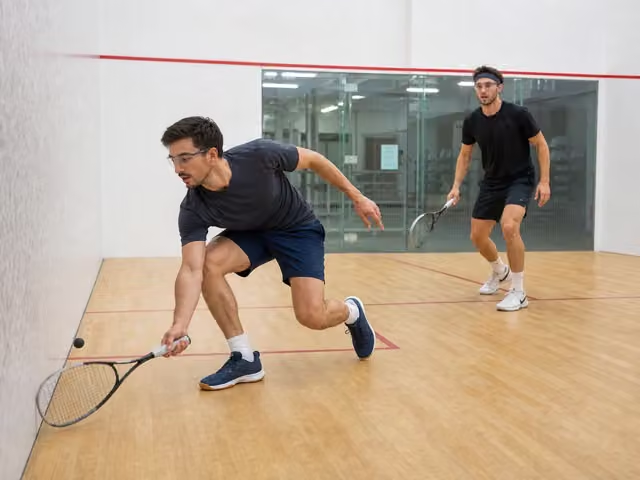
The quick version
Serve directly to the front wall above the service line, then into the opposite rear quarter unless volleyed. Return before the second floor bounce; your shot must reach the front wall above the tin before touching the floor. Every rally winner earns a point and serves next. Reach 11 with a two-point lead; win two games. Stop for an obstructed or dangerous shot.
Saved on this device only — clearing your browser's cache or site data removes them (no account backup).
Book a court and identify the lines
Reserve an indoor singles squash court and check the venue's footwear, eyewear, equipment-hire and first-visit requirements. Take two squash rackets and a squash ball, not a tennis or racquetball ball. Wear non-marking court shoes and properly fitted squash protective eyewear for warm-up and play; ordinary spectacles are not protective eyewear. For this guide, both players wear protection even where an adult recreational venue leaves it optional. Keep bags and spare balls outside, check the floor is dry, and close the court door.
For new players, ask staff for a manufacturer-labeled beginner squash ball, such as a Dunlop Intro. Using an introductory ball instead of a regulation competition ball is a recreational house adaptation: keep the written serve and scoring rules. Do not assume every brand's dot colors or ball sizes mean the same thing. A very low-bounce competition ball can make early rallies unnecessarily difficult.
The front wall is the hitting wall. Its lowest marked area is the tin; hit above it. The service line is higher up, and the out line bounds the top of the playable walls. A ball on an out line is out; a ball on the tin's top line is down. On the floor, the short line crosses the court; the half-court line splits the area behind it into two rear quarters. Each small square beside a side wall is a service box. During rallies, the floor lines do not restrict where the ball can bounce.
Agree on a best-of-three match: first to two game wins. Set a physical timer or use the court clock. Warm the ball by hitting to the front wall with equal turns for up to four minutes, changing left/right sides after two. Leave up to one minute before starting and up to two minutes between games. Ask staff to demonstrate safe movement and a legal serve if both players are new. Court-booking length does not predict match length.
Serve, rally and finish the match
Choose the opening server
Use a racket spin: one player calls the marked face before the result is revealed; the winner serves. Start at 0–0. The server chooses either service box and the receiver prepares in the opposite rear quarter. Call the server's score first and wait until the receiver is ready. Both may move anywhere during a rally.
Make a legal serve
Drop or toss the ball and strike it before it touches anything else; do not bounce-serve. At contact, at least one foot must touch the floor entirely inside the service box, clear of its boundary lines. Hit the front wall directly above the service line and below the out line, not the front/side-wall corner simultaneously. After that, side or back walls may be used, but the first floor bounce must be inside the opposite rear quarter, clear of its boundary lines, unless the receiver volleys it. A service fault loses the rally and gives the receiver a point and the serve; there is no second-serve allowance.
Take alternate returns
The receiver hits next, either before the serve bounces or after its first bounce. Thereafter take turns, striking before the second floor bounce. Each return must reach the front wall above the tin and below the out line before touching the floor; it may first hit a side wall or back wall. Hit once without carrying the ball. The service line no longer sets a minimum height after the serve. After your shot, move to give your opponent a view, route to the ball, reasonable swing and path to the front wall.
Award the rally and move the serve
A second floor bounce before your hit, a shot into the tin or out, a floor bounce before the shot reaches the front wall, or an illegal double hit/carry loses the rally. The opponent adds one point even if receiving. If the server wins, serve from the other box next. If the receiver wins, they become server and may choose either box. Say the new server's score first. For a let, no point changes and the same server repeats from the same box.
Close a game, then the match
At 10–10, keep playing until someone leads by two: 11–10 is unfinished, 12–10 wins, and there is no sudden-death cap. Record the game, reset points to 0–0, and let its winner serve first in the next game from either box. The first player to win two games wins the match; at one game each, play a deciding third. If your reservation ends mid-match, stop and record it as unfinished rather than inventing a timed winner.
Alex serves from the right at 3–2 and wins: Alex leads 4–2 and serves left. Sam wins that rally: Sam now calls 3–4 and may choose either box. A let at that score leaves Sam serving again from the same box.
Stop for interference and settle close calls
If the other player blocks your path, swing or shot, stop before striking and say Let, please. Do not swing through someone, hit them to claim a point, or run into them to prove obstruction. Be particularly cautious when a ball goes behind you and you turn; stop if you cannot see that the opponent is clear. Recover toward the central T only when that leaves the other player's access clear, rather than treating it as a place you own.
The official outcomes are a let (replay), a stroke (point to the obstructed striker) or no let (striker loses the rally). Common examples: if you could make a good return and the opponent tried to clear but still blocked access, a let can apply; if they failed to make every effort to clear, a stroke can apply. A prevented reasonable swing is a stroke. A blocked direct shot to the front wall on a first attempt without turning is a stroke; side-wall routes, turning and further attempts have additional rules. If you could not have made a good return, or there was no interference or reasonable fear of injury, a let is not earned. These examples do not replace the full referee rules.
Unrefereed house remedy: use clear agreed calls; when you cannot agree on a line, bounce or interference decision, replay that rally with the score, server and box unchanged. This replaces a referee's ruling on disputed cases; it does not make every obstruction an official let. If a ball hits a person, clothing or the non-striker's racket, stop immediately. The official outcome depends on its route and any turning or further attempt. For this recreational game, use the separate house remedy of replaying that rally only after checking everyone is unhurt and both want to continue. Stop the session if someone is hurt or unsafe play continues.
Correct a wrong service box before serving. If the error is discovered only after a completed rally, its result stands; a server who won then uses the alternate box from the one just used. If a receiver was not ready and made no return attempt, replay a good serve; a faulty serve still loses the rally. If you toss and make no attempt to hit, start again; a missed attempt may be followed by another attempt only while the ball has not touched anything else. If the ball breaks during a rally, replace it, share the warm-up and replay that rally with the score, server and box unchanged. Check suspected damage immediately: the receiver may appeal before attempting the next return of serve; a confirmed break of uncertain timing then permits replay of the previous rally. At a game's end, raise it immediately before leaving the court. An unbroken ball does not earn a replay merely for an odd bounce; stopping a rally for a mistaken broken-ball claim loses that rally.
Before scoring, rehearse a serve, one returned ball and a stopped interference call. Aim for controllable returns while learning rather than hard shots at someone. Extra friends wait outside the court and rotate between finished matches; they are not extra players in this two-person format. Record game scores and return hired equipment when finished.
Already know the game?
Ideas & Twists
Choose a variation together before you start.
Squash · See main rules
Suggested house match formatOne-game meeting
Replace best of three with one game to 11, still won by two. Keep all serve, rally and interference rules. That game's winner wins the meeting; a 10–10 tie continues normally. Finish a complete game before changing players, and record unfinished if court time expires. This reduces the number of games, not a guaranteed number of minutes.
Squash · See main rules
Suggested cooperative practice variationKeep the rally together
Replace opponent points with a shared count of legal racket hits, including a legal serve as one. Use the same alternate-hit, one-bounce and wall rules, aiming to give each other playable returns. A fault ends that attempt; a safety stop ends it too, without blame. Record your longest rally and let the other player serve the next attempt from either box. Before starting, agree when to finish, such as the end of your reserved practice slot; there is no individual winner or tie-break.
Squash · See main rules
Suggested house learning variationTwo-bounce learning game
Allow each player to return after up to two floor bounces, hitting before the third, during rallies. Keep the ordinary service requirement: its first bounce must still land in the opposite rear quarter unless volleyed. Keep the requirement that every hit reaches the front wall before the floor, along with scoring to 11, win by two and the best-of-three finish. The additional bounce gives learners another chance to reach a playable ball; it does not permit unsafe swings or remove interference stops. This is not regulation singles.
About this guide
Rules edition: World Squash Singles Rules 2025, cover V1.2, effective September 1, 2025; the hosted filename ends V1.2.2. Best of three is permitted by rule 2.3. Beginner-ball substitution, compulsory eyewear for this recreational guide, unrefereed disagreement/ball-contact remedies and the three variations are explicitly identified host choices. Competition officials, conduct penalties and injury procedures require the full rulebook and venue guidance. Community discussions informed the beginner-ball and cooperative-practice choices; they do not establish official rules or representative demand.
Ready for something different?
Find another game →