

The quick version
First place workers clockwise, choosing one location per placement and committing all workers you want there at once. You cannot add to your own earlier group. Tool maker and field each hold one worker total; hut needs two of one player's workers; each resource area has seven spaces; hunting has unlimited room.
Saved on this device only — clearing your browser's cache or site data removes them (no account backup).
Prepare the table
Give everyone five workers, twelve food, a player board and markers at zero on score and agriculture. Keep five further workers per color in supply. Sort resources, food and tools beside their board areas. Shuffle buildings into seven-tile stacks, using one stack per player and revealing each top. Shuffle Civilization cards and reveal four in the board's marked positions. Choose a first player.
Play a turn
First place workers clockwise, choosing one location per placement and committing all workers you want there at once. You cannot add to your own earlier group. Tool maker and field each hold one worker total; hut needs two of one player's workers; each resource area has seven spaces; hunting has unlimited room. Each visible card and building has one space. With two or three players, only two of tool maker, field and hut may be occupied per round. Resource areas accept at most one player's group with two players, or two players' groups with three.
After placement, first player resolves all their locations in any order and retrieves workers, then the next player does likewise. Tool maker gives a tool: fill three value-one tools before improving one to two, then improve the others; continue similarly to three and four. Each tool may add its whole value to one gathering roll per round; turn it after use. Field raises agriculture one; hut adds one available worker for future rounds.
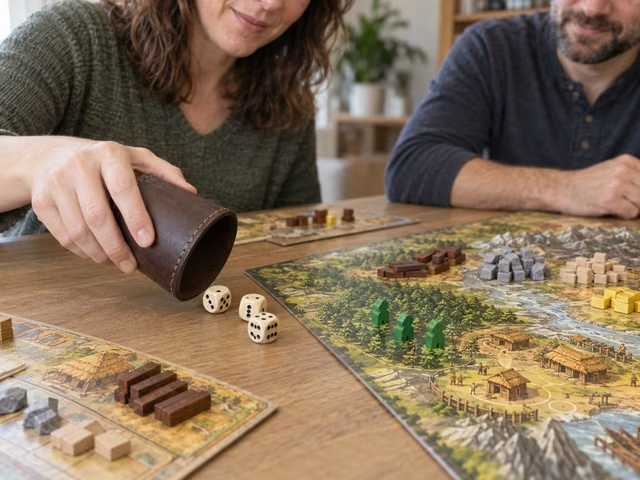
For gathering, roll one die per worker, sum and optionally add unused tools. Divide by two for food, three for wood, four for clay, five for stone or six for gold, rounding down. Spend any resources, excluding food, to buy an occupied Civilization card at its position's one-to-four-resource price. Resolve its upper immediate benefit using the supplied card summary and retain the bottom for final scoring. You may decline a purchase.
Buy an occupied building with its shown recipe, immediately scoring its value and exposing the next tile. Variable buildings specify how many resources and different types are required; score paid wood/clay/stone/gold as three/four/five/six each. The special flexible building accepts one to seven resources of your choice.
After everyone resolves, receive food equal to agriculture, then pay one food per worker, including new workers. If short, spend all food, then optionally replace each missing food with any resource. If you do not fully cover the shortage, lose ten points total, regardless of its size. Keep surplus food. Pass first player left, slide remaining cards toward the cheapest position, refill to four and ready tools.
Finish and score
If a building stack empties, finish that round including feeding. If four Civilization spaces cannot be refilled, stop before starting another round. Add final card points: form sets of different green cultural symbols, scoring each set's size squared; duplicate symbols can form additional sets. Sand-colored cards multiply their total pictured farmers by agriculture, tool makers by permanent tool value, builders by buildings and shamans by workers. Add one per remaining non-food resource. Most total points wins; ties favor the sum of agriculture, permanent tool value and workers, then share.
Host the first game
A recent Reddit recommendation praises the game's low reading demand once its symbols are learned, while noting the uncertainty from gathering dice. Teach one worker roll and one building purchase before play. Keep the Civilization summary open: acquiring a card can provide an immediate effect as well as a final multiplier.
Already know the game?
Ideas & Twists
Choose a variation together before you start.
Stone Age · See main rules
Original STUDplay house twistReliable first tool
Start everyone with a single value-one tool. Later tool-maker visits continue the normal sequence, so the next visit adds a second value-one tool.
Stone Age · See main rules
Original STUDplay house twistOne scouting exchange
After setup, each player may pay one starting food to replace one face-up Civilization card with the deck's top card. Resolve this optional exchange once per player in starting order; put replaced cards at the bottom.
Stone Age · See main rules
Original STUDplay house twistGentle shortage
Replace the fixed ten-point shortage penalty with two points per unfed worker after all food is spent and any chosen resource substitutions are paid. Feeding remains mandatory each round.
Stone Age · See main rules
Original STUDplay house twistTwo-building limit
During worker placement each player may occupy at most two building stacks. Card purchases and all other locations retain normal limits.
Stone Age · See main rules
Original STUDplay house twistOne reroll token
Give each player one paper token for the entire game. After a gathering roll but before applying tools, discard it to reroll exactly one die and keep the result. The token scores nothing.
About this guide
Requires the named physical game and its supplied components. Rules are paraphrased teaching guidance; keep the box's cards and reference diagrams beside the table. Original STUDplay house twists are optional, untested suggestions rather than publisher rules. Agree one before setup; unchanged rules still apply.
Ready for something different?
Find another game →