

The quick version
Give each player forty pieces and secretly fill the four rows nearest them. Remove the setup screen; red moves first. Move one piece straight to a neighboring square, or attack an enemy there; Scouts can travel farther along a clear straight line. Reveal both ranks for combat and remove the loser. Capture the flag or leave your opponent with no legal move to win.
Saved on this device only — clearing your browser's cache or site data removes them (no account backup).
Count the pieces and hide your formation
This guide uses Jumbo Stratego Original, article 19496, with forty pieces per player and Marshal 10 down to Spy 1. Check the rank chart in your purchased set: some older sets reverse the numbers, and versions with Spotters, battle cards or pirate ships have different rules.
Bring the board, forty red pieces, forty blue pieces, setup screen and the set's rank reference. The two sorting trays hold captured pieces; the practice envelopes are optional and are not used in the main game. Use a stable table with room for both armies and removed pieces, and sit opposite each other where each player can read their own ranks.
Each army contains 1 Marshal (10), 1 General (9), 2 Colonels (8), 3 Majors (7), 4 Captains (6), 4 Lieutenants (5), 4 Sergeants (4), 5 Miners (3), 8 Scouts (2), 1 Spy (1), 6 Bombs and 1 Flag. That is 33 movable pieces and 7 stationary pieces per player. Replace a missing piece before starting; do not quietly change the inventory.
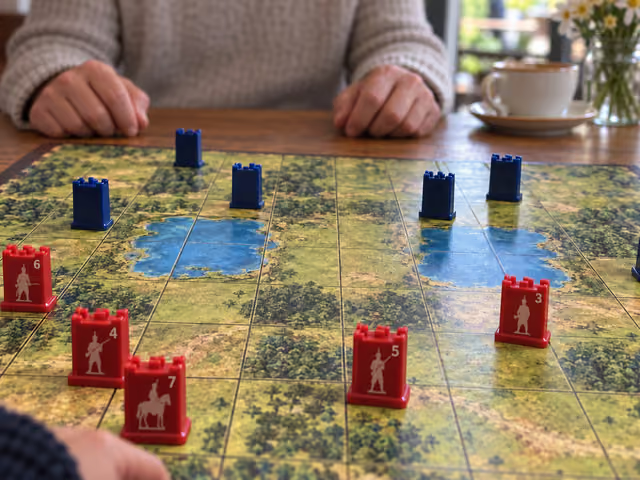
Choose colors fairly. Place the screen across the center of the ten-by-ten board. Each player puts all forty pieces on the four rows nearest them, one per square, with rank faces toward themselves and plain backs toward the opponent. Arrange them freely; there is no required Flag square. Leave the two middle rows empty. The two lakes each cover four squares and are always impassable. Remove the screen only when both formations are finished. Red takes the first turn.
Move, reveal and resolve one fight
Take the first move
Red takes the first legal move or attack using the movement rules below. Blue then takes a turn.
Move straight
Most pieces move one square forward, backward, left or right. Never move diagonally, enter a lake, cross a lake, jump a piece or end on your own piece. Flags and Bombs stay on their original squares for the whole game. A Scout (2) may instead travel any distance through consecutive empty squares in one straight direction; it may also move just one square to conceal its identity.
Commit to an attack
Choose an enemy in an adjacent land square, tap it with your attacking piece and announce your rank. The defender announces theirs too. A Scout can attack the first enemy reached along a clear straight line on the same turn; it cannot turn, jump intervening pieces or cross water. Attacking is optional when another legal move exists. Once made, a move or attack cannot be taken back.
Compare the ranks
The higher number wins ordinary combat. Remove the loser. A winning attacker occupies the defender's square; a winning defender stays where it was. Equal ranks remove both pieces, leaving both squares empty. Show removed pieces in the side trays where both players can inspect them. Turn a surviving piece back toward its owner; remembering its revealed identity is part of the game.
Use the exceptions
A Bomb defeats every attacker except a Miner (3), and remains in place after doing so. A Miner removes the Bomb and occupies its square. The Spy (1) defeats the Marshal (10) only when the Spy attacks; a Marshal attacking a Spy wins. Against other ranks the Spy is the lowest rank; two Spies remove each other. Any movable piece can capture the Flag, immediately winning.
Prevent repetitive movement
The same piece may cross back and forth between the same two squares at most three times in succession: A to B, B to A, A to B. A fourth crossing is forbidden. If both players repeat this pattern, the one who began must stop first. Continuing to chase the same fleeing enemy or enemies around more than two squares is also prohibited; the pursuer must break off with a different legal move.
Finish the game
You win immediately by capturing the enemy Flag, or when the opponent cannot make any legal move on their turn, whether all their movable pieces are gone or blocked. There are no capture points and no rank-value tiebreak. Losing all Miners does not itself lose or draw the game: eliminating or trapping the opponent's remaining movable pieces can still win. If both players agree a finish is unreachable, this guide suggests declaring a house draw and starting a fresh game; that agreement is not an automatic rule or a claim of tournament adjudication.
Teach the surprises before the first fight
Before hiding the armies, use pieces from the set to demonstrate four fights: Captain 6 beats Lieutenant 5; equal Captains both leave; a Miner removes a Bomb; and a Spy attacking a Marshal wins while the reverse attack loses. Reset those pieces into the complete inventory before setup. This is an unscored explanation, not a separate game.
Keep some Scouts and Miners available instead of spending them all immediately. Protecting the Flag with Bombs can help, but a formation must leave routes for your own army to reach the three passages around the lakes. Players in community discussions describe getting their Miners stuck behind their own pieces; consider their escape routes during setup. These are suggestions, not compulsory formations or a guaranteed winning strategy.
For disputes, identify the attacker first, then compare the printed rank chart and the three special piece rules. A distant Scout attack is allowed here; a Spy does not win when attacked by the Marshal. Do not import remembered numbers or powers from another edition. Stop an illegal move before combat and choose a legal one. If a bumped piece's original square is known, restore it; if the board cannot be reconstructed or hidden identities are widely exposed, this guide suggests a house restart without a winner. Never rearrange an army after the screen comes down.
Observers should avoid reactions or advice that reveal a hidden rank. If reading small symbols or remembering combat reveals is difficult, discuss a suitable adaptation before setup; being seated does not guarantee that the set meets someone's access needs. After the game, reveal the surviving armies and discuss one turning point before resetting.
Already know the game?
Ideas & Twists
Choose a variation together before you start.
Stratego · See main rules
Official option in the 19496 rulebookNine-piece training mission
Use only 1 Flag, 1 Marshal, 2 Miners, 2 Scouts, 2 Bombs and 1 Spy per player: nine pieces total. Secretly place them anywhere within your own four starting rows; all other pieces stay out. Red still starts. Movement, rank comparisons, special captures, repetition limits and the Flag-or-no-legal-move finish remain the same. This reduces the pieces to track; it is not the main forty-piece format or the different Travel booklet's ten-piece Duel inventory.
Stratego · See main rules
House learning optionLeave surviving ranks visible
After any combat, keep each surviving combatant's rank visible to both players for the rest of the game: lay it face-up within its square. A Scout that makes a long move also becomes face-up. Undiscovered pieces remain upright and hidden; face-up pieces cannot become hidden again. All movement, capture exceptions, forty-piece setup, repetition limits and winning conditions remain unchanged. This reduces memory demands while retaining the uncertainty of untouched pieces.
Stratego · See main rules
House two-game formatSwap-color return match
Play two full forty-piece games. Swap colors after game one, clear the board and build entirely new secret formations; each player therefore gets one red-first game. Award one match point for a win and half a point each for a mutually agreed house draw. The higher total wins the match; equal totals are a tied match, with no piece-count tiebreak. Each individual game uses the main movement, combat and finish rules.
About this guide
Main rules and the training inventory follow the English pages of Jumbo's currently linked Original 19496 booklet. Jumbo's Travel booklet explicitly shares the Original movement/combat rules and clarifies the two-square and chasing limits; its different ten-piece Duel inventory is not used. Visible surviving ranks, the return-match scoring, agreed draws and accident remedies are house suggestions. No tournament clock, repetition-draw count or rules from Pirates, Spotter editions or battle-card formats are imported.
Ready for something different?
Find another game →