

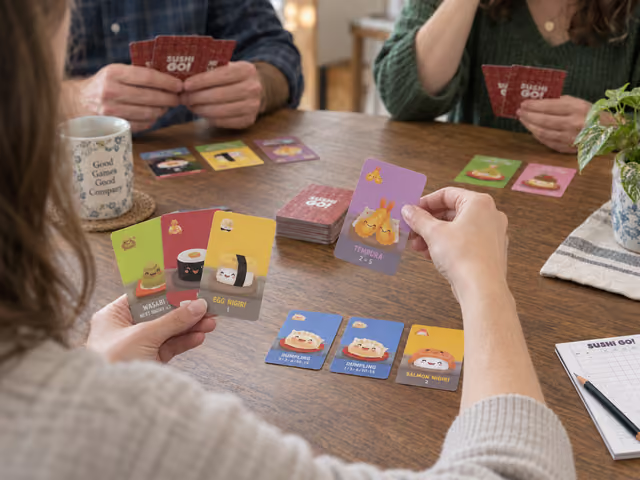
The quick version
Deal 10 cards each for two players, 9 for three, 8 for four or 7 for five. Pick one secretly, reveal together and pass the rest left. Keep collecting until the hands are empty. Score the round, keep puddings and discard everything else. Play three rounds, then score puddings. Highest total wins; most puddings breaks a points tie.
Saved on this device only — clearing your browser's cache or site data removes them (no account backup).
Check the deck and deal
Use the original 108-card deck: 14 tempura, 14 sashimi, 14 dumplings; 6 one-icon, 12 two-icon and 8 three-icon maki cards; 10 salmon, 5 squid and 5 egg nigiri; 10 puddings, 6 wasabi and 4 chopsticks. Keep the printed rules nearby. Do not add Party! cards or promotional cards to this format.
Seat two to five people around a table with room for each person's face-up collection. Make a score sheet with a column for each player, three round rows and a final pudding adjustment. Choose a scorekeeper. Shuffle all 108 cards. Deal everyone a private hand: 10 each at two players, 9 at three, 8 at four or 7 at five. Leave the undealt cards face-down in the center for later rounds.
Explain each dish's score before the first choice, particularly incomplete sets and pudding's delayed scoring. For a demonstration, show a tempura pair and a wasabi with one nigiri, then return those cards and reshuffle before the real deal. No starting player is needed: everyone chooses simultaneously.
Pick, reveal and pass
Make the first choice
Look at your hand and put any one card face-down in front of you. Wait until everyone has chosen, then reveal together. Leave that card in your own collection, grouping matching dishes so the table can see what you are collecting.
Pass the remaining hand
Pass all cards still in your hand face-down to the person on your left. Receive the hand from your right and choose again. Do not draw extra cards from the center during a round. Your face-up collection stays with you; only the remaining hand travels.
Use wasabi in order
An empty wasabi must take the next nigiri you play, tripling that nigiri's value. Put the nigiri on it to show the pairing. Each wasabi holds just one nigiri. A later wasabi cannot multiply a nigiri already collected, and two wasabi do not multiply one nigiri twice.
Trade chopsticks for a second choice
A chopsticks card already in your collection may be used on a later turn when your hand has at least two cards. Choose your usual card, call Sushi Go! before anyone reveals, and choose one more card from that same hand. Reveal both with everyone else's choices, then return the used chopsticks to the remaining hand before passing it left. Use at most one chopsticks card per turn; a chopsticks card taken this turn cannot be used immediately.
Finish the hand
Repeat until the final one-card hand arrives. That last card goes straight into your collection; you cannot skip it or use chopsticks to take an unavailable second card. Once every hand is empty, score everyone's collection before clearing it.
In this guide, either chopsticks pick may be any card type. If the two picks are wasabi and nigiri, resolve wasabi first so that nigiri can use it. This explicit table clarification follows community explanations; the selected English booklet does not spell out this same-turn ordering. Declare it before playing.
Score the dishes after each round
- Tempura: 5 points for each complete pair. Three cards score 5; four score 10. A leftover single scores zero.
- Sashimi: 10 points for each complete group of three. One or two score zero; four or five score 10; six score 20.
- Dumplings: the whole pile scores 1, 3, 6, 10 or 15 for one, two, three, four or five-or-more cards. Five score 15 total, not the sum of every earlier value.
- Nigiri: egg scores 1, salmon 2 and squid 3. A nigiri paired with wasabi scores 3, 6 or 9 instead. Unfilled wasabi and unused chopsticks score zero.
- Maki: count the small roll icons across your maki cards, not the number of cards. Most icons earns 6 points; second-most earns 3. A tie for most splits 6 equally, dropping any remainder, and cancels the second-place award. With one leader, tied runners-up split 3 equally and drop the remainder. For example, icon totals of 5, 3, 3 and 2 award 6, 1, 1 and 0 points.
- Pudding: score nothing yet. Keep every pudding for the end of round three.
Zero-maki table clarification: require at least one maki icon to receive a maki award. If only one person has maki, only that person scores 6; if nobody has any, award nothing. The English rulebook omits this edge case; this declared clarification follows the linked community discussion of other editions.
Announce and record each person's round total. Keep their puddings face-up in a separate area; discard all other collected cards beside the deck. Deal new hands of the same size from the remaining undealt deck for rounds two and three. Do not shuffle the discards back in. Continue passing left in all three rounds unless you chose the Pass both ways variation before starting.
Score dessert and find the winner
After recording the third round, compare the puddings collected across all three rounds. Most puddings earns 6 points. Fewest puddings loses 6 points, including players with zero. Tied leaders split the 6-point award equally; tied last-place players split the 6-point loss equally. Drop fractional remainders: four tied for fewest lose 1 each. If everyone has the same pudding count, nobody gains or loses pudding points.
With two players, nobody loses points for fewest puddings. Only the most-puddings award applies, and equal pudding counts still score nothing. Add the dessert adjustment to the three round totals. Highest final total wins; among tied players, most puddings wins. If both points and puddings remain equal, declare shared winners as this guide's suggested house resolution; the booklet gives no further tiebreak.
Ignore any undealt cards. For another game, gather all 108 cards, reset scores and shuffle the complete deck again.
Keep the table moving and settle close calls
Show how passing works with one unscored choice before starting. Keep the scoring section visible and total one player's cards aloud the first time. A four-player example collection of two tempura, three sashimi, two dumplings and one squid nigiri scores 21 before any maki award; puddings wait for the final adjustment. Players can inspect everyone's revealed collections, so remind them to look beyond their own hand.
Wait for every face-down choice before revealing. Do not choose a second chopsticks card after seeing other people's new cards; the original game's choice happens before reveal. The chopsticks return to the hand being passed, not the discard pile. If the final card is chopsticks, keep it and score zero. Incomplete tempura and sashimi do not carry into the next round; only pudding does.
Agree totals before discarding. For an accidental early reveal or wrong-way pass, this friendly house remedy pauses play, restores the identifiable hands and choices, and resumes without a point penalty. If the current turn cannot be reconstructed, the table agrees how to continue before another choice; do not invent a supposedly official penalty. Check the booklet for a disputed mechanic and distinguish any agreed house change from the base rules.
Two-player play here is the ordinary two-person, ten-card-hand game. The booklet's separate dummy-player variant is optional and is not being silently used. A sixth person needs another table or a different edition, rather than an extra hand from this guide's deck.
Already know the game?
Ideas & Twists
Choose a variation together before you start.
Sushi Go! · See main rules
Official Gamewright variationPass both ways
Pass left in rounds one and three, but right in round two. Keep the same hands, three-round scoring and finish. Announce the change before dealing round two so everyone knows who will receive their remaining cards; you now draft from a different neighbor.
Sushi Go! · See main rules
Suggested house variationOpen-hand learning game
For a learning game, keep each current hand face-up in front of its holder, separate from their collected dishes. Everyone still commits a choice face-down, reveals together and passes the entire remaining hand. Allow discussion before commitments, then use all normal scoring and the three-round finish. This removes hidden-hand information and lets the group explain combinations together. Restore private hands for the next game.
About this guide
Original Gamewright 108-card edition, stock #249; the linked rulebook carries a 2014 copyright. Official mechanics are paraphrased. Zero-maki eligibility and chopsticks same-turn ordering are declared table clarifications informed by community discussion, not claimed as explicit text in that booklet. Shared winners after both tiebreak criteria, error recovery and the open-hand variation are house suggestions. Pass both ways is in the official rulebook. Community posts identify teaching questions, not measured demand.
Ready for something different?
Find another game →