

The quick version
Alternate four pucks per side. After all eight stop, only pucks farther down the board than the opponent's farthest puck score: 1, 2 or 3 by zone, or 4 for an end hanger. The scoring side opens the next frame; on a blank frame, the previous last-shooting side opens. First to 15 or more after a full frame wins.
Saved on this device only — clearing your browser's cache or site data removes them (no account backup).
Prepare the table and place the players
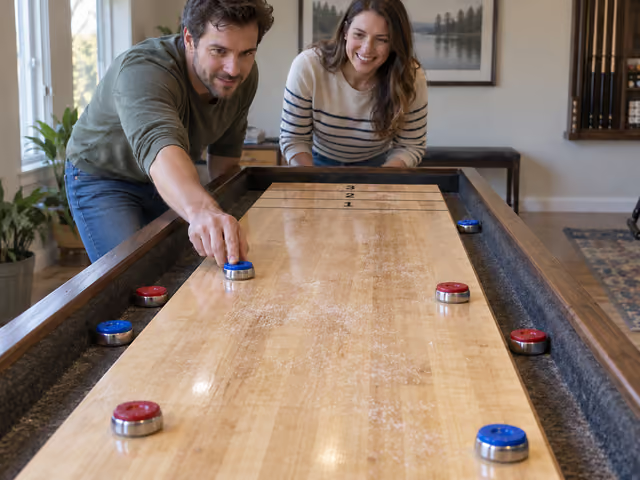
Use a stable, level shuffleboard table with a wooden playing surface, surrounding gutter, and marked 1, 2 and 3 scoring areas at both ends. Have four matching weighted pucks per color. A floor court, cues, air-hockey table or curling-style target board is a different setup. Check the table's instructions before using powder or changing its markings.
Have the table owner or venue prepare the surface with its approved shuffleboard speed powder, often called wax. Clear old loose powder and distribute a fresh light coating as the table's care instructions require. Keep drinks and loose items off the surface. Leave space at both ends to shoot and a clear path around the table. Use its scoreboard or write totals on paper.
Point out the foul line nearest the shooter: on a two-foul-line table, use the near line, not the far one. On a shorter table with one center foul line, that is the line to clear in either direction. A puck must pass this line completely to remain in play. If the table's scoring layout or foul line is unclear, resolve it with the table owner before starting; this guide does not assign new zones to an unmarked or multi-game table.
For singles, both opponents start at the same end and move to the other end after each frame. For doubles, place one member of each team at each end. Partners stay at opposite ends throughout the game: the two players at one end shoot one frame, then their partners shoot back. Each team still has four pucks, not four per person in the same frame.
Let everyone try a few unscored slides to learn the table speed, then clear all practice pucks. Set both totals to zero. Say the finish aloud: 15 or more after eight shots, with no exact-score reset or two-point margin. Flip a coin; its winner chooses either puck color or the hammer, meaning the last shot of the frame. The other side chooses the remaining option. Identify the opening shooter before the first puck moves.
Slide, score, and play back
Send the first puck
The side without the hammer shoots first. Slide one puck by hand along the surface toward the far end; do not toss it. For the legal delivery used here, start with both feet behind the shooting-end 2-point line, keep one foot on the floor behind that line, and release before the near foul line. Do not touch the puck again after release. Wait for pucks to stop and step aside so the opponent can shoot.
Alternate until all eight are used
Each shooter sends one puck, then the opponent sends one, until each has used four. You may hit either color to remove an opponent, move your own puck farther, or leave a blocker. Final positions decide points. A puck in the gutter is out for this frame even if it rebounds onto the surface; remove it once motion stops. A puck that stops without fully clearing the near foul line is also removed and uses its shot.
Find which pucks can score
After the eighth shot stops, compare pucks from the scoring end. Only the color with a puck farthest down the table can score. Add that color's pucks that are strictly farther ahead than the opponent's farthest remaining puck. Do not subtract the opponent's total. If only one color remains, count all its legal pucks. If none remain, both sides score zero.
Give each scoring puck its value
A legal puck before or touching the 2-point line is 1. Completely beyond the 2-point line but not completely beyond the 3-point line is 2. Completely beyond the 3-point line is 3. Still supported by the table but overhanging its far end is 4. A side overhang alone gets no hanger bonus. Look directly down from above for a line call: the whole puck must clear the line for the higher value.
Record, reverse, and finish
Agree on the frame score before moving pucks and add it to the running total. The scoring side opens the next frame, giving the other side the hammer. After any zero-score frame, switch the hammer: the previous last-shooting side now opens. Collect all eight pucks and play back from the opposite end. Stop when a side has 15 or more after a complete frame; an apparent winning puck can still be knocked off before that frame ends.
From farthest to nearest, suppose the pucks are red in 3, red in 2, blue in 2, then red in 1. Red scores 5. The red 1 is behind the leading blue, so it contributes nothing. Blue scores zero, rather than subtracting its 2 from red's 5.
Resolve close calls before clearing the board
Show one gentle placement shot and one controlled knock-off before the first frame. Suggest choosing a target before sliding rather than trying to force a hanger every time. Keep hands out of moving-puck paths, wait before retrieving weights, and avoid leaning on, striking or shaking the table.
For a close lead, compare the pucks' farthest edges against the end of the board, using the venue's straightedge or T-square if available without moving anything. A true dead heat between opposing pucks scores neither tied puck; only pucks strictly ahead of that tie can count. If the two leading pucks are tied, the frame scores zero and the hammer switches. Equal running totals below 15 simply mean play another frame. Since only one side scores each frame, the main game has no simultaneous winning-score tie.
For an end hanger, inspect from the side of the scoring edge. Ask the table owner to demonstrate a non-disturbing edge check if the overhang is uncertain. Never nudge a puck to settle a call. House agreement for this friendly format: if both sides cannot confirm a line or hanger bonus, use the lower value; if they cannot distinguish opposing puck depths, treat that pair as a dead heat.
House remedies: an illegal delivery uses the shot for zero; remove its puck and restore any displaced pucks to agreed prior positions. An out-of-turn shot is taken back and replayed in order, restoring displaced pucks first. Restore a settled puck accidentally bumped by a person or shaken off the table. If the prior positions cannot be agreed, replay the entire frame with running totals unchanged and the same opener. These replace formal officiating and penalty procedures; there is no extra point fine. Use no shot clock in this recreational game. Replenish dry spots only by mutual agreement and according to the table's care instructions.
Extra friends rotate into the next game; three or five active players are not this singles/doubles format. Reset scores and choose the next game's hammer and colors by a new coin flip. Leave the table and supplied weights as the venue or owner requests.
Already know the game?
Ideas & Twists
Choose a variation together before you start.
Table shuffleboard · See main rules
Manufacturer-supported alternativeDoubles to 21
With four people, replace the 15-point target with 21 or more. Keep four pucks per team, opposite-end partners, normal scoring and switch-hammer play. Finish only after all eight shots of the winning frame; going past 21 is allowed. Agree on the longer target before starting.
Table shuffleboard · See main rules
Suggested house variationFour-frame match
Replace the target score with exactly four complete frames, two shot from each end. Keep ordinary puck scoring and hammer changes, and record a frame count alongside totals. Higher total after frame four wins. If tied, play two more full frames, one from each end, then compare totals again; repeat pairs only while tied. This fixes the opening match length in frames, not minutes.
Table shuffleboard · See main rules
Suggested house variationPlacement practice
Replace Knock Off with a two-frame accuracy game, one frame from each end. Take turns shooting one puck at a time on an empty board, record its ordinary 0-to-4 value when it stops, then remove it before the next shot. Each side shoots four per frame. In doubles, the opposite-end partners shoot the second frame. Add every shot rather than comparing leading pucks; the higher total after two frames wins. If tied, repeat two frames and add the new points. Removing every puck takes knock-offs and blockers out of play so the focus is table speed.
About this guide
Reviewed October 2, 2026. This recreational adaptation selects McClure's 15-point Knock Off option for singles and doubles. Federation 2024 sections 6, 7 and 9 clarify delivery, short-line removal, scoring, dead heats and hammer changes. Introductory manufacturer sources vary on the target and foul-line wording. The no-clock format, demonstration, conservative uncertain-call agreement and restoration/replay remedies are explicit house choices; full tournament procedure is not reproduced. Variations are labeled individually.
Ready for something different?
Find another game →