

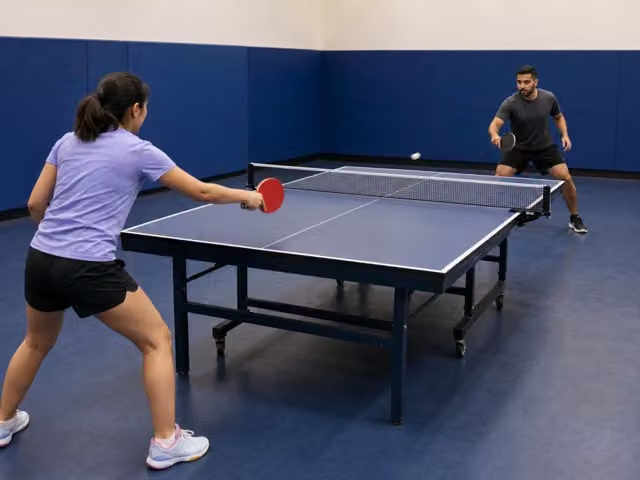
The quick version
Win two games to 11, leading by two. Each rally earns a point. Serve twice each, then once each from 10–10. Toss a visible ball at least 16 cm from an open palm; strike it falling.
Saved on this device only — clearing your browser's cache or site data removes them (no account backup).
Prepare and choose the finish
Use the whole tabletop with a fixed net. The centerline does not limit singles play. Leave room to move; keep spare balls off the table and floor.
Toss a coin. The winner chooses first serve/receive or an end; the opponent gets the remaining choice. Play best of three games to 11, win by two, with no cap at 10–10. Call the server's score first.
Serve, return and finish
Show the ball
Rest it freely on your stationary open palm, behind the table's end line and above tabletop height. Toss near vertically without adding spin, at least 16 cm upward. Keep it visible to the receiver and move your free arm out of the space between ball and net. Strike the falling ball; you cannot serve directly from your hand.
Bounce on both halves
The serve first touches your half, then the opponent's. In singles it may land anywhere on either half. A serve brushing the net and otherwise landing correctly is a let: replay it with no score and without using up that serve. A failed serve gives the opponent a point; there is no second attempt after a fault.
Return onto their half
Let each incoming ball bounce on your side, then hit before the second bounce. Your return must land directly on their half, possibly after brushing the net; it must not bounce on your own half first. Do not volley a ball still above or traveling toward the table. A ball clearly past the end and heading away without touching your half is already a missed return.
Award one point
The opponent scores if you fail to make a legal serve or return, let the ball bounce twice, deliberately strike twice, obstruct it, move the table, touch the net, or place your free hand on the tabletop during play. A ball clipping the top edge is in; a ball hitting only the vertical side is out.
Switch the server
Serve for two completed points, regardless of who wins them, then let your opponent serve two. At 10–10, alternate one serve each for the rest of that game. Lets do not count toward these blocks. Continue until someone has at least 11 and leads by two.
Reset between games
Change ends, reset to zero, and give first serve to the player who received first in the previous game. In game three, also change ends as soon as someone reaches five; keep the score and next server unchanged. First player to win two games wins the match.
Settle the common mix-ups
Practice serves with a partner checking height and visibility. Stop and replay for outside interference. Agree to replay unresolved edge/side calls as a consistent house dispute rule.
Serve blocks follow points played, not won: at 2–0 the opening server's block is over.
Already know the game?
Ideas & Twists
Choose a variation together before you start.
Table tennis · See main rules
Official doubles rules in a suggested best-of-three formatDoubles match
Use two pairs. Serve from your right half to their right half; the centerline counts as right. Choose A serving to C for game one. Each rally follows A, C, B, D, repeating; partners alternate hits. After two points change server/receiver: C to B, B to D, D to A, A to C. From 10–10 each pairing serves once. Next game, the other pair chooses its first server; the first receiver is the opponent who served to that player in the previous game. In deciding game three, change ends when a pair reaches five and reverse the receiving pair's order. Retain 11, win by two; two game wins finish the match.
Table tennis · See main rules
Suggested practice variationCooperative rally record
Use legal singles serves and returns but count successful shots together: serve one, return two, and so on. A miss resets the count; alternate server for each fresh attempt. Take ten attempts and record the longest rally. An agreed target, such as twenty, can finish the challenge early.
About this guide
Uses ITTF 2026 singles and doubles laws in a best-of-three match. Cooperative counting and unresolved-call replays are house suggestions. Formal officiating, expedite and adaptive provisions are in the full rules.
Ready for something different?
Find another game →