

The quick version
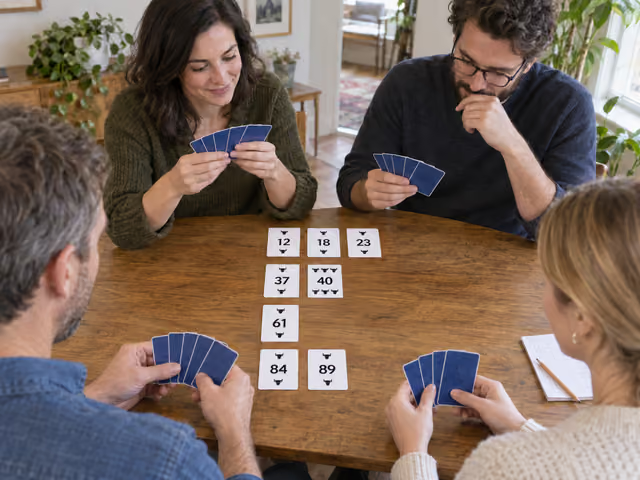
Deal ten cards each and start four rows with one face-up card apiece. Everyone chooses one card face-down and reveals together. Resolve the revealed cards from lowest number to highest: add yours after the closest lower row end. If that row already has five cards, take those five and restart it with yours. If yours is lower than every row end, take any one row and restart it. After ten turns, add the bullheads you collected to your score. In this Take 5 edition, finish after a round when someone has more than 66 points; lowest total wins.
Saved on this device only — clearing your browser's cache or site data removes them (no account backup).
Deal ten cards and leave room for four rows
This guide uses the basic Take 5 game in AMIGO's U.S. 2018 Take 5 / Take a Number package, item 18415, booklet V1-0818. Use its 104-card Take 5 deck, numbered 1–104. The separate Take a Number game uses a different deck and row cards; leave those out. A normal 52-card playing deck cannot supply this game. The related 6 nimmt! edition has a slightly different printed stopping threshold; see the finish section.
Seat 2–10 players where everyone can read the cards. Shuffle all 104 cards and deal ten to each player. Keep hands private; sorting them numerically can help. Deal four more cards face-up in a vertical column at the center of the table. Each starts a separate horizontal row that grows to the right. Leave space for five cards in every row. Set the unused deck aside: nobody draws from it during the round. At ten players, all 104 cards are in use.
Give each player a separate space for a face-down penalty pile and write their name on the score sheet, starting at zero. Before dealing, agree to the edition's more-than-66 finish and this guide's shared-win agreement for tied lowest scores. There is no dealer advantage or fixed first player during ordinary turns: the revealed numbers determine resolution order each time.
Choose together, then resolve one card at a time
Choose and reveal
Each player chooses exactly one card from their hand and puts it face-down in front of them. Wait until everyone has chosen, then turn all chosen cards face-up together. Do not place any into the rows yet. Nobody changes their choice after the reveal.
Find the only legal row
Resolve the revealed cards in ascending numerical order, lowest first. When yours comes up, look at the current rightmost card of each row. Among the row ends lower than your card, use the highest one: it is the closest lower number. Add your card to that row's right end if it has fewer than five cards. You cannot choose a cheaper row or insert a card into the middle. For row ends 23, 40, 61 and 89, a 65 must follow 61, not 40.
Take five when the row is full
If your required row already holds five cards, take all five into your face-down penalty pile. Put your played card in the cleared row's starting position. It is the new first card, not part of the penalty you just collected. Never put collected cards back in your hand.
Choose a row only when your number is too low
If your card is lower than all four current row ends, it fits nowhere. Choose any one complete row, take all its cards into your penalty pile, and start that row again with your played card. Compare the bullheads in the rows, not just how many cards they hold. This is the only ordinary situation in which you choose which row to take.
Finish the reveal before choosing again
Continue upward through every revealed card, using the rows as they now stand after each earlier placement or capture. A row cleared by an earlier low card can change where a later card must go. Once everyone's card is placed, choose again from your remaining hand and reveal together. Repeat for ten turns, until all hands are empty. No one is eliminated for collecting points.
Suppose a row contains 12, 18, 23 and its end is 23; the other rows end at 40, 61 and 89. The group reveals 24, 25, 26 and 90. Resolve 24, then 25: the first row now has five cards. The 26 takes those five and becomes that row's new first card. The 90 then follows 89. Being safe at selection time does not guarantee a safe placement.
Count bullheads, then check the finish
After the tenth turn is completely resolved, count the printed bullhead value of every card in your own penalty pile. Do not score the cards left in the four shared rows. Most cards are worth one point. Numbers ending in 5 are worth two, multiples of 10 are worth three, and double-digit repeats such as 11 or 44 are worth five. The exception 55 is worth seven. Count the value once per card: mirrored bullhead markings at the opposite edge do not double it. For example, collected cards 12, 25, 40 and 55 total 1 + 2 + 3 + 7 = 13 points.
Add each round's points to that player's running total. The 2018 U.S. Take 5 booklet stops when someone has more than 66 points. A total of exactly 66 alone does not end this version. Check only after the whole round, so everyone has played all ten cards. The player with the lowest cumulative total wins; reaching the threshold triggers the finish, not victory. This guide's table agreement is to share victory if players tie for the lowest total. The U.S. booklet does not specify a tie-break; AMIGO's English 6 nimmt! rules explicitly share ties.
If nobody exceeds 66, gather every card: all penalty piles, four remaining rows and the unused deck. Shuffle the full 104-card deck, deal fresh ten-card hands and four new row starters, and keep the running scores. If you use AMIGO's English 6 nimmt! version 2.10 instead, its printed finish is 66 or more. Decide which edition's threshold you are using before the first deal.
Help the table follow the moving rows
On the first reveal, have one person call the numbers from lowest to highest while each owner places their own card. Keep unprocessed cards in front of their owners so a card cannot get lost or resolved twice. Explain one row at a time: first check the closest lower end, then check its length. Five cards remain safely in a row; the next card collects them. Colors are not placement rules, and a low card means lower than all four row ends.
For a mistaken placement caught before the next selection, this guide suggests a house remedy: reconstruct that reveal's rows and penalties, then resolve the same chosen cards correctly from lowest to highest. Nobody changes their card. If reconstruction is impossible, agree to abandon that round, restore the scores from its start and reshuffle; do not invent a penalty for the learner. For an early reveal that gives someone an unfair look, agree to abandon and redeal the round with scores unchanged. These are host remedies, not published penalties.
A useful decision is to compare a predictable small penalty with a crowded row that could become expensive. A very low card can deliberately buy a cheap row; a card just above a row end can leave fewer intervening numbers for others to play. Neither is a guaranteed safe strategy: someone may clear the row before your card resolves. Talk through surprises after the reveal rather than telling players what hidden card to choose.
The two-player basic game is legal, but produces fewer simultaneous collisions than a larger table. Community players disagree about which count they enjoy most; try the official drafted variation if a smaller group wants more known information. Do not add random extra players or Take a Number mechanics to the basic game. Check that everyone can see the numbers and hold or privately arrange their hand; seated play is not a blanket accessibility promise.
Already know the game?
Ideas & Twists
Choose a variation together before you start.
Take 5 · See main rules
Publisher-permitted finish; three rounds is a house choiceThree-round match
Agree before dealing to play exactly three complete ten-turn rounds instead of using the more-than-66 threshold. Keep the full 104-card deck, normal private ten-card hands, four rows and all placement rules. Record cumulative bullheads and reshuffle all cards between rounds. Even if someone exceeds 66 early, play through round three; then the lowest total wins, sharing victory on a tie under this guide's table agreement. The publisher permits a fixed-round finish; the choice of three gives your gathering a known number of deals, not a promised minute limit.
Take 5 · See main rules
Official advanced option for 2–6 playersDraft the low-number deck
Use only cards 1 through (10 × number of players + 4): 1–24 for two, 1–34 for three, 1–44 for four, 1–54 for five, or 1–64 for six. Put those cards face-up. The youngest player picks one card first; continue clockwise, one card per person per pass, until everyone has ten. Clockwise order is this guide's table clarification of the booklet's instruction to take turns. Keep chosen hands private once picked. The four unchosen cards start the four rows; the higher-numbered cards remain out. Play the usual ten simultaneous selections and ascending resolutions, score printed bullheads, and repeat this draft setup each round. The main edition's more-than-66 finish and shared-win agreement still apply. This changes what cards can exist and lets players choose their own hand; it is not for seven to ten players.
Take 5 · See main rules
House teaching formatOpen-table learning round
Deal a normal full-deck round, but let everyone lay their ten-card hand face-up in front of them. Choose a starting seat; on each turn that seat, then the others clockwise, selects one card openly after discussing possible placements. Keep selected cards separate from the rows until all have chosen, then resolve those cards from lowest to highest with the usual full-row and low-card rules. Move the starting seat one place clockwise on the next turn. Keep penalty piles and count their bullheads to understand consequences, but award no winner and do not add these practice points to a match. Finish after all ten turns; gather all 104 cards, reshuffle and reset every score to zero before starting normal private-hand play. This changes hand visibility and selection order for teaching; the row mechanics stay intact.
About this guide
Main format: AMIGO's U.S. 2018 Take 5, item 18415 V1-0818, 104-card basic game, from pages 1–8 of the publisher-authored booklet preserved by a PDF mirror. Pages 9–16 describe Take a Number and are excluded. The original Take 5 text says more than 66; AMIGO English 6 nimmt! v2.10 says 66 or more and explicitly shares tied victories. Shared ties, clockwise draft order, correction/redeal remedies and open-table teaching are declared table agreements or house suggestions. Bullhead values are cross-checked against the accessible manufacturer rulebook. No minute duration, best-player-count claim, current purchase availability or online rating promise is imported.
Ready for something different?
Find another game →