

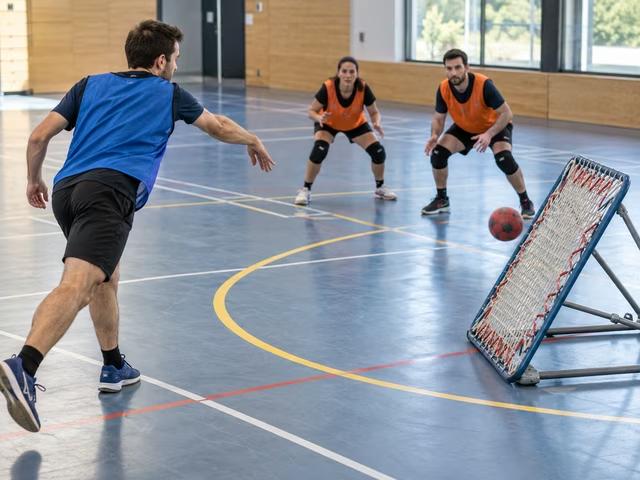
The quick version
Pass up to three times, holding for at most three seconds, then throw at either frame. Score when the rebound lands on the court outside the forbidden semicircle before defenders catch it. A clean catch gives that team possession. Play two eight-minute halves; most points wins.
Saved on this device only — clearing your browser's cache or site data removes them (no account backup).
Get the game ready
Ask a tchoukball instructor to set two secured frames at opposite ends of a clear court, with a 3 m forbidden semicircle around each. For this four-a-side house game, use a 20 m by 12 m marked court only if the instructor approves the hall and run-off. Use equipment designed for tchoukball, not a loose garden rebounder.
Divide eight adults into two teams with bibs. Nobody enters either semicircle during live play. In this introduction, catch, stop and pivot without further steps; take all shots with feet on the floor outside the forbidden zone. Toss for the first end-line restart. The instructor records score, pass count and consecutive shots at each frame.
Play the first game
Pass without interception
Start behind an end line by passing to a teammate. Defenders give the passing lane and shooter space: no blocking, tackling or interceptions. Keep the ball no more than three seconds and make no more than three passes before a shot. The restart pass does not count.
Choose a frame
Throw at either rebound net while staying outside its forbidden zone. Across both teams combined, only three consecutive shots may use the same frame; the next must use the other. A missed frame still counts as a shot toward it for this house rule.
Catch or concede
A normal net rebound landing in court outside the forbidden zone scores one for the shooters. A defender’s clean catch in legal court prevents the point and starts their possession. If a defender touches but fails to control that rebound, the shooters still score one when it lands, even out of court or in the forbidden zone. By contrast, missing the frame or sending an untouched rebound out or into the forbidden zone gives opponents one. Do not catch your own team’s rebound. If the ball hits the frame’s metal edge or fittings and rebounds abnormally, the instructor gives defenders a floor-touch restart if they cannot control it; an untouched out or forbidden-zone landing still gives defenders one.
Restart clearly
After a point, the team that conceded it passes in from behind the end line nearest that frame; its possession must cross halfway before a shot. A dropped pass, too many passes, overtime holding or zone violation gives opponents possession at that place: touch the ball to the floor with both hands, then pass before shooting. Move a restart outside a forbidden zone if necessary.
Two eight-minute halves
Take a two-minute rest and switch initial ends and first possession for the second half. The clock runs during ordinary stoppages and pauses for safety or coaching. Most points at the final whistle wins; ties stand. A rebound must land before the whistle to score in this house version.
Help everyone get started
Show the difference between defending a rebound and blocking a throw before starting. Keep the first throws gentle and reachable. No diving or sliding in this introductory session; the instructor teaches those separately. People waiting for a pass must also leave space for defenders to reach the rebound.
Already know the game?
Ideas & Twists
Choose a variation together before you start.
Tchoukball · See main rules
Suggested house variationAlternate frames
After every shot, regardless of which team shot, the next shot must use the other frame. The referee announces the available end. All other main rules and the timed finish remain; moving the ball across the court becomes essential.
Tchoukball · See main rules
Suggested house variationTwo-player connection
Before each shot, at least two different teammates must have received a pass during the possession. A clean rebound catch begins the count at zero; the catcher does not count as a pass recipient until subsequently receiving a pass. Shooting too early gives a floor-touch restart to opponents.
Tchoukball · See main rules
Suggested house variationCatch-and-return rally
Remove opposing scores. Each clean defensive catch followed by a legal shot toward the other frame adds one to a shared chain. A scoring landing, out ball or fault ends the chain. Run ten chains, alternating first possession; record the longest. Keep the same movement and contact limits.
Tchoukball · See main rules
Suggested house variationCalled landing side
Divide the usable area beside each forbidden semicircle into left and right landing sides. Before releasing a shot, name left or right. An untouched rebound landing in legal court earns one only on the named side; the wrong side gives opponents a floor-touch restart without a point. Once a defender touches the rebound, use the main catch-or-failed-catch scoring regardless of its landing side. Ordinary missed-frame, untouched out-ball and faulty-rebound rules remain.
Tchoukball · See main rules
Suggested house variationOne-frame game
With the instructor, use one frame and the same forbidden zone, marking a reset line 8 m in front of it. After a defensive catch or restart, complete a pass with the ball beyond that line before attacking. Ignore the consecutive-frame limit. Play two teams of four for ten minutes; normal point rules apply and ties stand.
About this guide
Four-a-side court size, stationary possession, no jumping/diving, short halves and the exact restart simplifications are editorial house rules. Standard play allows more movement and normally uses seven per side. The five variations are original house formats, not claimed community rules.
Ready for something different?
Find another game →