

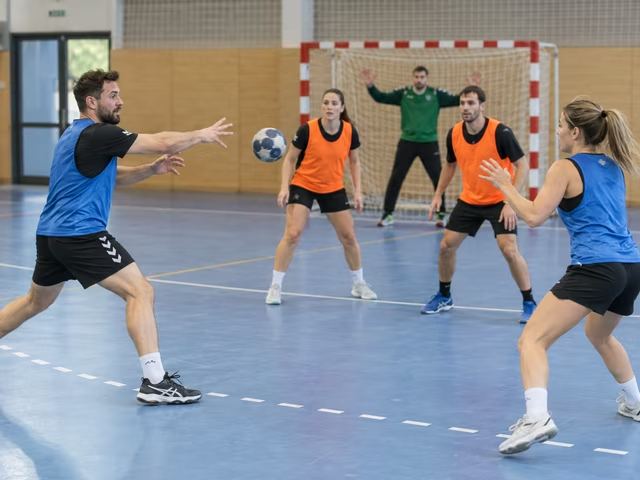
The quick version
Play two ten-minute halves. Carry the ball for at most three steps and three seconds, or dribble, then pass or shoot. Defenders intercept passes without touching players or taking a held ball. Score one when the whole ball crosses the goal line. Only the goalkeeper enters the 6 m area.
Saved on this device only — clearing your browser's cache or site data removes them (no account backup).
Get the game ready
Use a proper court with anchored goals, clear run-off and an instructor who can demonstrate the goal-area rule. Choose a soft ball everyone can grip; do not use resin unless the venue authorizes it. Divide ten adults into two teams of five and identify the goalkeepers with contrasting bibs.
This house match uses the venue’s marked handball court. Toss for first possession, start at halfway and agree to two ten-minute halves with a two-minute rest. The clock runs through ordinary stoppages; the referee pauses it for injury, unsafe conditions or a long explanation.
Play the first game
Start with a pass
Both teams begin in their own halves. The first team passes from halfway on the whistle, with opponents at least 3 m away. The passer keeps one foot planted until releasing. After a goal, the conceding team restarts the same way.
Move the ball
After catching, take up to three steps and hold no longer than three seconds. You may dribble repeatedly with one hand, then gather and again use up to three steps and three seconds. After gathering, pass or shoot; do not start dribbling again. Do not deliberately kick the ball.
Attack the goal
Shoot from outside the 6 m area. A jump shot must be released before landing inside; leave the area immediately without interfering. Defenders remain outside too. Goalkeepers may use their bodies inside their own area, but nobody charges a goalkeeper or shoots toward the head.
Restart faults and exits
For steps, time, double dribble or contact, give opponents a free pass at the fault, moved outside the 9 m line if necessary; defenders stand 3 m away. In this simplified match all fouls use that restart, with unsafe play stopped for coaching. A sideline exit gives the other team a throw-in. A ball over the end line off an attacker or goalkeeper becomes a goalkeeper throw; off another defender, opponents throw from the nearest corner. Keeper-area entries by attackers also give a goalkeeper throw.
Two ten-minute halves
Swap ends and starting possession after the break. The team with more goals at the final whistle wins; ties stand. A shot must cross the line before the whistle to count in this house format. Stop after the whistle and return the ball to the referee.
Help everyone get started
Demonstrate a legal dribble-gather-pass and one harmless goal-area violation before scoring begins. Give each willing player a chance in goal between halves; nobody must accept that role. The strict noncontact rule, short halves, simplified free-pass penalties and finish are house choices, so check that the instructor is happy to run them.
Already know the game?
Ideas & Twists
Choose a variation together before you start.
Team handball · See main rules
Suggested house variationPass-only attack
Remove dribbling for one match. The three-step and three-second limits remain. Dropping and re-catching your own ball is a turnover. Use the same goal count and timed finish; teammates must provide passing options instead of relying on a solo carry.
Team handball · See main rules
Suggested house variationThree receivers
A team must complete passes to three different teammates during its possession before shooting. The referee calls ready after the third distinct receiver. A shot taken too early gives opponents a free pass. Reset the count after a turnover or goal. Keep normal scoring and time.
Team handball · See main rules
Suggested house variationWing finish
Before the match, the coach marks a narrow wing shooting zone outside each end of the goal-area arc, clear of run-off. A goal released from either zone earns two; every other goal earns one. Normal jump and safety rules still apply. Keep two ten-minute halves and total the points.
Team handball · See main rules
Suggested house variationSupporting neutral
Use eleven adults. One identified neutral plays for whichever team has possession, may pass but cannot shoot or enter a goal area, and cannot immediately return the ball to the player who passed it to them. Change the neutral at halftime. Keep normal goals and time.
Team handball · See main rules
Suggested house variationNew scorer chain
After scoring, that player becomes a passer only until a teammate scores. A goal by the temporarily restricted player does not count and becomes a goalkeeper throw. Track one restricted scorer per team, replacing that name after every valid goal. Keep the timed match; attacks must find another finisher.
About this guide
The main game is a supervised five-a-side house introduction. It does not reproduce competition contact, disciplinary sanctions, passive-play procedure or seven-meter penalties. All five variations are editorial house formats.
Ready for something different?
Find another game →