

The quick version
Deal the 40 large cards. The player holding rocket 4 is commander and takes the single small task card drawn for Mission 1. After any permitted radio messages, the commander leads one card; everyone plays one clockwise, following its suit if possible. The highest rocket wins, or otherwise the highest card in the led suit. The commander must win the trick containing the exact color and number on their task. If they do, everyone succeeds; if someone else takes that card, everyone fails and redeals.
Saved on this device only — clearing your browser's cache or site data removes them (no account backup).
Prepare the crew and deal Mission 1
Use the English Thames & Kosmos/KOSMOS base edition The Crew: The Quest for Planet Nine, product 691868. Mission Deep Sea, Family Adventure and Journey to the Ends of the Earth have different mission systems. This guide uses the standard three-, four- or five-person game, not the separate official two-player procedure or advanced three-player deck reduction.
Seat everyone around a table with room for a central trick, a private hand, a public task card and a radio message in front of each player. Separate the 40 large playing cards from the 36 small task cards and the reminder cards. The large deck contains blue, green, pink and yellow cards numbered 1–9, plus black rockets numbered 1–4. The small task deck contains only the four colored suits, 1–9. Keep the logbook and pencil nearby; place the task-order tokens aside for later missions.
Shuffle all 40 large cards and deal them face down around the table. Four players receive ten each; five receive eight each. With three, one receives fourteen and the other two thirteen. That extra card stays unplayed after the thirteenth complete trick. Everyone looks at their own hand privately. Each player takes one radio token green side up and has one reminder card ready. Put the distress token inactive side up.
Open the logbook to Mission 1. Shuffle the small task deck and reveal exactly one small task card in the center. Whoever holds rocket 4 announces that fact, takes the commander marker and takes this sole task face up in front of them. They must capture the matching large card in a trick; they do not need to hold that card themselves. Everyone else helps. Mission 1 has no task-order tokens or extra special rule.
See how one trick completes a task
A trick is one face-up card from each player, not one player's turn. The first card sets the suit. If you have that suit, you must play it; if you have none, you may play any other color or a rocket. You never have to play your highest card or try to beat a teammate. Rockets are a fifth suit and trump the four colors: if a rocket leads, anyone holding a rocket must play one.
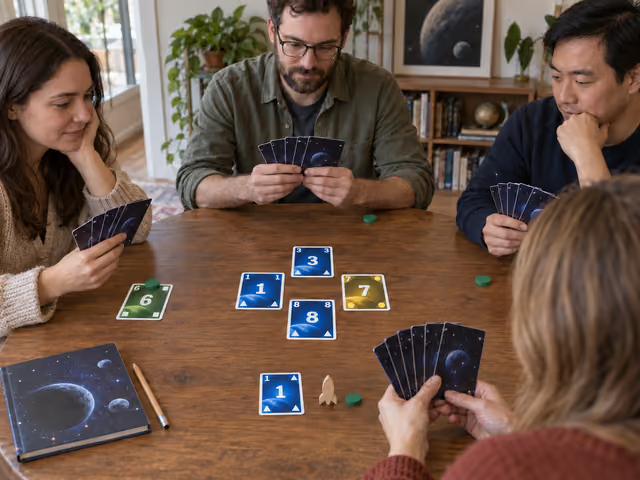
Before the real deal, show this four-person example with cards from the set. Give the demonstrator rocket 4 as the commander marker's explanation and put the small blue 1 task in front of them. Lay out blue 8 as their lead, then blue 3, blue 1 and yellow 7 clockwise. Explain that the yellow player has no blue cards; otherwise yellow 7 would be illegal. Blue 8 wins all four cards because blue was led and no rocket appeared. The commander has captured blue 1, so their task and Mission 1 are complete. Blue 1 did not have to win the trick.
Now explain the danger: if that blue-void yellow player had played rocket 2 instead, rocket 2 would win, taking blue 1 away from its assigned owner and failing the mission. They could only play that rocket because they had no blue cards. Gather every demonstration card back and shuffle the full deck before the real deal. These displayed cards are a teaching example, not a prescribed starting hand or a way to reveal a live hand. With three or five players, explain the same example first, then use exactly one card per actual player during play.
Send one legal radio message
Once task selection is finished, each player may communicate once per mission attempt, before any trick starts. Do not communicate after the first card of a trick has been played. You may use the message before the opening trick or save it for a later gap. It is optional. Outside this mechanism, do not tell, show, gesture or hint at information learned from your private hand. Asking how a rule works is allowed; saying 'I can take blue' or 'please lead green' based on your hand is not.
Choose one non-rocket card that is your highest, lowest or only card of its color at that moment. Put it face up in front of you. Place the green radio token at its top edge for highest, middle for only, or bottom for lowest. A card in the middle of several cards of one color cannot be communicated. When it is your only card of that color, use the middle position. Never communicate a rocket.
The displayed card still belongs to your hand and must be considered when following suit. Take a reminder card into your hand so you remember it. For example, if your green cards are 2 and 6, you may show green 6 as highest or green 2 as lowest. When you eventually play the displayed card, discard the reminder and turn your radio token red. Do not send another message. Leave the token's original position unchanged while the card is displayed, even if your hand later makes it your only card. A new mission attempt resets everyone's radio token and allowance.
Play tricks until the mission resolves
Lead and follow clockwise
After any distress-signal choice and permitted messages, the commander starts the first trick with any one card from their hand. Each other player plays one card clockwise, following the led color or rockets if they have it. With no card of that suit, choose any card. Do not play the reminder card as a playing card.
Name the winner
Once everyone has played, the highest rocket takes the trick if any rocket appears. Otherwise the highest card of the first card's suit takes it; high numbers of another color cannot win. Numbers are unique within each suit, so there is no tied trick. The winner gathers all the cards into a face-down pile. Only the most recently completed trick may be inspected.
Check the task
If the trick contains the large card matching a public task, its assigned owner must be the trick winner. The right owner turns their small task face down. The wrong winner immediately fails the mission for the whole group. In Mission 1, the commander capturing the sole target immediately succeeds; do not keep playing to use up the deck.
Continue or retry
If the mission is still unresolved, the last trick's winner leads the next one. If cards run out before the target is captured, the mission fails, including when the target is the unplayed extra card in a three-player hand. After failure, count that attempt, gather and reshuffle all large cards and the task deck, redeal, identify the new rocket-4 commander and draw a new Mission 1 task. Reset radio messages; retain an already activated distress signal until that mission is completed.
Record success and choose the finish
After success, write the total attempts used in the crew's Mission 1 logbook box. Add one if its distress field is circled. The result is shared success or failure, not individual points or most tricks. You can end the gathering here and resume with Mission 2, or continue immediately. Completing all 50 missions finishes the campaign; a single sitting need not do that.
Read the next mission before dealing
For Mission 2, the logbook specifies two tasks and no additional restriction. Deal fresh hands, reveal two small tasks, and have the commander choose one. The next person clockwise takes the other. Each must capture their own target. Continue choosing one task per person clockwise, beginning with the commander, whenever a later mission has more tasks than players; some players may have none. Finish task selection before radio communication.
For each subsequent mission, read its complete entry, task count, printed tokens and highlighted special rule before starting. Do not assume every mission merely adds another card: some use no task cards and require a condition over the whole hand. A task-order token stays with its task when chosen. Numbered tokens specify order among completed tasks, not trick numbers. Use the rulebook's symbol explanations when a new token or mission symbol appears, including its rules for tasks completed together.
A dead-zone symbol still allows one eligible colored card to be shown, but the red radio token sits beside it and gives no highest/only/lowest position. A disruption numbered 2 allows ordinary communication just before trick 2, after trick 1 is over; numbered 3 means just before trick 3. Commander-decision and commander-distribution missions replace normal task picking with their printed yes/no procedures. Consult those rules rather than negotiating from private hands.
At five players, the logbook flags an optional relief rule from Mission 25 onward: after the deal but before the first trick, one player may hand their task to another crewmate with everyone's agreement, without discussing private cards. The receiver need not already have a task, and only one task may move per attempt. This is optional and does not apply to Mission 1.
Keep counting retries and enter the successful total in the same crew column; retain the next mission number between gatherings. The printed logbook also permits entering 10 to skip a mission. That records a skip rather than a successful completion. Replaying a chosen earlier mission is allowed; record a separate replay result if you want to preserve the original campaign record. Do not carry hands or a commander from one attempt to the next.
Keep the puzzle fair and the table comfortable
Before inviting people, confirm you have this dedicated set and a readable mission log. An ordinary deck of playing cards does not supply the required suits, tasks and communication equipment. Arrange enough table space to distinguish large played cards from small targets and each player's message. The printed suit symbols supplement color; check that everyone can read the numbers and symbols. Seated play is a format fact, not a promise about every person's access needs.
Start unfamiliar players at Mission 1 even if the regular group is further along. Let each person make their own legal choice. The commander chooses first and leads first; the role does not authorize directing everyone else's private hand. After an attempt has ended, reveal hands if useful and discuss what the group inferred. Keep that discussion out of a live attempt and focus on the shared puzzle rather than blaming the person whose card ended it. Four and five players can feel different in difficulty; no headcount guarantees an easy mission.
To settle a trick dispute, identify the first card, check following suit, then apply rocket precedence. To settle a task dispute, compare the small target's exact color and number with the cards won, not the number of tricks someone took. Pause to check a public rule before playing the next card. Do not allow a newly used radio message during a trick to repair a mistake.
If a hand is exposed, a player fails to follow suit, or someone gives an unauthorized private-hand hint, this guide suggests a house remedy: stop and restart that attempt with a full shuffle and fresh tasks; count it in the attempt total. This restart procedure is a host agreement, not a printed general penalty. Agree it before play. All failures belong to the crew. Between attempts, offer the official distress option or the separate open-hand practice variation if people need help.
Already know the game?
Ideas & Twists
Choose a variation together before you start.
The Crew · See main rules
Official help optionDistress-signal assistance
After hands and tasks are distributed but before anyone communicates, agree together to activate the distress token and circle this mission's distress field. Agree left or right. Everyone chooses one non-rocket card from their own hand and passes it to the adjacent player in that same direction; choose your outgoing card before adding the incoming one. No rockets may move and no private-hand discussion is allowed. Then use normal communication, tricks and mission conditions. The signal stays active across retries of this mission: after each fresh deal/task distribution and before messages, everyone may pass again in an agreed direction, or everyone may decline the pass. When the mission succeeds, add one to its recorded attempt total even if a later retry did not use the pass. Turn the token inactive only for the next mission.
The Crew · See main rules
House teaching formatOpen-hand training mission
Use Mission 1's full deck, exact 3–5-player deal, random sole task and rocket-4 commander, but lay all playing hands face up in separate spaces. Discuss legal choices openly and leave radio tokens unused. Follow suit, rocket precedence, clockwise play and next-lead rules still apply. The commander must capture the target; stop on success, wrong-player capture or exhaustion. Then gather everything and redeal if the group wants another practice. Record no campaign result: open hands and unrestricted discussion remove the hidden-information challenge. Return to private hands and one legal radio message per player when starting the real Mission 1.
The Crew · See main rules
House format using an official communication ruleDead-zone rehearsal
Before dealing a standalone Mission 1 replay, agree to use the rulebook's dead-zone communication rule early. Deal and assign the sole task normally. Once per player per attempt, before a trick, show a colored card that is currently highest, lowest or only in its suit. Put your radio token red side up beside the card, without a position that reveals which condition applies; keep a reminder card in hand until the shown card is played. All other hand information remains private. Follow ordinary Mission 1 tricks and success/failure conditions; redeal on failure. Do not combine this rehearsal with open hands or mark it as completing a later logbook mission. The added restriction changes how teammates interpret a message; the official campaign applies it only when the chosen mission calls for it.
About this guide
Rules follow the physical English Planet Nine base edition (691868), especially rulebook pages 3–13 and 17–19 and logbook Missions 1–2. This guide fully teaches the first mission; later campaign entries and special symbols must be read in the included logbook and rulebook. The published two-player and advanced three-player variants are outside the supported main format. Open-hand training, early dead-zone rehearsal, the demonstration and accidental-information restart are explicitly host suggestions. Distress assistance is official. No Mission Deep Sea tasks or difficulty system are imported.
Ready for something different?
Find another game →