

The quick version
Deal seven cards each at two players, six each at three to five. Play at least two cards per turn, using ascending/descending piles and exact-ten reverse moves, then refill. After the draw deck empties, play at least one. Win together by playing all 98 cards.
Saved on this device only — clearing your browser's cache or site data removes them (no account backup).
Lay out four separate piles
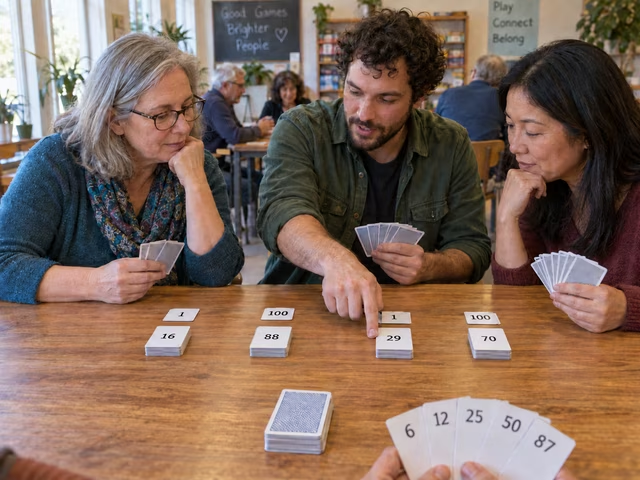
Use the original cooperative The Game, not Quick & Easy or Face to Face. Place two ascending 1 direction cards and two descending 100 direction cards face up, each marking its own empty play pile. Shuffle the 98 cards numbered 2–99. Deal seven each to two players or six each to three, four or five; leave a face-down draw deck.
Inspect hands privately and agree who will start. Play clockwise. You may discuss which pile should be protected or whether a move is painful, but never reveal, ask for or encode exact hand values.
Play at least two before refilling
On your turn play cards one at a time onto any of the four piles. On an ascending pile, play higher than its current top; on a descending pile, lower. At least two cards must be played while any draw deck remains. You may play more, including your entire hand. Draw only after finishing your plays, restoring your original hand size or taking what remains.
The sole direction exception is exactly ten backward: on an ascending 47 you may play 37; on a descending 65 you may play 75. These moves may be used repeatedly in a turn. A gap of nine or eleven backward is not legal. Keep piles stacked so only their current top values are visible.
Once the deck is empty, the minimum becomes one card per turn. Players with no cards skip their turns; everyone else continues without refilling.
Clear all cards or count what remains
The team wins if all 98 number cards reach the piles. The game ends unsuccessfully as soon as the active player cannot legally play the required minimum. Count all cards left in hands and deck as the result; fewer is better. Do not let a player skip merely because their move would be inconvenient.
An ascending pile might accept 43, then 33 by the backward rule, then 35. Show that chain before starting: it explains why another player's request to leave a pile untouched may be valuable.
Coordinate without dictating hands
Ask for broad signals such as needing a pile or wanting others to avoid a large jump. Do not agree a code that communicates exact numbers. Check both required plays before committing the first when the position is tight. Everyone owns their own hand decisions.
A dedicated player account discusses returning to this numerical puzzle. Invite useful range-based advice while keeping exact hand values private.
Already know the game?
Ideas & Twists
Choose a variation together before you start.
The Game · See main rules
Publisher expert variantThree-card minimum
While cards remain in the draw deck, each turn must play at least three rather than two. After the deck empties, return to the normal minimum of one. Refill to the normal hand size; all pile directions and exact-ten moves remain.
The Game · See main rules
Publisher expert optionSmaller hands
Deal and refill to six cards each at two players or five each at three to five players. This can accompany the publisher's three-card minimum, but agree whether using it alone as a house difficulty choice. The empty-deck minimum stays one and the objective remains all 98 cards.
The Game · See main rules
Original STUDplay house twistOne open card
After every refill, each player chooses one hand card to place face up in a separate personal area. It remains theirs to play and counts toward hand size. Its exact value may be discussed because it is public; all other hand values stay secret. If it is played, reveal its replacement only at the next refill.
The Game · See main rules
Original STUDplay house twistReserved pile
Give the group one paper token. At the end of a player's turn they may put it by one pile, requesting that nobody else play there until their next turn. The restriction is mandatory while marked; remove the token at the start of that player's next turn and discard it permanently. The group may still lose if a player cannot meet the minimum.
The Game · See main rules
Original STUDplay house twistEmergency briefing
Once per game, immediately before a player's turn, the group may use a shared paper token to let EACH person reveal exactly one chosen hand card. Leave those cards public until played. Every other card remains secret. No extra play, draw or turn is granted.
About this guide
Use the named physical base game and its supplied cards, boards and rules. Rules below are paraphrased teaching guidance. Original STUDplay house twists are optional suggestions, not publisher rules or balance-tested claims; agree one before setup.
Ready for something different?
Find another game →