

The quick version
Check the ball at the top of the arc, then pass to a teammate. Baskets count 1 inside or on the arc and 2 beyond it. After a basket, the other team checks. After a defensive rebound or steal, clear behind the arc before shooting. First to at least 11 with a two-point lead wins.
Saved on this device only — clearing your browser's cache or site data removes them (no account backup).
Choose teams and show the court
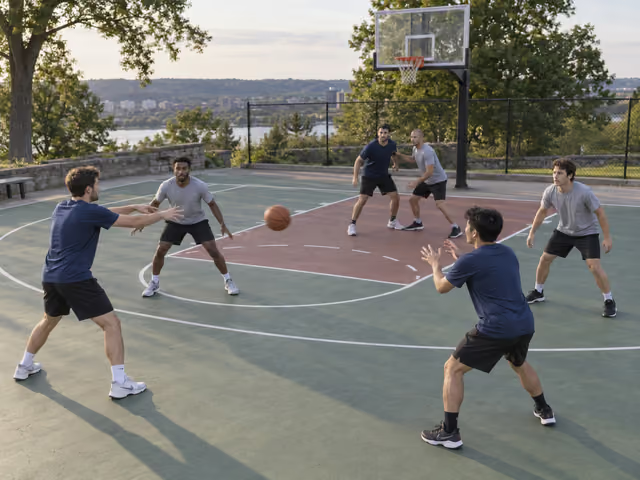
Use a basketball half-court, indoors or outdoors, with a secure 10-foot basket, visible sidelines, baseline, half-court boundary and three-point arc. The boundary lines themselves are out of bounds. The arc is your scoring and clearing line; use its existing distance rather than moving it during the game. Confirm permission or booking, inspect the surface for wet patches and debris, and keep bags and spectators outside the playing area. Wear athletic shoes with traction. Use one properly inflated basketball suitable for the surface; a standard size 7 ball is the default here.
Make two balanced teams of three. With eight people, make two teams of four and put one person from each team off court. Only three per team play at once. Substitutes enter at a stoppage before a check; tell the other team who is coming in and wait for the outgoing player to leave. Rotate the resting person at each such opportunity so the same person does not sit throughout. Seven is not a supported equal-roster format in this guide.
Point out the top of the arc where every check happens. Say the house agreement aloud: ones and twos, other team's ball after a basket, clear every live change of team possession, pass first after a check, call fouls, no free throws or clocks, and at least 11 with a two-point lead. Choose opening possession with rock-paper-scissors; replay a tied throw. Play one unscored check-and-clear demonstration, then reset to 0–0.
Check, play and change possession
Start with a check and a pass
The opening team's ball handler stands beyond the top of the arc and gives the ball to an opponent facing them. Once everyone is ready, the opponent returns it. The handler must pass to a teammate before dribbling or shooting; that first pass can be intercepted. After releasing it, the handler joins normal play and can receive a return pass. A check after a stoppage already counts as clearing the ball.
Move the ball and take a shot
Pass, dribble and cut into space while defenders try to stop the shot or steal the ball. Bounce the ball with one hand while moving with it. Once you stop your dribble and hold the ball, pass or shoot rather than starting another dribble. When holding the ball, pivot on one foot instead of walking; release the ball to begin a dribble before lifting that pivot foot. You may lift it to pass or shoot, but release before it returns to the floor. Do not jump and land still holding the ball. Keep screens stationary: do not step into or push a moving defender.
Count the basket and give the other team the ball
A made shot is 1 point if the shooter's foot touches the arc or is inside it, and 2 if both feet are beyond the arc at takeoff or release. Call the updated score using the same team order every time. Stop after a made basket and check at the top with the team that conceded it on offense. The scoring team does not keep the ball.
Clear a rebound or steal before attacking
After a miss, the shooting team's own rebound stays live and may be put straight back up. If the other team gains control, it must pass or dribble to a player controlling the ball with both feet beyond the arc before any shot. This also applies to airballs, blocked shots and steals. A mere defensive touch is not possession; control means securing the ball, not just tipping it. Play stays live while clearing, so defenders may contest the pass or dribble. Once cleared, attack without another check. If the ball changes teams again, the new offense must clear again, even if that team cleared earlier.
Finish with the agreed margin
Stop as soon as one team has at least 11 and leads by at least 2. Going past 11 is allowed: 10–9 becoming 12–9 ends the game; 11–10 does not. At 11–11, keep playing the same rules until someone leads by 2. There is no separate overtime, exact-score reset or sudden-death shot. Confirm the final score, then reset scores and choose opening possession again for another game.
Team A misses; Team B catches the rebound in the lane. B passes to a teammate with both feet beyond the arc, who may shoot or pass back inside. If A steals that pass before B clears, A must still clear its new possession. An offensive rebound by the same team needs no clearing.
Handle stops and close calls
Lines and violations. If a player holding the ball steps on or beyond a boundary, or the ball touches the floor outside, stop and give the other team a check. If the ball went out after a deflection, the team that did not touch it last gets the check. A travel, second dribble after gathering, intentional kick, or failure to pass first after a check also gives the other team a check. A shot attempted before clearing ends the possession immediately, scores zero even if it goes in, and gives the other team a check.
Fouls. The fouled player or the player committing the foul calls it promptly; stop play. Do not grab, push, hit arms, use moving screens or step under an airborne player. For a defensive foul, the offense keeps the ball for a check; for an offensive foul, the defense gets the check. If a shot was already released when a defensive foul was called and goes in, count its normal 1 or 2 and give the other team the next check. A shot released after the call cannot count. A missed shot released before the call gives the fouled team a check. These are house remedies: no free throws, bonus foul counts or extra and-one point. Deliberate or repeated dangerous contact is a reason to stop the game and change participants, not a tactic to reward or answer with retaliation.
Held balls and interruptions. When opponents both hold the ball firmly, stop instead of wrestling: the defending team gets a check. A ball stuck at the basket also goes to the defending team for a check. Keep hands off the rim and net; do not touch a ball resting or bouncing on the rim. For interference in this house game, stop, cancel that shot and let the shooting team check again. Stop immediately for injury, a loose object or another person entering the court. For an unrelated interruption, cancel any shot still in flight and restore the interrupted offense with a check. Take water or rest breaks at a stoppage and resume with the same score and possession; no timer is required.
Disputed calls. Confirm the score before restarting. If a line, foul, last-touch or clearing call cannot be agreed, cancel the disputed basket and replay that possession by checking to the team that had the ball just before the disputed play. Use the last mutually agreed running score. If nobody can agree who had possession, use rock-paper-scissors for the replay's check. Do not settle a rules argument by shooting for it or changing rules midgame. Stop the game if honest agreement is no longer possible.
Spread one teammate to each side of the ball handler so a new player can see two passing options. Encourage defenders to play the ball without crashing into people. Move into a useful passing lane after passing rather than following the ball into a crowd. There is no shot clock: work toward a shot, and pause to address deliberate stalling rather than inventing a countdown penalty. If someone leaves and neither team has a substitute to restore three on court, stop the match without declaring a score-based winner; agree a different game before continuing.
Already know the game?
Ideas & Twists
Choose a variation together before you start.
Three-on-three basketball · See main rules
Suggested house variationEvery basket counts one
Count every legal made basket as 1, including shots beyond the arc. Keep clearing at the arc, pass-first checks, other team's ball after a basket, and the 11-or-more finish with a two-point lead. Long shots no longer earn double an inside basket; choose this before the game, not after a team has built a lead.
Three-on-three basketball · See main rules
Suggested house variationPass and cut
Remove dribbling during the attack so teammates must pass and move into space. A player holding the ball may pivot but cannot walk with it. Clear defensive rebounds and steals by passing to a teammate with both feet beyond the arc; do not dribble out. Any deliberate dribble is a turnover and the other team checks. Keep normal basket values and the 11-or-more, two-point-margin finish. This still involves active movement and contested play.
Three-on-three basketball · See main rules
Suggested house variationRace to seven
Replace the target of 11 with at least 7, still requiring a two-point lead. Keep all other rules. At 7–6, continue; 8–6 wins. Reset teams or rotate opponents after each completed game. A lower target changes the commitment but does not guarantee a number of minutes.
About this guide
Recreational organizations support the half-court, ones-and-twos, clearing and pass-first-check mechanics. This guide is an explicitly authored house game, not either league's full rules: its target, two-foot clearing test, substitutions, interruption/dispute remedies and foul treatment are specified here. It uses no league clock, officials, free throws or roster administration. Community discussions informed the explanations, not official rule claims. See the packet research for exact source boundaries.
Ready for something different?
Find another game →