

The quick version
Take one action per turn: draw train cards, claim one whole route, or draw new tickets. Routes earn points immediately. At the finish, add completed tickets, subtract unfinished tickets and award the 10-point longest-path bonus. Highest total wins.
Saved on this device only — clearing your browser's cache or site data removes them (no account backup).
Check the edition and deal
Use the USA refresh base game and its English rulebook dated April 25, 2025. The box provides a North America board; trains in five colors; five matching scoring markers; 110 train cards (12 each in eight colors plus 14 locomotive wilds); 33 tickets; one longest-path bonus card; and the rulebook. Count out exactly 45 trains for each player and leave any replacement trains in the box. Set unused colors aside.
Older USA boxes commonly use a three-ticket opening deal. Europe, city editions and USA 1910 have their own rules or decks. Do not mix those components or their setup with this guide; use their matching rulebook instead.
Put the board on a table everyone can see and reach, with room beside it for two decks, discards and five face-up train cards. Seat players around it and put their score markers on 0. Shuffle train cards, deal four to each player and lay out five face up beside the remaining deck. Whenever at least three face-up cards are locomotives, discard all five and replace the display; check again.
Set out the bonus card. Shuffle the 33 tickets and deal four to each player. Secretly keep at least two; keeping three or four is allowed. Shuffle the rejected tickets together and place them at the bottom of the remaining ticket deck. Kept tickets stay private until final scoring and cannot later be abandoned.
Agree who starts; a coin flip is a simple choice. Continue clockwise. Before the first turn, distinguish a route (one printed link between adjacent cities) from a ticket (two cities to connect through any continuous chain of your own routes).
Choose one action each turn
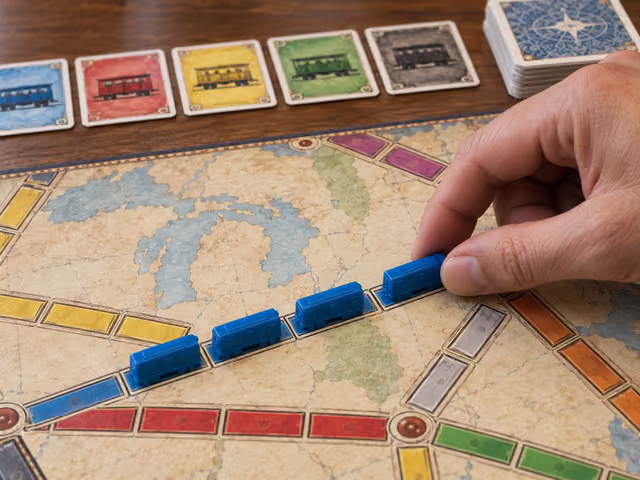
Immediately score each claimed route by its number of spaces: 1 = 1 point; 2 = 2; 3 = 4; 4 = 7; 5 = 10; 6 = 15. Move your score marker, and track another lap if you pass the end of the printed track. For example, three red cards plus a locomotive can claim a four-space red route, placing four trains and earning seven points.
Double routes: at two or three players, once either side of a paired link is claimed, the other is closed for everyone. At four or five players, two different players can each claim one side. The same player may never own both sides, even if their colors differ.
Recheck the five-card display whenever it changes: at least three locomotives means discard and replace all five. When the train deck runs out, thoroughly shuffle its discards into a new draw deck. There is no hand-size limit. If no train cards remain available and there are no discards to recycle, you cannot draw train cards; choose a legal route claim or new tickets instead.
Draw train cards
Normally draw two, one at a time, choosing each from the face-up display or blindly from the deck. Replace each face-up card immediately before choosing the next. A face-up locomotive must be your first draw and uses your entire turn: no second card. After taking any other first card, you cannot take a face-up locomotive second. A locomotive drawn blindly counts as one card, so you may still take a second blind or non-locomotive face-up card. Keep train cards in your hand.
Claim one route
Choose an unclaimed legal link and pay one matching card per printed space, then cover every space with one train of your color and discard the paid cards. Colored links require that color; gray links require any one color, not a mixture. Locomotives substitute for any number of cards, including the whole set. You must have enough physical trains and pay for the entire link now. It need not touch your existing network. Claim only one route; drawing cards and claiming in the same turn is not allowed.
Draw new tickets
Take the top three tickets, or all available if fewer than three remain. Keep at least one of those drawn, and return the others to the bottom of the ticket deck in any order. You cannot return a previously kept ticket. Drawing tickets uses the whole turn, even if one is already connected by your network. Keep all tickets private until the finish. If the deck is empty, choose another available action.
Before the actual deal, demonstrate drawing a face-up regular card, replacing it and choosing a second regular card. Then show that a face-up locomotive ends the draw. Return the demonstration cards and shuffle before dealing; these are teaching examples, not bonus cards.
Call the final turn and count
At the end of any player's turn, if that player has zero, one or two unused trains, announce the final turn. Continue clockwise for exactly one more turn per player, including the player who triggered it. That player's next turn is the last turn of the game. Completing your tickets does not itself end play, and the finish does not wait for everyone to use every train.
Check route points by recounting the printed links each player owns. Reveal every kept ticket. Add its printed value if its two cities are connected by a continuous chain of your trains; otherwise subtract that value. A longer indirect connection counts. You cannot borrow another player's trains. Your same links can satisfy multiple tickets; each completed ticket scores separately. Unused train cards earn nothing.
Award 10 points for the longest continuous path, measured by the number of physical trains in one traversable path, not by route points or the total size of a branching network. It may loop or revisit a city, but cannot count the same train twice. If several players tie for the longest path, each gets 10. Trace close candidates together; a branch is counted only if it can be included without reusing an already counted train.
Highest final points wins. Among tied leaders, the most completed tickets breaks the tie. If still tied, a tied leader who earned the longest-path bonus wins over one who did not. If that still does not separate them, they share victory. Negative final totals remain valid; do not replace them with zero.
For another game, separate all paid train cards and tickets back into their correct decks, count out 45 trains per player again, reset the score markers and redeal. Do not carry earned points or completed tickets into a new game.
Keep the table moving and resolve disputes
Let each player locate both cities on each opening ticket before choosing what to keep. Explain that keeping extra tickets is a commitment: unfinished ones subtract points. A useful first plan is to find two tickets that share part of a possible connection, then notice short links that could close before you reach them. This is a suggestion, not a required strategy or a promise of winning.
Blocking an open link is legal; there is no reserved route because someone collected its cards or announced a plan. Stay friendly about it and look for an alternate connection. The USA base game has no station that lets you borrow an opponent's link. Check double-route availability before anyone discards cards.
Confirm payment, remaining trains and route points aloud when claiming. A gray four-space route cannot be paid with one card each of four ordinary colors; four of one color, or one color supplemented by locomotives, is needed. Choosing a locomotive from the replacement display after your first draw is still choosing a face-up locomotive and is not allowed as your second card.
Pause a contested action and consult the linked rulebook before the next player acts. Suggested house correction for an illegal payment caught immediately: restore those cards and trains, reverse any route points, and have that player choose a legal action. If later hidden draws make a clean rewind impossible, agree a correction together rather than inventing a penalty or secretly moving pieces. This correction procedure is hosting advice, not a manufacturer tournament rule.
The physical format needs reading the map and tickets, holding cards and moving small pieces. Ask the group about their practical needs; a seated game does not establish universal accessibility. Keep the rulebook nearby. Allow time for explanation and final counting rather than promising a fixed finish time.
Already know the game?
Ideas & Twists
Choose a variation together before you start.
Ticket to Ride · See main rules
Suggested house variationOpen-ticket learning game
For a teaching game with the same two to five players, expose every kept ticket beside its owner after the normal four-ticket deal and selection. Newly kept tickets are also face up. Train hands remain private. Let players ask for help tracing their connections; route ownership, blocking, turn actions, train-triggered finish, scoring and tie rules stay the same. This replaces ticket secrecy and reveals opponents' goals, so agree to it before dealing.
Ticket to Ride · See main rules
Suggested house variationOpening tickets only
For the same two to five players, deal four tickets and keep at least two normally, then set the ticket deck aside. Remove the draw-new-tickets action: every turn must draw train cards or claim one legal route. You may still claim routes after your tickets are complete. Use the normal train-triggered final turn, ticket penalties, longest-path bonus and tie rules. This fixes each player's destinations at the start and reduces late ticket surprises; it does not guarantee a shorter game.
About this guide
Main mechanics follow the 2025 USA refresh rulebook, not the older USA opening deal or Europe. Teaching advice, the correction procedure and both variations are explicit house suggestions. Community comments show edition confusion and differing views on blocking and ticket-focused strategy; they do not establish representative demand or official rules.
Ready for something different?
Find another game →