

The quick version
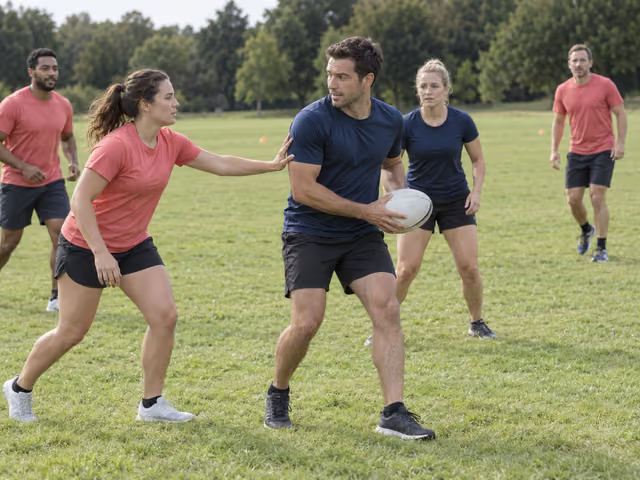
Make two teams of six. Start with a tap at halfway, with defenders 10 metres back. Carry forward, but pass only sideways or backwards. When touched, stop at the touch spot, put the ball between your feet and step over it; another teammate picks up. Defenders retreat 7 metres. That picker-up is the acting half: being touched or grounding in goal before passing loses possession. A controlled grounding on or beyond the opponents' try line earns one point. Six touches turn the ball over. The higher score after both halves wins; an equal score is a draw.
Saved on this device only — clearing your browser's cache or site data removes them (no account backup).
Choose teams and mark a real field
Use exactly twelve participating adults, six per side, with no bench in this main format. Balance experience and choose one playing captain for each team. Captains share timekeeping and scoring during stopped play; there is no extra required referee. This is a recreational house format using the Federation of International Touch fifth-edition core mechanics, not tournament compliance. Team registration, numbered uniforms, mixed-competition roster requirements, interchange and official disciplinary procedures are outside this format.
Use a permitted level grass space, clear of holes, debris, traffic and other park users. Mark 70 metres between try lines and 50 metres between sidelines, with a 7-metre-deep in-goal area beyond each try line and a dead-ball line at each far end. Leave at least 5 metres of clear space outside the boundaries. Mark halfway and both lines 7 metres inside the try lines. Use existing lines or measure and mark with safe soft cones; do not put rigid objects or raised ropes in running paths. Goalposts are unnecessary. If that space is unavailable, use the explicitly smaller four-a-side twist instead of squeezing twelve into a small lawn.
Bring an oval ball inflated to its manufacturer's instructions, distinguishable team tops or bibs, footwear suitable for the surface, a physical stopwatch and paper and pen for the score. Screw-in studs, sharp nails and unsafe jewellery do not belong in play. Check the surface and agree on a stop signal. Warm up with easy movement and backward passes before starting. Touch involves deliberate light contact and running; ask everyone whether that suits them, rather than calling it contact-free.
Agree to two 20-minute halves and a 5-minute break. House choice: pause the stopwatch for injury, safety checks and unresolved disputes; brief ordinary restarts keep the clock running. Either captain can request a rest pause for the whole group. Choose possession and first attacking direction by a mutually agreed random choice, such as drawing one of two folded paper slips. At halftime exchange ends and let the team that did not start the first half take the second-half tap.
Tap, support, touch and restart
Start with a tap
Place the ball at halfway, release both hands, gently tap it with a foot and pick it up cleanly. It must not move more than 1 metre. All attackers start onside, level with or behind the ball; all defenders start at least 10 metres away. Wait until both captains signal ready. The tapper may run, pass or score: the acting-half restriction applies only after an ordinary rollball. Begin the touch count at zero.
Carry forward and pass back
Run toward the opponents' try line while receivers stay level with or behind the ball. Pass sideways or backwards, never forwards. Do not kick in open play, throw forward to yourself, use a teammate as a screen or push a defender away. A supporting attacker ahead of the ball must move back onside before joining play. A player can gently initiate a touch on a defender; it does not license barging into them.
Stop on a genuine touch
Minimal contact between a defender and the carrier, including the ball or clothing, is a touch. Call 'touch' and the new count aloud: one through six. Stop, return promptly to the exact spot of contact if momentum carried you past it, face the opponents' try line and perform the rollball. Passing after being touched gives the other team a penalty tap. A ball accidentally knocked out during the touch is retrieved for the rollball and counts as that touch, not a separate dropped-ball turnover. Deliberately slapping it out of a carrier's hands is a penalty.
Make the rollball and name the half
Set the ball between your feet at the mark, align with the sidelines and step forward over it. Alternatively roll it backwards between your feet no more than 1 metre. A different teammate positioned just behind picks it up without delay; that person is the acting half, often called the dummy half. The half may run or pass but loses possession if touched while holding it, or if the ball they control touches the ground in goal. Once they pass to a teammate they cease to be the half and may later receive and score normally. The rollball player gets back behind the ball to offer support; they cannot pick up their own rollball.
Give the attack its restart space
After every touch, all defenders retreat at least 7 metres from the rollball, without blocking the attackers. When the mark is within 7 metres of their try line, retreat with both feet on or behind that line. Onside defenders normally advance when the half first touches the ball. If no half is within 1 metre of the rollball, they may advance as soon as the rollball player releases it; an onside defender reaching that unattended ball takes possession and restarts with a rollball. Never obstruct the rollball or half. Within the defensive 7-metre zone, when a defender enters that zone the defending team must move forward at a reasonable pace until a touch is imminent or made. If only the ball carrier enters the zone, defenders need not advance but cannot keep retreating toward their line until a touch is imminent or made.
Change possession cleanly
The sixth touch ends the set: hand over at that mark and the new attacking team makes a rollball, with its count reset to zero. A dropped ball or pass to ground also changes possession where it first hit the ground. A touched half changes possession at the touch mark. Sidelines and dead-ball lines are out: a carrier stepping on a sideline or a ball landing on or outside it gives the other team a rollball 7 metres infield from the crossing. If the touch happened before the carrier crossed the side, use the touch mark instead. House boundary choice: an uncontrolled ball or carrier reaching a dead-ball line gives the other team a rollball on its nearest 7-metre line, aligned with the crossing. Move any restart mark in goal to the nearest 7-metre line. No scramble for a ball after a turnover.
Handle an interception or deflection
A clean interception stays live: the new carrier can run or pass, and their first subsequent touch is zero, followed by touches one through six. House simplification: any defender's deflection of a legal pass that falls to ground leaves possession with the original attack at the landing spot, restarting by rollball at zero; if an attacker catches the deflection before it lands, play continues and the next touch is zero. This deliberately avoids FIT's different accidental-contact and direction-of-deflection cases. A forward pass remains a penalty, and an attacker deliberately throwing at a defender to manufacture a reset gives away a penalty.
Score a try and restart
A player other than the acting half scores one point by placing the ball under control on or beyond the opponents' try line before a touch, within the in-goal boundaries. There are no conversion kicks or different player values. Running across the line without grounding has not scored. If touched in goal before grounding, count the touch and rollball on the 7-metre line directly infield; on touch six or a touched half, give the opponent possession there. If someone grounds and releases short of the try line, count a touch and rollball there; keeping the ball in hand on the ground short does not itself add a touch. After a try, record and announce the score; the conceding team taps at halfway.
Finish each half and the match
When the stopwatch reaches 20 minutes, call time but continue the current action until the next touch or dead ball; a try in that action counts. If a penalty occurs before play has ended, take the penalty and again end at the next touch or dead ball. At the first-half ending, record the score, take the break and switch ends. After the second, the team with more tries wins. Equal scores, including 0–0, are a draw; this social format uses no official drop-off overtime. If the group must stop permanently for injury, weather or loss of a player, record an unfinished game rather than manufacture a winner. To play again, reset score and time, recheck conditions and choose the starting team again.
A carries, a defender lightly touches A, and A calls 'one', places the ball and steps over. B picks up as half and passes backwards to C while the defenders retreat 7 metres. A then moves behind C to support the next touch. Repeat with B touched before passing so everyone sees the immediate turnover. This practice sequence is unscored.
Make calls understandable and keep everyone involved
Spread across the field rather than bunching around the carrier. A teammate says 'half' and arrives behind the next rollball; another offers a receiver behind them. A short reliable pass is better than a desperate long throw. Keep the touch count audible and confirm it at each restart. Demonstrate the measured 7-metre distance before kickoff so 'back' means the same thing to both teams. Explain the half as a temporary job, not a permanent position.
House officiating procedure: genuine touches are acknowledged immediately. Anyone can call stop for safety. For a disputed forward pass, touch-before-grounding, boundary, count or mark, stop before the next restart. Each captain gives one account; use an agreed witnessed fact. If neither can establish it, replay from the last agreed restart with the prior possession, count and score. Do not award a disputed try or add a touch on a guess. A clear error after a new restart stands; apply the correction going forward. Pause the clock for this process and avoid lengthy arguments.
A forward pass, pass after touch, voluntary rollball, rollball beyond the mark, delaying a restart, offside interference, obstruction, false touch claim or excessive contact gives a penalty tap to the non-offending team. House penalty procedure: stop rather than play advantage, set the mark at the infringement, moved onto the nearest 7-metre line if in the end zone, and restart that team's touch count at zero. Defenders retreat 10 metres or to their try line if nearer. Use a tap for every penalty here; this format omits FIT's alternative penalty rollball, advanced mark adjustments, penalty tries and escalating exclusion rules. For a badly formed rollball, including rolling more than 1 metre or picking up your own, change possession with a rollball at the mark. A badly performed tap is repeated correctly rather than treated as an ordinary dropped pass.
No tackling, grabbing, charging, tripping, blocking or fending with a hand. Use a light touch to the upper arm or torso where practical, even though the formal definition includes other body areas. Stop immediately for a dangerous collision or a player who feels unwell. House conduct remedy: explain and correct a first minor lapse; deliberate dangerous behavior or repeated refusal ends the match. With exactly twelve players, this guide does not continue short-handed after someone leaves. Follow venue instructions for lightning, unsafe ground or poor light. Rest pauses and a warm-up do not guarantee anyone's fitness or access needs are met.
Already know the game?
Ideas & Twists
Choose a variation together before you start.
Touch rugby · See main rules
Suggested house variationFour-a-side on a smaller field
Use exactly eight adults, two teams of four, and mark 40 metres between try lines by 30 metres wide, with 7-metre in-goal areas and the same clear boundary space. Replace the main format's twelve-person requirement and 70-by-50 playing field only. Keep six touches, 7-metre rollball retreat, 10-metre tap retreat, half restrictions, both 20-minute halves, scoring and draw finish. If a player leaves, stop as unfinished rather than inventing an uneven game. This remains a running field game, not a small-room option.
Touch rugby · See main rules
Suggested house variationFirst to five tries
Replace the timed halves with a race to five tries. Keep twelve players and the main field. After either team reaches three tries for the first time, stop after that scoring play, change ends and let the conceding team take the normal halfway tap; do this once only. The first team to five wins immediately, with no equal-possession reply and no possible scoring tie. All tries remain one point. Other restarts, touch counts, contact and half rules stay the same. No stopwatch is required; take rest pauses by agreement. If play must end before five, record unfinished rather than award the lead. This has no promised duration.
Touch rugby · See main rules
Suggested house variationThree receivers before a try
Keep the twelve-player timed match, but a try is eligible only after at least three distinct teammates have caught legal passes in the current set. The starting carrier and a half merely lifting a rollball do not count as receivers unless they later catch a pass. Say each qualifying receiver's name aloud; the same person counts once. A turnover, new halfway tap, penalty or zero-touch reset clears the receiver list. Six touches still end the set. Grounding in goal before the requirement is met gives the opponent a rollball on the nearest 7-metre line and no point; this replaces the normal try outcome. The half still cannot score, even if all three have received. Keep normal scores, time and draws. Use this when the group wants to build passing support rather than reward a solo break.
About this guide
Reviewed October 2, 2026 against the FIT fifth edition linked by FIT, with introductory cross-checks and qualitative community needs. This is an explicitly self-officiated social house format for exactly twelve players. House choices cover team selection, no bench or gender quotas, five-minute break, safety/dispute clock pauses, disputed-play replay, simplified penalty marks/no advantage or disciplinary exclusions, all-deflection zero resets, dead-ball-line turnover and unfinished matches. The three twists are original house suggestions. Formal competition requires its complete rulebook, officials and local conditions; forum comments are not rule authority.
- Federation of International Touch · fifth-edition playing rules (2020) ↗
- Federation of International Touch · official rules landing page ↗
- England Touch · introductory rules and glossary ↗
- Philly Touch Rugby · local introduction ↗
- r/touchrugby · 5m or 7m? (October 2023) ↗
- r/rugbyunion · Coach Here, Need advice on various issues (November 2021) ↗
- r/rugbyunion · Confusing terms for a rookie (November 2021) ↗
Ready for something different?
Find another game →