

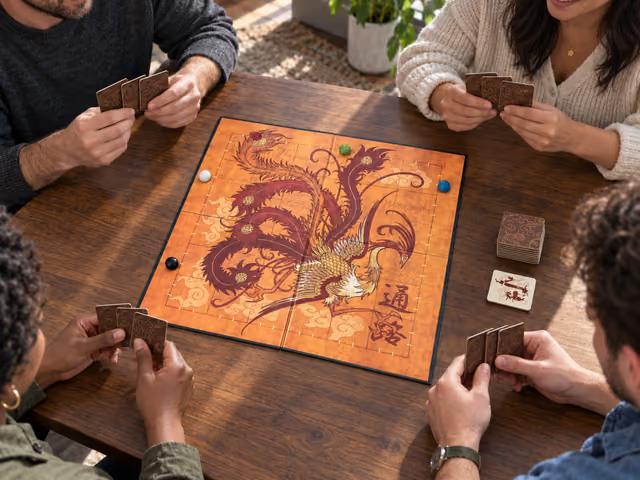
The quick version
Deal three hidden path tiles each and choose separate starting marks around the board. On your turn, place one tile in the empty square directly ahead of your stone. Follow your path all the way to its open end, then move every other stone whose path the new tile extends. Remove stones that leave the board or meet each other, return eliminated players' hand tiles to the draw pile, and refill hands. Turns go clockwise. One remaining stone wins; the final players can share a win.
Saved on this device only — clearing your browser's cache or site data removes them (no account backup).
Deal tiles and choose a starting path
Use Calliope Games' original Tsuro: The Game of the Path, with its six-by-six board, 35 path tiles, eight colored marker stones and one Dragon tile. This guide follows the publisher-linked 2020 rule sheet. Use 2–8 players, each controlling one stone. Tsuro of the Seas and Phoenix Rising have different equipment and rules.
Set the board where everyone can see and reach it. Keep the Dragon tile beside the board; it is a drawing-priority marker, never a path tile. Shuffle the 35 path tiles face down, deal three to each person, and stack the rest face down as the draw pile. Look at your own hand but keep its tile faces hidden from opponents.
The oldest player starts. Beginning with that player and going clockwise, place each stone on a different unoccupied starting mark at the board's outer edge. Choose one of the small marks, not a square's center. Everyone chooses before any tile is played. A starting mark points into the square where that stone's first tile will go; two stones may face the same empty square from different marks.
Before starting, show one spare tile and trace a line from one edge point to its matching endpoint. Every tile has four separate paths, with two endpoints per side. Where lines cross, keep following your original line; a crossing is not a junction. Return the demonstration tile to the draw pile and shuffle it before play.
Place, trace, then draw
Choose a tile and rotation
Play one tile from your hand face up in the empty square directly ahead of your stone's path endpoint. You may rotate it in quarter turns before committing. You cannot place elsewhere to target someone, cover an existing tile, or change a tile after placement. Check every tile and rotation before choosing a move that sends your own stone off the board: an edge exit is allowed only if no other move is possible.
Move along the whole route
Move your stone along the new tile's line and continue through every connected tile already on the board. Stop only at an endpoint facing an empty square. Then move the other stones beside the new tile along their own complete paths. Move every affected stone, even if its owner has already taken a turn. Do not stop at each tile boundary or choose a different branch at a crossing.
Resolve eliminations together
A stone reaching the outside edge is eliminated. If two stones' paths connect so that the stones meet, both are eliminated; lines merely crossing do not cause a collision. Remove those stones and shuffle the path tiles still in their owners' hands into the draw pile. Leave every placed tile on the board. Resolve all stones affected by this placement before declaring the result.
Refill and continue clockwise
If the game continues, refill hands as explained below. Usually you alone draw one tile to replace the tile you played. When several surviving players have fewer than three tiles, start with the active player (unless the Dragon holder has priority) and distribute one tile at a time clockwise until every hand has three or the pile runs out. The next surviving player clockwise then takes a turn. Eliminated players no longer place or draw tiles.
Your stone starts outside the board, aimed at an empty square. Try a tile's rotations to see which line enters from that starting mark. Place your chosen rotation, slide the stone along that line to its endpoint, and draw a replacement. If another starting stone faces the same square, your tile moves that stone too.
Use the Dragon when tiles run short
With three or more players, hands can shrink after the draw pile runs out. The first player who needs to draw but cannot takes the Dragon tile, unless someone already holds it. The Dragon stays with its holder while no path tiles are available. Keep playing with the path tiles left in your hands; the Dragon cannot be placed on the board.
When an elimination returns tiles to the pile, shuffle those returned hand tiles into it. Begin the refill with the Dragon holder rather than the active player. That holder draws one path tile and sets the Dragon aside. Continue clockwise among surviving players: anyone with fewer than three path tiles draws one, then move to the next person. Make further circuits if needed. Do not give one player a full hand before anyone else draws.
Stop when all surviving hands have three or the pile is exhausted. If someone still needs a tile and cannot draw, that person takes the now-available Dragon; that marks the next refill's starting player. If the Dragon holder is eliminated, pass it clockwise to the next surviving player with fewer than three path tiles. In a two-player game, leave the Dragon aside.
Example: Three survivors A, B and C have one, two and one path tiles. A holds the Dragon and four tiles become available. Give one to A, then one to B, then one to C, then another to A. Their hands are now three, three and two. C needs the next tile but the pile is empty, so C takes the Dragon. The Dragon changes draw priority, not turn order.
Outlast the others or share the win
There are no points, laps or path-length scores in the main game. After resolving a tile's movement, one surviving stone wins immediately. If the same tile eliminates every remaining player, those final players tie for the win; players eliminated earlier do not join that tie.
If all 35 path tiles have been placed and two or more stones remain, all remaining players share the win. One board square will remain empty because the board has 36 squares. Do not invent another tile, count occupied squares for each stone, or give the active player an advantage to break the tie.
For another game, clear the entire board, return all hand tiles, shuffle all 35 path tiles, deal three each and choose starting marks again. Put the Dragon aside. Start with the oldest player again, or agree before the next game to rotate the first player as a house suggestion.
Keep the paths and choices clear
Use good lighting and leave space to inspect tile rotations. Trace routes with a finger hovering above the board before moving stones. A player can ask someone to trace or move a stone for them while keeping the tile choice their own. If a stone was moved along the wrong line, retrace its route from its starting mark and correct its position before continuing.
A closed loop can appear among placed paths, but a stone cannot enter one from its starting route without switching lines at a crossing. If a stone seems trapped circulating forever, check the route rather than treating the loop as a safe place to wait.
As the board fills, inspect where your route will stop and which other stones your tile moves. More players make neighboring paths interact sooner. Tell the group before dealing that elimination is part of the game; an eliminated player may help trace a route when asked, but should not choose another player's moves. Start a fresh game together once the result is settled.
Make tile placement a clear commitment: inspect candidates in your hand, then announce your choice as you put it down. For an accidental bump, restore the unchanged tile orientation and stone endpoint together. If the group cannot reconstruct a disturbed position, this guide suggests ending that game without a result and starting again; this is a house remedy.
Already know the game?
Ideas & Twists
Choose a variation together before you start.
Tsuro · See main rules
Official advanced option · 3–8 playersElimination bonus
Before dealing, agree to use the rulebook's elimination bonus. When your placed tile eliminates an opponent, you may immediately exchange any number of the path tiles still in your hand for the same number from eliminated opponents' hands, before those hands enter the draw pile. You may inspect those available tiles to choose the exchange. You gain no extra tiles from the exchange itself. Shuffle the remaining eliminated hand tiles into the pile, then refill in the normal order, including Dragon priority. Placement, movement, elimination and shared-win rules stay the same. This adds a reason to consider routes that affect several stones.
Tsuro · See main rules
House suggestion · 2–8 playersOpen-hand teaching game
Deal the usual three tiles each, but keep each hand face up beside its owner throughout this game. On a turn, the owner chooses the tile and rotation; the others may help trace its consequences before it is committed. Replacements also stay visible. Use the normal placement, Dragon, elimination and finish rules, but treat this first game as practice with no recorded winner. Clear the board and shuffle all tiles before returning to hidden hands for a competitive game. This lets newcomers see why a rotation changes their route.
Tsuro · See main rules
House suggestion · 2–8 playersThree-game path series
Agree to play exactly three fresh games with the same players. Use the main rules in each game, but rotate the first player one seat clockwise after each result; choose starting marks in that new order. Give one point to every winner of a game, including each player sharing a win. Earlier eliminated players get zero for that game. Use paper and a pen to track the points. After game three, the highest total wins the series; equal highest totals share the series win. Elimination bonus stays off unless everyone agrees before game one to use it in all three games.
About this guide
Main play uses Calliope's original physical set and its publisher-linked 2020 rules, including Dragon draws and shared wins. The elimination bonus is an official advanced option. Open hands, the three-game series, rotated starts, the tracing demonstration and the unrecoverable-position restart are host suggestions. App scoring modes and rules from other Tsuro games are not included.
Ready for something different?
Find another game →