

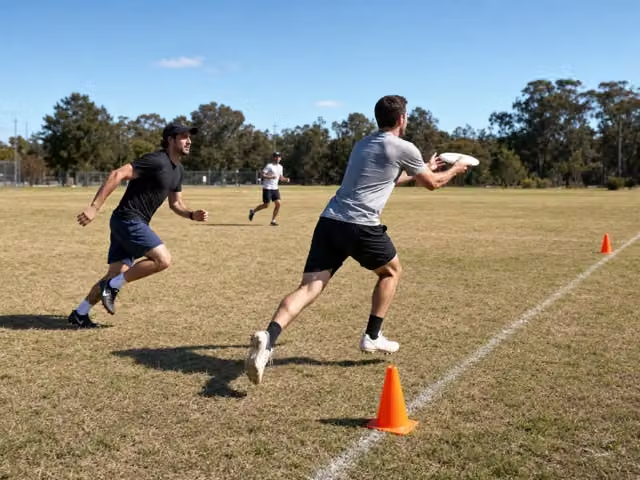
The quick version
Catch, stop and pivot, then pass in any direction. A drop, interception or out-of-bounds pass changes possession. Catch a teammate's pass inside the end zone you are attacking for one goal. Change ends, then the scorers throw the next opening pull. First to five wins, including 5–4.
Saved on this device only — clearing your browser's cache or site data removes them (no account backup).
Mark the field and choose teams
Find flat grass with clear space beyond the field. Measure a rectangle 53 yards long and 25 yards wide. Place four flexible cones at its corners and four more on the sidelines, 8 yards in from each end. The lines between those inner cone pairs are the goal lines: two 8-yard-deep end zones surround a 37-yard central zone. Sight straight lines between cones; agree where they run before play. Perimeter lines are out; goal lines belong to the central zone.
Bring one full-size Ultimate disc, preferably 175 grams, a tape or other distance measure, and shoes suitable for the surface. Split into balanced light-shirt and dark-shirt teams. Put exactly four from each team on the field. For nine to twelve people, split the extra players between team rosters as evenly as possible and rotate reserves after goals, before signaling ready. There are no running substitutions. Swap rosters between games if one team has more reserves.
Say the house rules aloud: first to five, no two-goal margin, no clock or halftime; ten-count stall; an out-of-bounds pull starts at the receiving goal-line center; every stopped-play restart resets the count to one. Only a teammate's pass can score, so an interception in your attacking end zone does not count as a goal. Take rest breaks between points. Stop immediately for injury or danger; do not play on with an injured person.
Pull, pass and score
Make the first pull
Choose the first receiving team by a fair draw; the other team chooses its starting end. Both teams wait behind their own goal lines. The puller and a receiver raise a hand when their teams are ready. The puller throws toward the other team; everyone may then move. Defenders may not touch the pull before a receiver does. Catch it, or let it land untouched and pick it up where it stops. A receiver who touches but fails to catch an in-bounds pull gives the other team possession. If the pull touches out-of-bounds, even after rolling, the receiving team instead starts at the center of its own goal line. These pull positions are house rules; there is no brick-mark option.
Stop, pivot and find a pass
After a catch, take only the steps needed to stop. Keep one foot at that spot as your pivot until you release the disc; move your other foot to turn and pass forward, sideways or backward. In this house format, stop before throwing rather than using the official moving-throw exception. Teammates run into open space to receive. No handoffs, intentional self-passes or kicking the disc. An untouched self-catch or a handoff is a turnover.
Defend and count
Defenders cover opponents and try to block or intercept the airborne disc. Do not tackle, screen, strip a held disc or run through someone. Only one defender marks the thrower within 10 feet; other defenders stay outside that radius unless following another receiver. As a house spacing rule, the marker stays at least an arm's length away. Once a pivot is established, the marker says 'stalling one' and counts aloud to ten, at least one second between numbers. Release before the first sound of 'ten' or call 'stall' and stop: possession changes at that pivot. With no nearby marker there is no count. A new marker, or a marker who leaves that radius and returns, starts again at one.
Change possession after a miss
A pass hitting the ground, being caught out-of-bounds or being intercepted gives the other team the disc immediately. A mere defensive tip does not: a teammate can still catch it before it lands. Any player on the new attacking team may pick up a grounded disc, establish a pivot and continue. For a pass that goes out, restart just inside the sideline where it last crossed, rather than where it finally lands. If that spot is alongside an end zone, move to the nearest point on that zone's goal line. As a house simplification, any disc gained in either end zone without scoring is brought straight to the nearest goal-line spot. Touch it to the ground before passing from any relocated restart.
Recognize a goal
A teammate must control a pass with their first ground contact wholly inside the attacking end zone and keep control through the landing. Standing on its goal line is not a goal; touching a sideline or back line makes the catch out. Catching in the central zone and then running across the goal line is not a goal: return to the goal line and pass again. A simultaneous offensive and defensive catch stays with the offense. An interception is possession, never a goal in this house format.
Change ends and finish
Confirm the score aloud. Switch directions after every goal: the scorers stay in the end zone where they just scored and now defend it; the other team walks to the opposite end. Rotate any substitutes, then the scoring team pulls to the other team. Turnovers never require a new pull. First to five goals wins immediately, including 5–4. There is no tied finish in a completed game. If the group must leave before five, record an unfinished score rather than inventing a winner. For a rematch, reset the score and let the previous losing team receive first.
Blue catches the pull, stops, then passes sideways to Blue. The next pass drops: White picks it up and attacks the opposite end without a pull. White catches a teammate's pass wholly beyond that goal line: 1–0. White now defends that same end zone and pulls to Blue.
Teach one point and settle calls
Before scoring, demonstrate a catch, quick stop, planted pivot and short pass. Show one catch on the goal line and one beyond it. Let each player throw and receive an unscored pass. Keep one receiver near the thrower as a return option; other receivers should move into separate lanes rather than crowding around the disc.
House stoppage procedure: Call the problem immediately and stop everyone. A pass released after the call is annulled; return it to that thrower. For an agreed travel, restore the pivot and keep possession. For an agreed foul on a thrower, return the disc there; for a defender's agreed foul preventing a reception, give the intended receiver the disc at the foul spot, brought to the goal line if in an end zone. For an offensive foul, restore the previous thrower and players to their positions at the incident. A pick is a blocked defender's route: allow that defender to regain the position they would have had, then return the disc to the previous thrower. Do not use teammates as screens.
For a contested foul, travel, stall, or an unresolved in/out or catch/drop call, return the disc to the previous thrower and restore positions at the disputed action. For a catch whose end-zone status alone is unclear, the receiver keeps it at the goal line and passes again; no goal is awarded. If the disputed event was the opening pull, repeat the pull. Players involved explain what they saw; do not decide by shouting or a team vote.
Correct fast counting, crowding or double marking before restarting. After any stopped-play restart, the thrower asks the nearest defender 'ready?', waits for agreement, touches the disc to the ground and announces 'disc in'; everyone moves and any count restarts at one. These reset and replay remedies replace official continuation and count-resumption tables. For an injury, stop, retain the disc and positions, and let either team replace the same number of players. If four on each side cannot safely continue, pause or end the game as unfinished. No catch justifies a collision.
Already know the game?
Ideas & Twists
Choose a variation together before you start.
Ultimate · See main rules
Suggested house variationSix-person mini
For exactly six players, use three against three with no reserves. Change the field to 42 yards long and 20 yards wide, with 6-yard end zones and a 30-yard central zone. This sizing is a house choice, not an official standard. Keep the ten-count stall, first-to-five finish and all house restart rules. The smaller teams give each receiver more space.
Ultimate · See main rules
Suggested house variationSeven a side
For exactly fourteen players, use seven against seven with no reserves on a 110-by-40-yard field: 70 yards between goal lines and 20-yard end zones. Move the same eight cones to the new corners and goal-line intersections. Keep this guide's first-to-five finish, ten-count stall and house pull, interception and stoppage rules. This remains a friendly house game; it does not become the full tournament rulebook.
Ultimate · See main rules
Suggested house variationNo-pull restart
Replace every pull, including the opener, with possession at the center of the receiving team's goal line. Both teams set up anywhere in-bounds, the receiver establishes a pivot, and play starts with the ready/disc-in procedure. After goals, still change ends and give possession to the team that conceded. Ordinary turnovers still continue from their normal spot. This removes the opening long throw and its catch/drop decisions, while keeping passing and defensive play.
About this guide
Selected format: friendly four-a-side house Ultimate, not sanctioned Ultimate 4's. The 2026–2027 official rules establish the disc-sport fundamentals and 53-by-25-yard field. Ten-count stalls use standard Ultimate rather than the official 4's seven-count. A single game to five, optional reserves, arm's-length marking, mandatory stop before throwing, goal-line relocation from either end zone, out-of-bounds-pull placement, no interception goals and simplified immediate stoppage/replay/count reset are explicit house choices. The older recreational PDF is supplementary teaching evidence; its old field and clock rules are not adopted. Variations are house suggestions.
Ready for something different?
Find another game →