

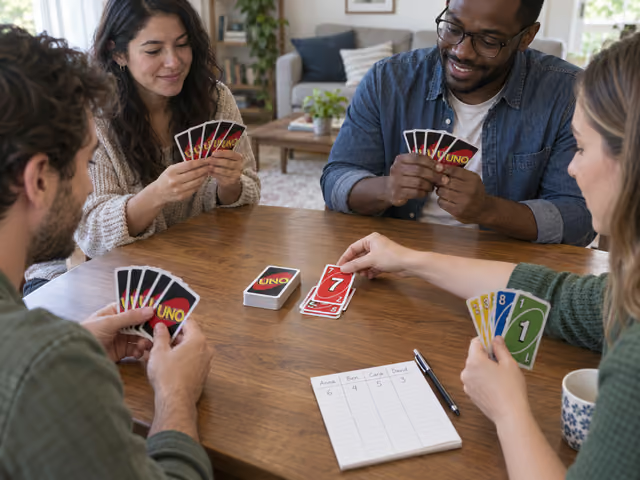
The quick version
Deal seven each. On your turn play one matching card or draw one; you may play that drawn card if legal. Draw cards make the next player draw and miss a turn: penalties do not stack. Call UNO when one card remains. The round winner scores the other hands; first to 500 or more wins.
Saved on this device only — clearing your browser's cache or site data removes them (no account backup).
Prepare the deck and deal
Use the classic 108 cards: in each of four colors, one 0 and two each of 1–9, Skip, Reverse and Draw Two; plus four Wild and four Wild Draw Four cards. If your standard deck has extra customizable, swap, shuffle or other special Wild cards, remove those extras. Do not mix in UNO Flip, No Mercy or add-on cards.
Seat everyone around a table with the center piles in reach. Each person draws a card to choose the dealer: highest number deals, with action cards counting as zero. House tie procedure: only tied players draw again until one is highest. Return the selection cards, shuffle, deal seven facedown to each person, and keep hands private. Put the rest facedown as the draw pile and turn its top card faceup beside it as the discard pile. Write names and zero starting scores on paper.
Normally the person on the dealer's left starts and play moves clockwise. An opening Draw Two makes that person draw two and lose their turn; an opening Skip skips them. An opening Reverse makes the dealer start and play move counterclockwise. For an opening Wild, the person on the dealer's left names the starting color and takes the first turn. Return an opening Wild Draw Four to the deck, shuffle and reveal another opening card.
Agree to the labeled house clarifications before dealing. With two players, a played Skip or Reverse gives the same player another turn; after a Draw Two or Wild Draw Four, the opponent takes the penalty and play returns to its player. For an opening Reverse, the dealer starts; an opening Skip or Draw Two skips the other player, so the dealer starts.
Take a turn, call UNO and finish
Play one card or draw one
Match the top discard by color, number or action symbol. On a red 7, any red card or any color 7 works. After a Wild, use its announced color. You may play a normal Wild even when you have a matching card. If you cannot play, or choose not to, draw exactly one. You may play that new card immediately if legal, or keep it; you cannot play an older card from your hand after drawing. Then the turn ends. Do not draw repeatedly until a card fits.
Resolve action cards
Skip misses the next player; Reverse changes direction. Draw Two makes the next player draw two and miss their turn. Match these colored action cards by color or identical symbol. A Draw Two may match an earlier Draw Two on your later normal turn; the player currently owing a penalty cannot play one to pass it on. Wild lets you announce any of the four colors. Wild Draw Four also changes color and makes the next player draw four and miss their turn, but is legal only if your hand has no card of the color in play. Having a matching number or symbol in another color does not prohibit it.
Resolve a Wild Draw Four challenge
The player facing the four-card penalty may challenge before drawing. Show your remaining hand privately to that player. If you held the previous active color, you draw four instead; if not, the challenger draws six and loses their turn. House clarification for a successful challenge: the challenger takes their normal turn on the announced new color, and the Wild Draw Four remains on the discard pile. You cannot challenge a normal Wild or a Draw Two.
Call UNO at one card
Say UNO as you play your next-to-last card. If another player catches the omission before the next turn begins, draw two. House timing clarification: the next turn begins when that player touches the draw pile to draw or places a card on the discard pile; saying UNO before another person catches you avoids the penalty. This also applies when a two-player action gives you another turn. Do not wait until playing your last card to make the call.
Refill the draw pile
When it runs out, leave the current top discard faceup and shuffle the older discards into a new facedown draw pile. Preserve the active color and direction. Finish any pending draw penalty from the refilled pile. House deadlock remedy: if no cards can be drawn and everyone passes once without a legal play, void that round, keep match scores unchanged and redeal.
Score the round and the match
The first person legally playing their last card wins the round; you may finish on an action or Wild card. If it is Draw Two or Wild Draw Four, the next player still draws that penalty before scoring. Nobody stacks another card to keep the round going. Add every opponent's remaining cards to the winner's score: numbers at face value, Skip/Reverse/Draw Two at 20 each, Wild/Wild Draw Four at 50 each. For example, a 7, Reverse and Wild left in one hand contribute 77. Only the round winner gains points. First to reach or pass 500 wins the match; only one player scores each round, so there is no match tie. Otherwise collect all cards, move the dealer one seat clockwise as a house rotation, shuffle and deal another round.
Settle familiar rule disagreements early
Before the first scored hand, place a red 7 and ask which cards could follow it. Demonstrate drawing one and keeping it, then a Draw Two with a missed turn. Say the three easy-to-confuse points aloud: one card per turn, no stacking, and Wild Draw Four tests the current color rather than every playable card. Explain that a single round and the full 500-point match have different finishes.
Keep the announced color clear after every Wild, and say whose turn follows a Reverse. A two-player extra turn still requires a separate legal play; it is not permission to drop several cards together. The UNO call needs to be audible, not shouted.
For a mistaken ordinary play caught before the next action, use this house correction: return that card to its owner's hand and have them complete the same turn legally, with no invented extra penalty. If the next action has already happened and the prior state cannot be agreed, redeal the round with match scores unchanged. Pause to resolve a challenge before anyone else plays. Change rules only between rounds with everyone's agreement; another edition's rules do not silently replace these.
Already know the game?
Ideas & Twists
Choose a variation together before you start.
UNO · See main rules
Suggested house variationOne round, one winner
Replace the 500-point match with one hand. The first person to empty their hand wins after resolving any final draw penalty; omit point totals and the score sheet. Keep all turn, challenge and UNO-call rules. A fresh hand is a new game, and a round has one winner.
UNO · See main rules
Mattel alternative scoring with a house tie procedureLow-score match
Record each person's own remaining-card points after every round; the round winner records zero. When anyone reaches or passes 500, the lowest running total wins. This reverses the aim of match scoring, not the turn rules. If the lowest total is tied, everyone plays another full round and adds their hand points; repeat until one person alone has the lowest total.
UNO · See main rules
Suggested four-player house formatAcross-the-table partners
Use exactly four players in two pairs, with partners opposite each other and private hands. When either partner empties their hand, the round ends; resolve a final draw penalty, then score only the two opponents' remaining cards for the winning pair. Ignore the winner's partner's remaining cards. First pair to 500 or more wins. Keep individual turns and UNO calls; agree not to reveal hands or coach a partner's play. This replaces individual match scoring.
About this guide
Selected base: Mattel's classic 108-card W2085-0629 English rules, copyright 2012, opened October 2, 2026. This is an identified classic format, not a claim about every current retail edition. Two-player play is an explicit house clarification consistent with Mattel's older J4299 instructions; that themed deck's special cards are excluded. Dealer ties/rotation, precise call/challenge timing, successful-challenge continuation, draw-pile top retention, deadlock and mistake remedies are stated house procedures where the selected sheet is brief. Single-round and partners are suggested house formats; low-score scoring is Mattel's alternative, with our labeled tie procedure. Hosting advice is a suggestion.
Ready for something different?
Find another game →