

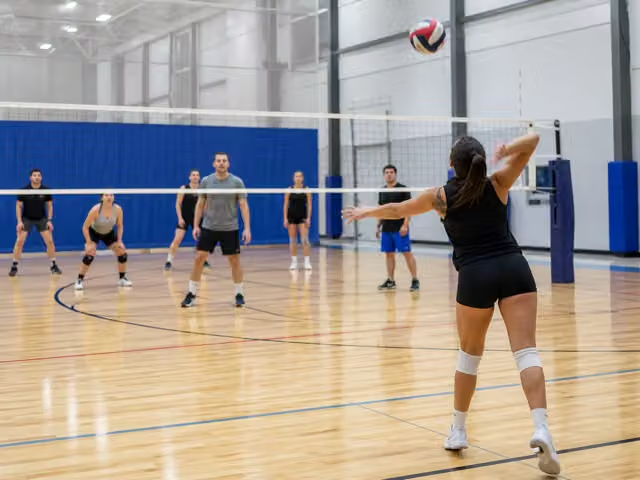
The quick version
First to 15, win by two. Every rally earns a point. Use up to three hits without catching. Rotate clockwise when receivers win serve; keep the same server after serving wins. No blocking in this house game.
Saved on this device only — clearing your browser's cache or site data removes them (no account backup).
Place four players and choose the finish
Use a marked court, narrowing it equally on both sides if necessary. Agree lines and net height; adjustments are house choices. Keep run-off space and posts clear.
Make two teams of four with front-left, front-right, back-right and back-left places. Draw an order; back-right serves first. Toss for serve; the other team chooses an end. Play to 15, win by two, without a cap. Exchange ends when a team reaches eight; retain score, positions and server.
Serve, pass and rotate
Serve from behind the end line
When everyone is ready, release or toss the ball and hit with one hand or any part of the arm; underhand is fine. Keep feet off the court and end line at contact. Send it over the net into their court; a net touch is legal. One attempt: a missed or out serve loses the rally.
Use up to three hits
Receive the ball before it touches the ground. A forearm pass toward a teammate, a set upward and a controlled hit over are a useful sequence, not a requirement to use all three. Any body part may contact the ball. It must rebound, not be held or thrown. Do not hit twice consecutively; on a team's first hit, contacts with several body parts during one action are allowed.
Keep play on your side
Return over the net between the court's side limits by your third hit. No blocking, including blocking serve. Make initial contact on your side. Any of the four players may attack from any position: back-row attack restrictions are removed as a house simplification. Do not touch the net during your playing action or step across the centerline, a stricter house boundary.
Score the rally
Landing the ball on their court earns a point. Lines count in. If your ball lands out, fails to cross, or your team makes a fourth hit or another fault, they earn the point. Two simultaneous teammate touches count as two hits. If the ball touches the net in a rally, keep playing if you can return it legally.
Change serve and rotate
When the serving team wins, the same person serves again and nobody rotates. When the receiving team wins, it gets a point and serve; all four move one place clockwise: front-right to back-right, back-right to back-left, back-left to front-left, front-left to front-right. The new back-right player serves. Restore those places before each serve, then move within your side during the rally.
Finish and restart
At 14–14, keep going until a two-point lead. For a new game, reset to zero, exchange ends and give the other team first serve. Keep the player order or agree a new one before that game's first serve. This rematch arrangement is a house choice.
Help the first rally happen
Try an unscored serve–pass–set–return. Call for the ball so teammates do not collide. Stop and replay for outside interference. Agree any adjusted serving line beforehand as a house accommodation.
Already know the game?
Ideas & Twists
Choose a variation together before you start.
Social volleyball · See main rules
Suggested house variationCatch the second touch
Allow the second contact to be a catch and, within two seconds, a two-handed upward toss to a teammate. Catch plus toss counts as one hit; that player cannot take the third hit. First and third contacts remain rebound hits. Keep rotation, no blocking and 15, win by two. This provides a steadier set.
Social volleyball · See main rules
Suggested house variationTwo-rally wash scoring
A rally win earns a pending mark. A second consecutive win banks one point and clears the mark; an opponent's win erases it and gives the opponents a pending mark. The rally winner always serves next. When serve changes teams, the new serving team rotates clockwise and its new back-right player serves. Play to five, with the fifth winning even at 4–4. Keep the contact and no-block rules. Consecutive wins are required, so this may last longer.
About this guide
Uses FIVB 2025–2028 indoor fundamentals. Four-player positions, 15-point games, end changes at eight, no blocking, removal of back-row attack restrictions and a stricter centerline boundary are house choices, as are both variations. Organized indoor and beach formats differ.
Ready for something different?
Find another game →