

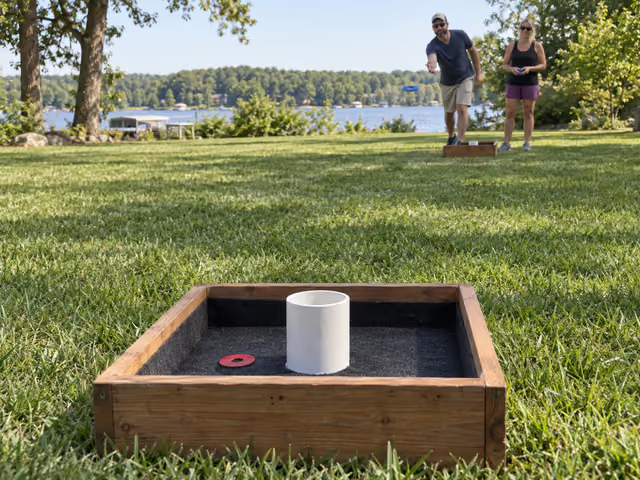
The quick version
Alternate four underhand tosses each. At the end of all eight throws, count cup washers as 3 and box washers as 1. Subtract the lower total from the higher; only that difference scores. First to 21 or more after a full round wins. This format allows overshooting 21 and requires no two-point margin.
Saved on this device only — clearing your browser's cache or site data removes them (no account backup).
Choose the boxes, lane and partners
Use two stable open-top washer boxes, each with one securely fixed center cup, and eight purpose-made washers: four red and four blue, all the same size and weight. The referenced GoSports set has felt-lined wooden boxes and plastic-coated steel washers; use its supplied washers, as its care sheet directs. Check the cups, box joints and washers for damage before playing. These rules do not apply to a flat three-hole board.
Set the boxes on level outdoor ground with a clear throwing lane and space beyond and beside both targets. Bring a tape measure, removable line markers, paper and a pen. The GoSports rule sheet gives 20 feet between targets without an exact measuring edge; our house convention is 20 feet between the two front edges facing each other. Mark a throwing line across each front edge. Both feet stay behind that line at release.
For singles, both opponents start beside the same box, each holding four washers of one color. For doubles, put one partner from each pair at each end. The two opponents at one end throw this round; their partners throw back next round. People at the receiving end step well clear of the target and flight path while washers are being thrown.
For opening order, our house procedure uses the two starting throwers: each makes one unscored toss. The washer closest to the receiving cup opens the game. Repeat those two tosses if equally close, including two cup shots. Retrieve the practice washers before round one. Give everyone an unscored practice toss first if needed, then say: cup 3, box 1, subtract totals, finish at 21 or more after eight throws.
Toss, cancel and change ends
Take the first turn
From beside your box and behind its line, gently toss one washer underhand toward the other box. Your opponent throws one, then you alternate until each has thrown four. Leave legal washers where they finish: a later throw may move one into or out of a scoring area. Our house rule permits a washer to bounce off the ground into the target. Nobody retrieves washers during the round.
Count final positions
After all eight throws settle, count each washer once: 3 inside the center cup, 1 inside the box but outside the cup, and 0 outside the box. Our house edge rules give 1 to a washer bridging the cup opening without falling in, or leaning against the cup inside the box; 0 to one resting on top of the box wall or touching the ground outside. Leaners receive no extra bonus. A washer pushed from the box into the cup now counts 3, replacing its earlier 1.
Subtract the two totals
Add each color's points, then subtract the smaller total from the larger. Only the higher side adds that difference to its running score. One cup washer plus two box washers makes 5; against one cup washer, worth 3, that side earns 2. Equal totals earn neither side any points. Cancel whole totals, not matching washers by location. Both sides agree before anything is picked up.
Finish or throw back
If the scoring side now has 21 or more, it wins. Finish the full round even if an early throw seems to reach 21: later throws can change or cancel it. Going over is allowed, with no reset and no win-by-two rule. Otherwise collect all eight washers. Singles walk to the receiving end and throw back; doubles' waiting partners take over there. The side that scored opens next. Our house rule retains the previous opener when the round is tied.
At a running score of 20, a round total of 5 against 3 adds 2 and wins at 22. If the opponent instead totals 5, neither side scores and the game continues. Because cancellation awards points to only one side, this format cannot end with both sides newly reaching 21 in the same round.
Settle calls before collecting
Keep the running score on paper and announce each round's two raw totals and the difference. Explain the house clarifications before play: front-edge spacing and line, underhand throws, ground bounces allowed, the stated edge values, tied-round opener, and the foul remedy below. Local washer games use different distances, washer counts and bonus scores; agree to this complete format rather than adding remembered rules halfway through.
A throw released with either foot past the line is spent and worth zero. As a house remedy, pause and remove that washer once safe before the next throw. If it moved other washers, restore their agreed earlier positions. If the players cannot agree those positions, replay the entire round with running scores unchanged and the same opener. Use the same house remedy if someone moves washers before both sides confirm the score. A legal throw that moves a washer is ordinary play and uses its final position.
For an edge dispute, leave the washers untouched and look from the side together. Use the printed values above; being closest outside the box earns nothing. If a scoring position still cannot be agreed, replay the round with unchanged scores. If a box shifts, stop, measure and reset it; replay an affected round rather than scoring a displaced target. Stop throwing whenever someone enters the lane, and collect only after the round is finished.
After the game, reset scores and choose the next opener with fresh unscored tosses. Extra friends rotate into the next game; this guide supports exactly two or four active players. Walk and retrieve between rounds; this is not a seated or quiet-play guarantee.
Already know the game?
Ideas & Twists
Choose a variation together before you start.
Washer toss · See main rules
Suggested house variationShorter lane
Move the boxes to 15 feet between their front edges for the whole game. Keep every other rule, including four washers per side, cancellation and a 21-or-more finish. Both sides use the same distance; check that the lane and space beyond the receiving box remain clear. This changes throwing distance, not scoring.
Washer toss · See main rules
Suggested house variationSix-round match
Replace the race to 21 with six complete rounds and keep adding net cancellation points. Higher running score after round six wins, even if both scores are below 21 or already above it. If tied, play another full round; repeat while tied. In doubles, six rounds give each end three turns before any tiebreak. Track rounds separately from points; this is a round limit, not a promise of minutes.
Washer toss · See main rules
Optional manufacturer variationExact 21
Use the GoSports rule sheet's Exacta finish instead of 21 or more. After all eight throws and cancellation, a side reaching exactly 21 wins. If its net points would take it above 21, its running score becomes 15. Keep the rest of this guide's house clarifications. Announce this change before the first toss; it can extend the game and does not add a win-by-two requirement.
About this guide
The GoSports WT-01 sheet supports the eight-washer cancellation format, 20-foot target spacing, singles/doubles, alternate throws, scoring-side opener and optional Exacta. Its model label differs from the current WT-02-WOOD equipment page; this is not a claim of a newly issued WT-02 official rulebook. Our measuring edges, foot line, underhand requirement, bounce permission, edge/leaner values, opening-toss tie, tied-round opener and dispute remedies are explicit house clarifications. Hathaway's different exact-21 format and community bonus scores are comparison evidence, not extra main-game rules. Shorter lane and six-round matches are suggested house variations.
Ready for something different?
Find another game →