

The quick version
The Psychic privately randomizes and views the target, gives one clue for the card's spectrum, then stays silent. Their team sets the dial; the other team chooses whether the target's center is left or right of it. Reveal, award both teams' points, and check the 10-point finish before continuing.
Saved on this device only — clearing your browser's cache or site data removes them (no account backup).
Prepare the box and teams
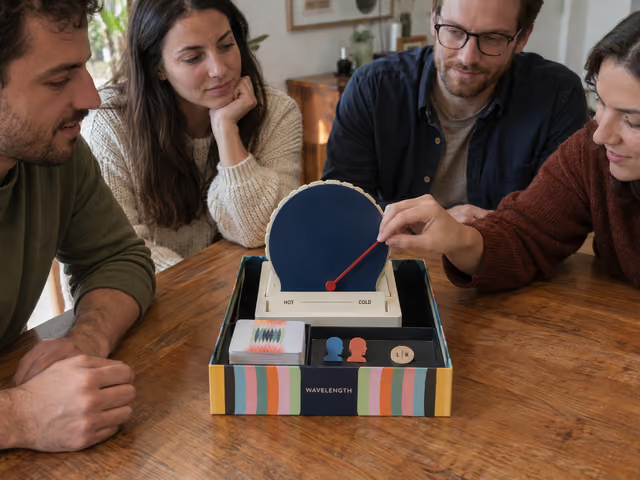
Use the English WAV01 set: one plastic device with rotating target wheel, blue screen and red dial; 84 Wavelength cards and 42 Advanced cards; two team scoring tokens and one left/right guessing token; the rulebook; and the custom tray inside the box. The 42 Advanced cards are included in this edition, not required as a separate purchase. Start with the standard cards, shuffled. Have the rulebook nearby for its component diagram.
Seat four to twelve people around a table with room to pass the box. Keep the device upright in the tray's central slot, the cards in their holder, and the tokens in the tray's matching tracks/slots. Check that the screen opens without shifting the target wheel or dial. Every guesser must be able to see the displayed card and reach, or ask a teammate to move, the dial. A private viewing angle for the clue giver is essential.
Split into two roughly equal teams; five people can play two against three. Choose a first Psychic on each team and an opening team by agreement. The opening team starts at 0; the second team starts at 1. Explain that a completed round can give points to both teams, and that reaching 10 ends normal play. Rotate the Psychic within each team when that team next gives a clue.
Give a clue, place the dial and reveal
Prepare the first secret target
The opening Psychic turns the device away from everyone else and closes the screen completely. Draw one card, choose either face, put it in the front slot and read both endpoints aloud. With the screen closed, spin the target wheel at its wavy edge to randomize it. Open the screen fully in private. If none of the central 4-point wedge is visible, close and spin again; even a sliver of that wedge at an extreme is a valid target.
Give one clue and stop helping
Choose an existing thing that fits the card's spectrum at the target's position. The clue may contain several words but must express one idea. Give it, close the screen fully, and turn the box toward your team. From now until the reveal, offer no explanation, answer, gesture or revealing reaction. The clue's meaning belongs to the guessers.
Agree on one dial position
Your teammates discuss the clue and rotate the red dial while the target stays hidden. Any teammate may adjust it; come to an agreement and announce that the position is final. Describe positions in ordinary language rather than percentages. The opposing team may join the discussion, but only the active team controls its guess. Once final, leave the dial untouched.
Give the other team its guess
The opposing team chooses whether the center of the target is to the LEFT or RIGHT of the final dial position. Put its guessing token in the corresponding slot beside the card before the screen opens. This is about the hidden center relative to the dial, not which endpoint better describes the clue.
Reveal and score both teams
The Psychic opens the screen using its handle, keeping the base steady. The active team receives the target wedge's printed value: 2, 3 or 4; outside the target scores 0. A dial on a boundary receives the higher adjacent result. Ignore stray target color at the opposite extreme from the central wedge. The opposing team earns 1 for a correct left/right choice, except that an active-team score of 4 prevents it from scoring. Update both totals before moving anything.
Check the finish, then choose the next turn
If either total is 10 or more after the full scoring, the higher total wins. If tied, use the paired tie turns below. Otherwise the other team takes the next clue turn with a new Psychic. Exception: if the active team scored 4 and is still behind after scoring, it immediately takes another clue turn with a different Psychic. A tie after scoring 4 does not earn an extra turn. Discard the used card and reset the guessing token for the next round.
If your team starts on 7 and lands in a 3-point wedge, it reaches 10. An opponent on 9 who guessed the correct side also reaches 10: the game goes to tie turns. If you land in the 4-point wedge, that opponent gets no left/right point.
Resolve a tie and start again
For a tie at the finish, give each team one fresh clue turn, with ordinary wedge and left/right scoring on both turns. Complete both turns before comparing the points each team gained across the pair. The higher gain wins; repeat another pair if equal. These are paired sudden-death turns, not a new race to 10 or an extra turn awarded halfway through the pair.
For a rematch, reshuffle used cards, reset the markers, and choose the starting team and Psychics again. Remember the 0/1 starting totals.
Keep clues fair and the reveal trustworthy
Official clue limits: express one thought; use something that exists, including established fiction; stay on the card's topic; avoid the endpoint words, their word families and synonyms; and do not use numbers, percentages or ratios to encode a position. Numbers in a proper name are allowed. A relevant work's actual title may contain an endpoint word. Wordplay that changes the topic is not a shortcut around the rules.
The rulebook recommends concise clues, avoiding modifiers and using proper names when the card asks for a particular kind of person or thing. Its five-word suggestion is not a mandatory word limit. For a practice explanation, invent an unscored spectrum such as Easy to carry–Hard to carry and ask where a sofa would belong. Then use a real card for play. Explain that the task is to understand the Psychic's judgment, not find a scientifically correct rating.
Suggested house remedies: if an illegal clue or accidental peek exposes the answer, abandon that round without scoring and let the same team restart with a new card and randomized target. If the dial is bumped during the reveal, restore a clearly agreed locked position; if nobody can establish it, discard the round and restart the same way. These remedies replace argument with a clean restart; they are not automatic official penalties. If the mechanism repeatedly moves the target wheel when the screen opens, stop using the faulty unit and contact publisher support.
Choose clues the whole team can recognize; a private reference can leave everyone else with nothing to discuss. Invite each guesser to speak before locking the dial. If your group wants a facilitator to resolve prolonged disagreement, agree on that as a house convention before starting; rotate that role instead of letting one player control every decision. There is no official turn timer in this format, so do not penalize someone for thinking.
Already know the game?
Ideas & Twists
Choose a variation together before you start.
Wavelength · See main rules
Suggested house variationOne-word clues
Limit every clue to one word for the whole game; everything else keeps the team rules above. Multiword proper names are not eligible under this house restriction. Apply all normal topic, synonym and number limits. Agree on this before play so a clever one-word clue earns the same points as any other legal clue.
About this guide
Rules are for the physical English CMYK/Palm Court WAV01 base game; the publisher-authored rulebook is hosted by Buffalo & Erie County Public Library and retains the original Palm Court credit. The official cooperative variant is separate. Clue restarts, bumped-dial remedies, facilitator advice, one-word clues and themed redraws are labeled host suggestions or house changes. Component counts follow the publisher-linked WAV01 listing. Community accounts inform hosting advice, not official rules or popularity claims.
Ready for something different?
Find another game →