

The quick version
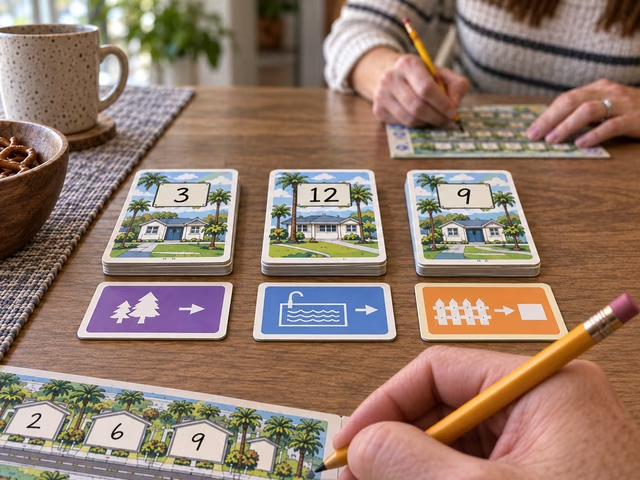
Each round flip the top card of each stack beside it, action side up. Each stack's new top number pairs with its adjacent action. Everyone simultaneously chooses one of the three pairs; choices are not exclusive.
Saved on this device only — clearing your browser's cache or site data removes them (no account backup).
Prepare the table
This guide follows the Collector Edition's Classic-sheet standard game. Give each of two to six people a Classic sheet, marker and aid. Shuffle sixty-three Construction cards into three equal stacks, number sides up. Display one randomly selected Standard plan each from A, B and C, project sides up. Keep the printed scoring tracks visible; do not mix Classic and expansion sheets.
Play a turn
Each round flip the top card of each stack beside it, action side up. Each stack's new top number pairs with its adjacent action. Everyone simultaneously chooses one of the three pairs; choices are not exclusive. Write its number in an empty house, maintaining strictly increasing numbers left to right within each street. Gaps are allowed. If at least one number can be placed, you must place one. Otherwise cross the next refusal and take no action. Using the associated action is optional.
A fence draws one boundary between houses anywhere. Street ends already have fences. A complete estate contains only numbered houses between two fences; sizes one to six score. Improvement crosses the next value for one chosen estate size, raising every estate of that size's final value. A park crosses the next park box in the same street as the new number. A pool works only when that number was written in a house with a printed pool: circle it and advance the pool track.
A temporary worker changes the paired number by zero, one or two in either direction, never below zero; cross a worker box even if choosing zero change. You need not use this optional action to avoid refusal. An extension, after the normal number, copies any existing house number into an immediately neighboring empty house, adding B and advancing the penalty track. Repeated B copies are allowed, even across fences.
Finally you may claim any fulfilled plans. A Standard plan requires its depicted combination of complete estate sizes. Mark the used estates; they cannot be subdivided or reused for another plan, but still score at the end. Everyone first claiming a plan in the same round gets its higher value; flip it afterward so later claimants receive the lower value. Each person claims each plan once. When construction stacks run out, shuffle the three discards separately to rebuild them number side up.
Finish and score
Finish the round in which someone claims all three plans, marks their third refusal or fills every house. Add claimed plan points, each street's lowest uncrossed park value, the lowest uncrossed pool value, and complete estates multiplied by their current size values. Rank positive temporary-worker counts for seven, four and one points; ties share a rank and the next distinct count takes the next rank. Zero workers earns zero. Subtract the lowest uncrossed extension and refusal penalties. Most points wins; ties favor more complete estates, then share victory.
Host the first game
The Reddit group-size discussion recommends Welcome To for adding players without adding turn downtime. Keep the three combinations visible to everyone and wait until all have finished a round before flipping again. This box supplies six sheets; larger groups need legitimate extra Classic sheets and the same shared view.
Already know the game?
Ideas & Twists
Choose a variation together before you start.
Welcome To Your Perfect Home · See main rules
Published Collector Edition optionRoundabouts
Use the Collector rulebook's optional roundabouts: during a round replace an empty house with a circle and fences on each side. Number the separated street portions independently. At most two per player; cross their printed track and subtract its final penalty. A roundabout is not an estate or house.
Welcome To Your Perfect Home · See main rules
Original STUDplay house twistFixed public plans
Before shuffling Construction cards, agree on one Standard A, B and C plan together instead of drawing them. Claim timing and scoring remain unchanged.
Welcome To Your Perfect Home · See main rules
Original STUDplay house twistOne construction adjustment
Give everyone one paper token. Before writing a round's chosen number, discard it to change that number by exactly one up or down, never below zero. Do not combine this with a temporary-worker adjustment or mark a worker box for it. Place the adjusted number legally and resolve the paired action normally, if it is not a temporary worker.
Welcome To Your Perfect Home · See main rules
Original STUDplay house twistNo neighboring parks
When choosing a park action, you cannot use it in the same street where you last used a park action. Track that street with a small mark. Numbering remains mandatory and you may decline the park action.
Welcome To Your Perfect Home · See main rules
Original STUDplay house twistLate plan race
For every plan, all claimants receive its lower value, including the first. Completing three plans still triggers the end, so speed changes the finish without awarding an early-claim premium.
About this guide
Requires the named physical game and its supplied components. Rules are paraphrased teaching guidance; keep the box's cards and reference diagrams beside the table. Original STUDplay house twists are optional, untested suggestions rather than publisher rules. Agree one before setup; unchanged rules still apply.
Ready for something different?
Find another game →