

The quick version
Give non-dreamers secret roles, leaving one selected role undealt. Hide the dreamer’s view and give one-word clues clockwise for two minutes. Each guess or pass moves to a new card without revealing whether it was right. The dreamer retells the answers before seeing them. Score roles, rotate the dreamer and finish after everyone dreams once.
Saved on this device only — clearing your browser's cache or site data removes them (no account backup).
Prepare the dream and hidden roles
Set the bed on the board. Mix the double-sided dream cards by shuffling, rotating and flipping them, then use the headboard to cover one of the two visible words. Put tokens and hourglass nearby. Set aside any unwanted subject cards before play.
Select roles by total player count, stated as Fairies/Boogeymen/Sandmen: 4 players use 1/1/2; 5 use 2/1/2; 6 use 3/2/1; 7 use 3/2/2; 8 use 4/3/1; 9 use 4/3/2; 10 use 5/4/1. This intentionally makes one more role card than there are clue givers.
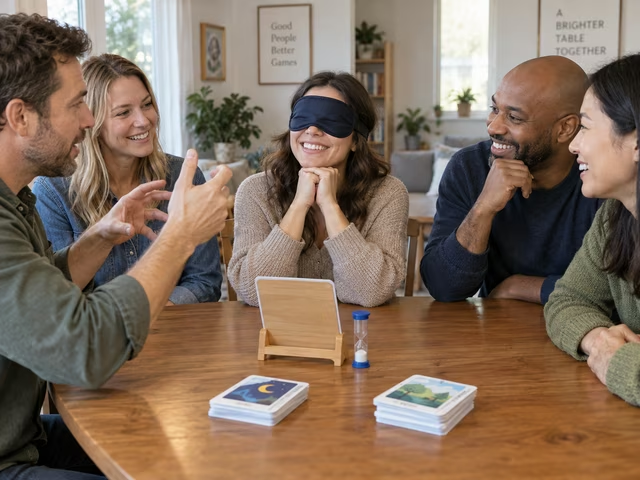
Choose a dreamer. Shuffle the selected roles, give one secretly to every other player and leave the spare face down. The dreamer puts on the mask while remaining seated. Move the top dream card to the bottom so the dreamer has not seen the starting answer, then turn the hourglass.
One clue at a time
Starting left of the dreamer, clue givers speak one word clockwise, repeating circuits until the dreamer guesses. Fairies suggest the answer, Boogeymen misdirect, Sandmen choose whichever helps balance results. A clue cannot be derived from, sound like or translate the answer. A giver may pass; more than five seconds of hesitation also passes their turn.
The dreamer may interrupt for exactly one guess per card or say pass. Put a correct card on the yellow side; a wrong or passed one on the blue side. Do not tell the dreamer the result. Continue clue turns with the next card. An illegal clue puts that card in front of its giver as a one-point penalty; announce that the answer has changed, then continue.
At two minutes, allow one final guess at the current card or leave it untouched. Before removing the mask, the dreamer tells a short story using remembered answers. Other players track which correct answers they mention without prompting. Then reveal the cards and roles.
Each Fairy scores the number of correct yellow cards. Each Boogeyman scores wrong/passed blue cards. The dreamer scores yellow cards plus 2 if their retelling included every yellow answer. A Sandman scores yellow count plus 2 if both piles are equal; if they differ by one, the larger count; if they differ by two or more, the smaller count.
Return used dream cards to the bottom after rotating/flipping them. Pass the dreamer role left and reshuffle all selected spirit roles, including the spare. After everyone has dreamed once, subtract each player’s illegal-clue penalties. Highest score wins; tied players compare fewer penalties, then share any remaining tie.
Keep the result secret until morning
A cheer, wince or corrective remark can spoil the dreamer’s uncertainty. Place cards discreetly and never repeat a clue as coaching. Tell the dreamer before play that they may pass; waiting for certainty can consume the whole night. Use a comfortable sitting position and stop immediately if the mask becomes uncomfortable.
Already know the game?
Ideas & Twists
Choose a variation together before you start.
When I Dream · See main rules
House suggestionSeated away from the cards
Replace the mask with a seat facing away from the table. Keep cards, correct/wrong piles and role cards outside the dreamer’s view. Do not turn back until the retelling ends. All clues and scoring remain unchanged.
When I Dream · See main rules
House suggestionShort dream
Use a separate one-minute timer for every player’s dream. Keep all role ratios, retelling and points. Every dreamer must receive the same time limit.
When I Dream · See main rules
House suggestionHelpful rehearsal
Before the scored game, run one practice dream with every clue giver helping. Use five cards, no timer and no roles or points. The volunteer guesses once per card, hears the result and learns the turn order. Then reset completely for ordinary play.
When I Dream · See main rules
House suggestionNo retelling bonus
End each dream by revealing immediately instead of telling a story. The dreamer earns only the yellow-card count, with no memory bonus. Spirit scoring and the one-turn-per-person finish stay unchanged.
When I Dream · See main rules
House suggestionQuiet recall
Give the dreamer a paper and pen instead of asking for an spoken story. While still unable to see cards, they list remembered answers, then reveal their list. Award the usual 2-point bonus only if all yellow answers appear. Do not score literary quality or spelling variants that clearly identify the word.
About this guide
Main role ratios, two-minute dreams, clue restrictions, retelling, scoring and tiebreak follow the English rules. The five clearly labelled variations and comfortable-mask hosting advice are house suggestions.
Ready for something different?
Find another game →