

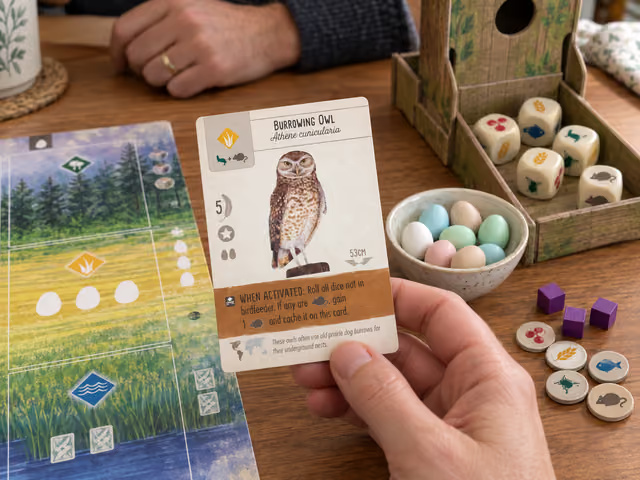
The quick version
Give everyone a mat and eight action cubes. Deal five birds, two bonus cards and one food of each type; keep one bonus and give up one food for every bird kept. On each clockwise turn, spend one cube to play a bird, gain food, lay eggs or draw cards. Habitat actions work even before you have birds, then activate that row's brown powers from right to left. Score one public goal after each round and leave one cube there. After rounds of 8, 7, 6 and 5 turns, add bird, bonus and goal points, plus eggs, cached food and tucked cards.
Saved on this device only — clearing your browser's cache or site data removes them (no account backup).
Set out the preserve and choose your starting birds
Use Stonemaier Games' physical English original Wingspan base game, with its original mats and five non-nectar food dice, for 2–5 individual players. This guide uses the blue goal-board side. Keep expansion and promo cards separate; use the original 170-bird deck. Swift-Start teaching cards, if included in your box, can stay aside for this ordinary random setup. Solo Automa, Asia Duet or Flock, Oceania mats, European powers and Wingspan Pocket use other instructions.
Seat everyone at an indoor table with a clear view of the shared bird tray, feeder and goal board. Give each person one mat, eight action cubes of one color and room for their hand and food. Each mat has three habitats: forest for food, grassland for eggs and wetland for cards. Each row holds up to five birds.
Shuffle the bird deck and place three cards face up in the bird tray. Put the rest face down beside it, leaving a discard area. Shuffle the bonus deck separately. Put food and eggs in shared supplies, and roll all five custom dice through the feeder. Turn the goal board blue side up. Randomly select four goal tiles without choosing their faces; place one random face in each round's goal space. Put unused tiles away.
Deal each player five bird cards, two bonus cards and five food tokens: one invertebrate, one seed, one fish, one fruit and one rodent. Look at both bonuses while choosing your birds. Keep any number of the five birds, including none, and discard the rest. Return one food token of your choice for each bird you keep. Keeping two birds leaves three food; keeping all five leaves none. Keep one bonus card and discard the other. Choose the first player randomly and give them the first-player token. Everyone starts with no eggs or birds on their mat.
Before starting, point out the first empty slot in each habitat. Its benefit is available even with no birds in that row. Read each public goal aloud, using the appendix's goal explanations for the symbols. Put the scorepad, pencil, rulebook and appendix where everyone can reach them.
Choose one action, then move the cube
The first player takes one turn, followed clockwise. Take one unused cube and choose exactly one of the four actions below. You may choose the same action on consecutive turns. A cube counts the turn; do not return used cubes to your supply until the round ends.
For food, eggs or cards, put the cube on the leftmost uncovered action slot in that habitat, immediately after its last bird. With five birds, use the benefit printed beyond the fifth bird. Resolve that slot's benefit and any optional conversion shown there, then slide the cube left across the row. You may activate each brown bird power you pass once, in right-to-left order. Leave the cube at the row's far left. An empty habitat still supplies its printed benefit.
Play one bird
Choose a bird in your hand and a habitat pictured on its card. It must fit the leftmost empty bird space in that row. Put your cube in the Play a Bird header above that column. Pay the food shown on the card and the column's egg cost: 0 eggs in column 1, 1 in columns 2–3, and 2 in columns 4–5. Eggs can come from any birds on your mat, and food must come from your personal supply. A slash in a food cost means choose either type; a wild symbol accepts any food; a crossed-out circle means no food cost. Only when paying to play a bird, any two food tokens can replace one required food. If you cannot pay the complete cost, choose another action. Place the card, use its white when-played power if you wish, and move the cube to the header's far left. Playing a bird does not activate that habitat's brown powers.
Gain food in the forest
Take the number of food indicated by the first uncovered forest slot. For each food, remove one die from the feeder and take one matching token from the shared supply. A die showing invertebrate/seed gives one of those foods, not both. Leave the selected dice outside the feeder. If this slot shows a card-to-food conversion, you may discard at most one bird from your hand to take one additional food from a die. Then move left through the forest's brown powers.
Lay eggs in the grassland
Take the number of eggs printed in the first uncovered grassland slot. Put them on any of your played birds, in any habitats, within each card's printed egg capacity. Egg color has no effect. Eggs cannot sit on bare mat spaces or in a personal reserve. Lose any eggs you cannot place. If the slot shows a food-to-egg conversion, you may return at most one personal food token for one extra egg. Then move left through the grassland's brown powers. You do not need a grassland bird to take this action, but you need a bird somewhere to hold the eggs.
Draw cards in the wetland
Draw the number of birds printed in the first uncovered wetland slot. Choose each from the three face-up cards or the top of the face-down deck; you may mix the two sources. Do not refill tray spaces between draws or during brown powers. If the slot shows an egg-to-card conversion, you may return at most one egg from any of your birds to draw one extra card. Then move left through the wetland's brown powers. Refill empty tray spaces at the end of your turn. There is no hand limit; drawing a bird does not play it.
If you kept a bird and enough food to pay its cost, you can play it into the first space of a matching habitat without paying an egg. If you lack that food, use the forest's first uncovered slot to gain food instead. Gaining food does not require an egg; the egg symbols in the top header apply only when playing birds into those columns.
Read the bird's timing and keep its points separate
White powers happen only when that bird is played. Brown powers happen when you take its habitat action, after the slot benefit, from right to left. Pink powers can trigger during another player's turn, at most once between your own turns; tell the table what triggers yours and help each other notice. All powers are optional. Follow the particular card's costs and limits, using the appendix for named-bird clarifications. A benefit from a power is part of the current turn, not another action or another cube.
Food gained from the supply is different from food gained from the feeder: take supply food without removing a die unless the card instructs you to do so. A predator that says to roll dice outside the feeder uses only those dice; it does not reroll the feeder's available dice. Leave those rolled dice outside afterward. Resolve its exact success condition and reward. Cached food sits on the bird as points and cannot pay future costs. A tucked card is slid face down behind a bird as points: it has no active power, nest or extra bird identity. Only tuck or cache when a power tells you to.
A repeat power can use an eligible other bird's power in the same habitat again, even if that bird has already activated this turn; follow the repeated power's costs and limits. A moving bird can change habitats only when its own power permits it and it is the rightmost bird in its current row; move it to the leftmost empty slot of the destination row. Moving is not playing a bird, so it does not trigger pink powers that require another player to play a bird. A white power allowing a second bird still requires that second bird's full food and column egg costs, but no extra action cube.
A bird's nest icon is platform, bowl, cavity, ground or a wild star. A star matches any of the four ordinary nest types for goals and bonuses. Its egg limit still applies. Use the printed wingspan only when a power or bonus asks for it. Each bonus card states what qualifies, often particular played birds and sometimes cards in hand, and how many points it earns. A percentage printed on a bonus describes deck composition, not an extra score. If a power draws two bonuses and keeps one, keep your existing bonuses too; reshuffle discarded bonus cards if that deck runs out.
Score the goal and begin the next round
Round 1 ends after every player has used all eight cubes. Collect cubes from the mats, count the current goal and leave one cube per person on that round's goal track, even for zero points. With the blue board, each qualifying item is worth one point, up to five points. Score the same goal independently for every player: another player's result does not reduce yours.
A habitat-bird goal counts played birds in that row; the total-birds goal counts all played birds. A nest-type bird goal counts birds of that nest type that each hold at least one egg, once per bird. A habitat-egg goal counts every egg in that row; a nest-type egg goal counts every egg on birds with that nest. Wild-star nests qualify for each ordinary nest type. For sets of eggs across habitats, count complete sets, each containing an egg in forest, grassland and wetland: 3 forest eggs, 2 grassland eggs and 4 wetland eggs make 2 sets. Read the tile's symbols against the appendix before counting.
Leave scored cubes on the goal board for the rest of the game. Discard all remaining face-up birds and deal three fresh tray cards. Pass the first-player token one seat clockwise. Keep your birds, eggs, tucked cards, cached food, hand and personal food. Do not reset the feeder just because a round ended. The dice still available remain there.
Play the next round with the cubes not on the goal board. Everyone gets seven turns in round 2, six in round 3 and five in round 4. Resolve and score round 4's goal before final scoring. The game does not end early because one player fills their mat or has an especially high score.
Add the six scoring categories
After round 4, total each player's printed points on played bird cards, all earned bonus-card points and the four recorded goal scores. Add one point for each egg still on their birds, each cached food token on their birds and each tucked card. A tucked card contributes one point, not its printed bird value. Ordinary food beside the mat and cards still in hand score nothing unless a bonus specifically says otherwise.
The highest total wins. If totals tie, compare unused food in the tied players' personal supplies; the one with more wins. Cached food is not unused food. If unused food also ties, share the victory. For another game, return all cards and supplies, shuffle, deal new starting hands and select new goals.
Keep resource mistakes and forgotten powers manageable
Explain the four actions before explaining clever combinations. Let players plan during other turns; announce the action you chose and any power that affects others. Offer choices and explanations during teaching, then let each person make their own decision. Gathering food or cards and playing a bird are separate actions. The optional conversion under a habitat benefit is not a mandatory price for using that habitat.
The feeder refills whenever it becomes empty: roll all five dice back into it. If you are about to take food from the feeder and its remaining dice all show the same face, including a single remaining die, you may reroll all five first. The invertebrate/seed face is one distinct face; it is not identical to a seed-only face. Check this permission before each food selection, including food taken through a power. A power that only gives food from the supply does not by itself let you reroll the feeder.
Reshuffle discarded bird cards if the bird deck runs out. Food and egg supplies are not a limit: use clearly distinguished paper substitutes if the physical supply runs out, recording which bird holds any substitute eggs or cached food. Egg capacities still apply. Keep ordinary personal food and cached food physically separate.
For a rules dispute, pause before the next choice and read the card, base-game rulebook and appendix. This guide suggests a house correction for an immediately noticed illegal move: restore its paid resources and position, then have that player take a legal action with the same cube. Agree before playing that a missed optional power can be taken back only before the next player starts, and only if its conditions were met and no new hidden information was revealed. Later missed powers stay missed. These correction limits are house suggestions, not printed penalties.
Already know the game?
Ideas & Twists
Choose a variation together before you start.
Wingspan · See main rules
Official green-board optionCompete for round goals
Before dealing, turn the goal board green side up instead of blue; keep the same four randomly selected goals and all other rules. At each round end, rank players by how many targeted items they have. The board's 1st/2nd/3rd awards are 4/1/0, 5/2/1, 6/3/2 and 7/4/3 in rounds 1–4; fourth and fifth earn zero. You must have at least one qualifying item to earn points. For a tie, add the awards for all ranks the tied players occupy, divide by the number tied and round down for each. Ranks beyond third contribute zero. Skip those occupied ranks for everyone else: two tied first take the first and second awards, and the next player is third. In round 2, two tied first each score 3, from (5+2)/2 rounded down; the next player scores 1. Place every player's cube, including zero scores. Final total and unused-food tiebreak stay unchanged.
Wingspan · See main rules
Official visibility choice with host coachingOpen-hand learning game
Before starting, agree that everyone lays their bird hand and kept bonus face up where the table can read them. Deal and keep the ordinary starting cards and food; change no costs, draws, action counts, powers or scoring. Each player explains their intended action before using the cube, and the group may flag an unaffordable cost or missed pink trigger. Advice is optional and the active player decides. New cards join that player's open hand. Deck order remains hidden and nobody looks ahead. Play all four rounds, score normally and use the same final tiebreak. Public bird hands are permitted by the base rules; revealing bonuses and the coaching arrangement are host suggestions.
Wingspan · See main rules
House suggestion for a considered openingDraft your opening birds
Replace only the initial random five-bird hand with a draft. Wait to populate the shared bird tray until the draft is complete. Deal five birds to each of 2–5 players, and deal the normal two bonuses and five starting foods. Players may inspect their bonuses while drafting. Simultaneously choose one bird from the dealt hand and place it face down in their own pile; pass the remaining hand left. Repeat until each person has drafted five birds. Do not play cards or activate powers during the draft. Then look at your drafted five, keep any number and return one starting food per kept bird; discard the other birds. Choose one bonus normally. Set the shared three-card tray from the undealt deck and begin with a random first player. Nobody gains extra cards or food. All turns, powers, goals, final scoring and ties follow the main game. This adds a shared drafting decision; it does not guarantee a strong starting hand.
About this guide
The original physical base game supplies the mechanics. This guide chooses the official blue goal board; the green-board variation restores the official majority scoring. Public bird hands are allowed by the rules. Revealed bonuses, coaching, the opening draft and mistake-correction limits are host suggestions. Use the printed cards and appendix for individual bird powers and bonus definitions; expansion rules are separate.
Ready for something different?
Find another game →