

The quick version
Roll all five dice, then reroll any dice up to twice more. Enter a score or zero in one empty category and pass left. After everyone has filled all 13 categories, add category points and bonuses; highest total wins. An extra Yahtzee still fills one category and never grants an extra turn.
Saved on this device only — clearing your browser's cache or site data removes them (no account backup).
Give everyone a scorecard
The selected E0950 set contains five dice, a dice cup, ten bonus chips and a score pad. Add a pen or pencil for each player. Give everyone one game column with the six upper categories, seven lower categories, upper bonus, Yahtzee bonus tally and totals. A different classic set can supply the dice and cards, but announce that you are using the E0950 rules below. Do not substitute a Yatzy scorecard with extra pair categories.
Use a level table with room to roll and keep held dice separate. A rimmed tray is optional. Keep the scorecards visible. If bonus chips are missing or run out, use this bookkeeping house adaptation: record every earned bonus as a check mark; each mark is worth 100, and the supply of chips does not limit bonuses.
To choose the opener, everyone rolls all five dice once and adds them. Highest total starts; play passes left. For an opening tie, our house procedure is for only the tied highest players to repeat until one leads. These opening rolls are unscored. Explain that everyone will take 13 turns and choose a category after rolling, not before.
Before play, agree on the two house procedures in this guide: reroll only an off-table or tilted die, keeping the other results, and share a win if final totals tie. Introduce the Joker section before anyone needs it.
Roll, keep and spend one box
Start with all five
The opener shakes and rolls all five dice. Stop and score now, or set useful dice aside and take a second roll. You may reroll any or all dice, including ones you previously kept.
Use at most three rolls
After roll two, stop or take a final roll with any dice you choose. You can change your intended combination at any point. Unused rolls expire when you score; they do not carry into another turn.
Record one category
Use the scoring list below to choose one empty box. Enter its points, or enter zero in an empty category you cannot or choose not to score. A filled box is unavailable for the rest of this game. When a Yahtzee is rolled with the Yahtzee box already filled, follow the Joker procedure instead of choosing freely.
Pass and repeat
Leave the dice in place while the score is checked, then pass the cup left. Everyone takes one turn per round. Continue for 13 rounds, even if someone has a large lead.
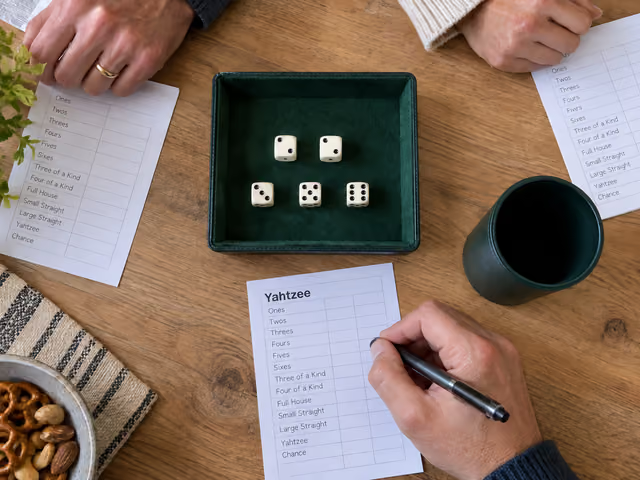
Set out 2, 2, 2, 5, 6. If open, Twos scores 6; Three of a Kind or Chance scores 17. Choose only one box. Demonstrate rerolling the 5 and 6, then clear this example before the first real turn.
Know all 13 categories
Upper section: Aces (Ones), Twos, Threes, Fours, Fives and Sixes each count only dice showing that number. For 4, 4, 4, 1, 6, Fours scores 12. Add these six entries; a subtotal of 63 or more earns a 35-point bonus. Any mix totaling 63 qualifies.
- Three of a Kind: at least three matching dice; add all five dice.
- Four of a Kind: at least four matching dice; add all five dice.
- Full House: three of one number plus two of a different number; 25 points.
- Small Straight: the roll contains 1-2-3-4, 2-3-4-5 or 3-4-5-6; 30 points. The fifth die can be anything.
- Large Straight: 1-2-3-4-5 or 2-3-4-5-6; 40 points.
- Yahtzee: all five dice match; 50 points.
- Chance: any roll; add all five dice.
Dice need not land in numerical order for a straight. For example, 2, 3, 3, 4, 5 is a Small Straight; the duplicate 3 does not erase 2-3-4-5. A Large Straight can instead fill an open Small Straight for 30, but one roll cannot fill both. Four matching dice also qualify for Three of a Kind. Five matching dice are not an ordinary Full House in this edition; the Joker exception below can allow that score.
Handle another Yahtzee in the right order
If your Yahtzee box is still empty, choose an ordinary eligible category, including 50 in Yahtzee. You receive no 100-point bonus on that turn. If you put the five matching dice elsewhere, a later Yahtzee earns no bonus until you have actually recorded 50 in the Yahtzee box on an earlier turn.
If the Yahtzee box already contains 50, each later scored Yahtzee earns a separate 100-point bonus. Mark it and take a bonus chip if available. If that box already contains zero, there is no 100-point bonus. In either case, fill one ordinary category using these forced Joker steps:
- If the matching upper box is empty, put the five-dice total there: five Twos go in Twos for 10.
- If that upper box is already filled, choose any empty lower category. Three of a Kind, Four of a Kind and Chance score the five-dice total; Full House scores 25, Small Straight 30 and Large Straight 40, even though the dice do not form those combinations.
- If the matching upper box and every lower category are filled, put zero in any remaining upper category.
Example: you already have 50 in Yahtzee and Fives is filled. You score five Fives in an empty Large Straight for 40 and mark a separate 100-point bonus. You have used exactly one category and one turn. With zero already in Yahtzee, the same Joker placement scores 40 but earns no bonus. If Fives were empty, you would have to put 25 there instead. A zero is a filled box, so a zero already in Fives also sends you to step two.
Once you record a category, the turn ends. Do not reroll a Yahtzee to claim another bonus on the same turn.
Total the card and name the result
Finish after everyone has filled all 13 categories. Each player adds their six upper entries, then adds 35 if that subtotal is at least 63. Add the seven lower entries and 100 for each earned Yahtzee-bonus mark. Add the upper and lower totals for the grand total. Count the original 50 in Yahtzee once; bonus chips and matching check marks represent the same bonuses, not two separate awards.
Example: upper entries total 66, lower entries total 148 and there are two extra-Yahtzee marks. The result is 66 + 35 + 148 + 200 = 449. Highest grand total wins. The selected instructions give no tie procedure; our house finish is a shared win after checking arithmetic. If the group wants another contest, start a fresh 13-turn game with new columns rather than appending tie-breaking rolls to the completed card.
Keep the table moving and settle disputes
Let the active player make their own keep and scoring decisions. Offer advice when asked; pointing out which boxes are still empty is often enough. Show the unscored example before the game rather than lecturing through every possible roll. A shared cup means people wait while others choose, so tell a larger group that turn count grows with headcount. There is no promised whole-game time.
For this table's house roll remedy, reroll only a die that falls off the table or rests tilted against an object. Keep all other results; the replacement belongs to the same roll and does not spend an additional one. If a stray die disturbs held dice, restore their previously agreed values before continuing; if those values are disputed, pause and agree a remedy before anyone rerolls.
Check the roll and category before collecting dice. Correct an arithmetic error from the agreed recorded values. A change of mind after the score is recorded does not reopen a used category. Missing rolls, extra turns and moving an old score into a better box are not part of this format.
For a Full House dispute, first check whether the Yahtzee box is filled and the matching upper box is filled. That determines whether the Joker exception applies. For a bonus dispute, look for the earlier 50 in Yahtzee; a zero cannot earn a bonus. Keep the selected rule sheet nearby because familiar editions and apps may behave differently.
Already know the game?
Ideas & Twists
Choose a variation together before you start.
Yahtzee · See main rules
Suggested house variationTwo-roll turns
Reduce the maximum to two rolls per turn: roll all five, then reroll any dice once if you want. Keep all 13 categories, bonus values, forced Joker steps and the usual finish. Stopping after the first roll is still allowed. This changes the chance of completing combinations; compare scores only with other games using this same rule. It reduces available rerolls, not a guaranteed number of minutes.
Yahtzee · See main rules
Suggested house variationPairs at one scorecard
For four or six people, form two or three pairs. Each pair shares one game column and takes 13 team turns, with the teams passing left. Partners may discuss keep and scoring choices; alternate which partner physically rolls on successive team turns. Keep the five dice, three-roll limit and all scoring rules. Highest team grand total wins, with tied teams sharing the win. This gives each partner a say while reducing the number of scorecards and total turns.
Yahtzee · See main rules
Official solo format in the selected editionSolo score challenge
Use one scorecard and play the same 13 turns, three-roll limit, bonuses and Joker rules on your own. Record the grand total and compare it with your previous scores under the same rules. There is no opponent, winner tie or new target quota; the aim is to improve your own score. Skip the opening-player roll.
About this guide
Mechanics follow the explicitly selected 1996 E0950 rule sheet, freshly reviewed October 2, 2026, with Hasbro's extra-Yahtzee FAQ confirming its forced Joker procedure. This is not a claim that every modern classic set uses identical instructions. The two-to-six hosting range is editorial; the selected rules also support solo play and state no upper player limit. Opening-tie rerolls, shared final ties, invalid-die remedies and replacing missing chips with a written tally are labeled house procedures. Two-roll turns and paired scorecards are suggestions; solo play is in the selected rules.
Ready for something different?
Find another game →